


Panelling And Fitted Furniture. Part 2
Description
This section is from the book "Old Oak Furniture", by Fred Roe. Also available from Amazon: Old Oak Furniture.
Panelling And Fitted Furniture. Part 2
All over the country, and along the East coast line especially, these wonderful linen-panelled apartments remain, cut up into tenements and offices, in the manner that many at King's Lynn are, speaking eloquently of the increase of wealth and comfort that marked the era of peace succeeding the Wars of the Roses. That wonderful flint and stone building, the Dolphin Inn, once Bishop Hall's Palace, at Heigham, near Norwich, still contains some relics of its former grandeur in the shape of some Jacobean fireplaces and a magnificent Gothic staircase newel, the latter decorated with a poppy-head and heraldic lion. It is to be feared that the surroundings of this once noble mansion, which comprise a class of very small tenements, will for ever prevent a return of the building to its former high status.
To return to the old English mansions, Haddon in itself offers a really remarkable field of study. The screen of the great hall, with its fifteenth-century tracery, is one of the earliest examples of panelling to be found in this country, consisting of huge planks of unjoined wood mortised into chamfered uprights; and to carry out such woodwork as this on any large scale a forest must have contributed its choicest trees. It is in the dining-room at Haddon, however, that we find the most interesting panelling. This is carried out in the style that prevailed in the reign of Henry VIII., and was erected by Sir George Vernon in 1545. The moulding round the edges of the stiles is simply a plain, heavy bead without any mitring, although the frieze and cornice are highly decorated in the mixed styles of the late Gothic and early Renaissance, and in the recess of the bay-window are some very interesting portrait panels, one of which, bearing the typical grotesque smile of the period, the cicerone will possibly inform visitors is the portrait of a jester. This legend, however, need not be taken too seriously.
The smile counts for nothing, since it was a common characteristic of these medallion heads, which are generally supposed to represent long-nosed Francis I., 'the handsomest man of his time.' * In the tier below the so-called 'jester panel'are a couple of veritable portraits carved in low relief on the surface of the wood, and locally said to represent Henry VII. and his Queen. This, again, is probably a fable, seeing that the panelling of the room, as already mentioned, bears the date 1545. It is much more probable that they are the portraits of Sir George Vernon and his wife, taken at the time that the dining-room was fitted with panelling, for the dress, so far as it is seen, especially of the lady, is that usually associated with Holbein's portraits of courtly personages of the time of Henry VIII., and therefore could not well be assigned to the earlier reign.
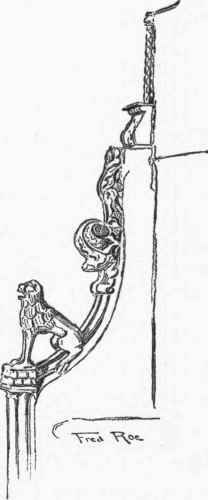
STAIRCASE NEWEL AT THE DOLPHIN INN, FORMERLY BISHOP HALL'S PALACE, HEIGHAM, NEAR NORWICH.

PANEL CARVED WITH MEDALLION AND LINEN-FOLD, IN THE DINING-ROOM, HADDON HALL.
Erected by Sir George Vernon in 1545.
Probably one of the finest displays of combined medallion and linen panelling is that at Smithills Hall, Lancashire. The history of this building and its structural alterations is preserved, and it is considered almost certain that a good portion of this internal decoration was added by Sir Andrew Barton during the reign of Henry VII. The knight's rebus, by the way, with his initials, 'A. B.,'may be seen incorporated in the panelling of one of the rooms. The top tier of panelling, next the cornice, is enriched with pilasters of Gothic design, beneath which appears a tier of panels with carved medallion portraits of the family. From the character of the head-dresses of some of these personages it would appear as though these portraits were executed late in the reign of Henry VII., as they verge on the Holbeinesque style, to which reference has already been made. A run of panelling of a somewhat similar character has of recent years found a home in the Victoria and Albert Museum. This example once formed part of the internal fittings of the abbey house at Waltham Abbey, which was granted, at the dissolution of the monasteries, by Henry VIII. on lease to Sir Anthony Denny. The panelling in question possesses its original overmantel, with a boldly projecting central head, the material forming the mask being applied in the peculiar manner described in the chapter on 'The Renaissance and After.'The carved designs on these panels indicate a distinct endeavour on the part of an English craftsman to assimilate the dying Gothic with the new style.
Many of the panels exhibit the figure of a pomegranate, which would seem to point to their being produced at a time previous to the disfavour of Catherine of Arragon.
* At Rye House Inn is a medallion panel bearing an actual jester's head in the typical cap and bells.
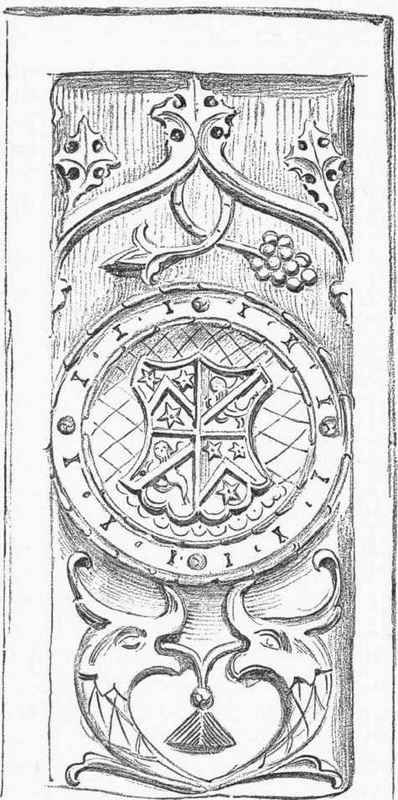
Fred Roe. PANEL FROM SIR ANTHONY DENNY'S HOUSE AT WALTHAM ABBEY.
(Size of panel, 24 x 10 1/4 in.) An attempt of an English craftsman to imitate Italian design, though still retaining certain Gothic features.
Fine as are the specimens which have just been mentioned, they are certainly equalled by the marvellous room full of panelling, which has been more than once referred to, at Abington Hall, Northampton. A book could well be written on the Abington Hall room alone. The linen panelling is elaborate and gracefully designed, certain of the folds being embellished with the ribbon pattern, and the cornice is decorated with a running grape-vine sculptured in high relief. The most singular features, however, are the parehemin panels, which appear in various portions of the room, as well as a series of oblong subject panels, which constitute a sort of frieze between the linen panels and the cornice.
Continue to:


My Books

