


Tables And Forms. Part 2
Description
This section is from the book "Old Oak Furniture", by Fred Roe. Also available from Amazon: Old Oak Furniture.
Tables And Forms. Part 2
The Lord's table on the dais is framed, and more or less a fixture. These tables at Haddon and Penshurst are probably not of a very early date, being perhaps made in late Tudor times.
It is a fact that the decline of vassalage and the introduction of the private dining-room in Tudor days led to the disuse of the great hall to a large extent for meals, and hence we often find such apartments but scantily provided with furniture. It is evident that the reduction in size of the eating apartment was responsible to a certain degree for the shrinkage in the dimensions of the table. Some of the tables, however, were still of considerable size, and often provided with enormous melon-shaped bulbs on their legs. The best productions of the Elizabethan era are frequently beautifully and elaborately carved, presenting a distinct contrast to their ruder predecessors on the one hand, and to the tables in the severer style which followed on the other. A huge, and yet most exquisitely beautiful, specimen of the Elizabethan banqueting-table may be seen in Abington Hall, near Northampton, and smaller tables of this type may be found, such as the superb carved and inlaid specimen, No. 384, 1898, in the Victoria and Albert Museum.
The history of this piece of furniture and its acquisition by the museum authorities is rather interesting. A few years ago it was in the possession of a country clergyman, who, recognising its uncommon beauties, had expressed a hope that it would eventually find a resting-place in one of our national museums. On the decease of the owner, his representatives made inquiries as to whether a purchaser could be found for it at an extremely modest sum. Fortunately, the inquiries were made of a conscientious man with some knowledge of oak, who forthwith instructed the parties in question to be in no hurry, but to communicate with the museum authorities and to raise the price to £100 - something nearer its proper value. This was accordingly done, with the result that the table was purchased for the nation for £ 80.
The Abington and Kensington tables demand careful attention and comparison, for, though very similar in structure and decoration, they represent two distinct types, one intended for the banqueting-hall, and the other appropriate to the private dining-room. It may be mentioned that the table in Abington Hall possesses six legs - one at each corner, the other two placed on a connecting-bar running parallel with the length of the table.
In the example at South Kensington there is a sliding extension at each end, by means of which the top can be enlarged to twice its ordinary size. The framework of bars connecting the legs which commences with tables of this period is a curious revelation of the state of the times. The bars were intended for footstools to enable those seated at meat to avoid the necessity of placing their feet upon the rushes with which the floor was strewn.
These were not removed so often as modern sanitation would demand, and, unless freshly strewn, afforded anything but a pleasant resting-place for the feet. These foot-frames long survived the rush-strewn floors, for in evolution an organ does not disappear immediately that it has ceased to be of use; but they are none the less an indication of the inconveniences attending that early custom. The love of art was innate in the old constructors, and although they may not actually have intended that an object should be picturesque, much of the picturesqueness came about by the satisfying of needs as they arose.
Fine specimens of Elizabethan tables with the 'melon' leg are rare, and consequently very difficult to acquire. The best specimens of this class have their legs surmounted by an exquisitely-moulded shallow capital, and the bottom of the stretchers immediately above the capitals edged with boldly-sculptured jewel-moulding. A very beautiful example used to exist, and perhaps may still be seen, at Leeds Castle, Kent. It may be remarked here that these 'melons' were so enormous in diameter compared with the rest of the leg that, to avoid waste, it was necessary to build up the bulb with applied material, the surface-carving being executed after the piecing together of the parts. Some of the very beautiful mouldings on the pillar-caps - such, for instance, as the volutes and their returns - were applied, and are liable to become detached through age or rough usage; hence it is that these most beautiful productions of the Elizabethan period have so often suffered in their outline.
Though tables of such a quality as that at Kensington, recently mentioned, are seldom met with in the world of museums and collections, they still exist in some of our country churches, but in most cases they have descended from their original station in the sanctuary. A magnificent example remains in Blyford Church, Suffolk, and another at Dinton, Bucks. The latter is a strikingly fine piece, of noble proportions, and. except for one unfortunate circumstance, is in a good state of preservation. The caps to its bulbed and jewelled legs have beautifully-carved volutes, above which is a projecting course of handsome jewel moulding. The top stretchers are evidently inlaid, for the mortises, from which some pieces of the lighter wood have fallen, are distinctly visible. This decoration appears to be designed in the form of floral devices and tendrils, but its course, as well as an inscription on the front stretcher, cannot now be well deciphered, the whole piece being at present covered with successive coats of that Georgian paint which antiquaries so much deplore. On the top surface of the Dinton table appears another inscription, which, from the fact of its only being incised, and not filled up with inlay, is perfectly legible.
It is worded as follows: ' FRANSIS HVNTTS GEVEN BY THE YOVTH OF vpton.' This morsel of information carries one's mind somewhat sadly to the decadence of rural England. Upton, a picturesque but poor and straggling hamlet in this parish, would surely not be able to furnish such a superb voluntary effort from the pockets of its youth in these degenerate days. It may be added that Fransis Huntt, was probably at one time Vicar of the parish of Dinton, and the date of the production and presentation of this table is duly recorded by the figures 16-06 which are carved on its uprights.
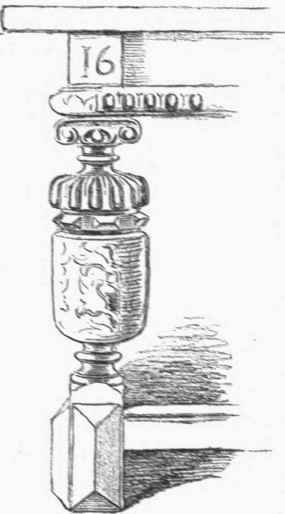
LEG OF THE TABLE IN DINTON CHURCH, BUCKS, DATED 1606.
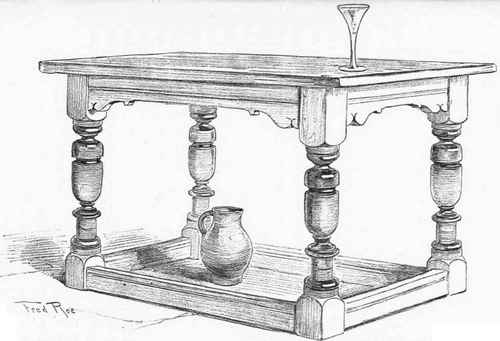
TABLE IN THE POSSESSION OF THE HON. MR. JUSTICE SWINFEN EADY, FIRST HALF OF THE SEVENTEENTH CENTURY.
Height, 2 ft. 6 1/2 in.; length, 4 ft. 5 1/2 in.; width, 2 ft. 2 in.
Continue to:


My Books

