


The Gothic Styles. Part 3
Description
This section is from the book "Old Oak Furniture", by Fred Roe. Also available from Amazon: Old Oak Furniture.
The Gothic Styles. Part 3
It may be this simplicity which has led to the destruction of similar pieces by the ignorant, while less pure and over-decorated specimens of a later time have been preserved. The common mind tends to associate value and beauty with an excess of frills and trimmings, and this may account for the excessive rarity of pre-Reformation domestic furniture. What the large cupboards of the fifteenth century were like may be learned from a solitary armory which remains in York Cathedral. The top is battlemented, the hinges are strap-shaped, and the arrangement of doors or shutters is very irregular. This irregularity is a distinctive and very pleasing feature of Gothic work, and is in itself an evidence of higher imaginative capacity than goes to produce an object of that absolute regularity of design which would seem to have been a weakness of later periods.
Another reason may perhaps be advanced to account for the exceptional rarity of articles of the fifteenth century. Nearly all of the second half of that period was occupied by the English people in internecine warfare of a most sanguinary character, which destroyed in a great measure the arts of peace. Between the first battle of St. Albans and the conflict on Bosworth Field some fourteen pitched battles were fought, exclusive of smaller frays and petty skirmishes, and it is probable that the number of those who actually perished in the larger conflicts alone is rather over than under 100,000. Not only was it the bone and muscle of England that was decimated; there probably never was another war fought where so many of the wealthy nobility fell. Contrary to the usual custom of the Middle Ages, on many occasions the winning side received orders to spare the common soldiers, but slay the leaders, and those who escaped were for the most part irreparably ruined. Thus, the dissolution of great fortunes and estates impoverished the very class best able to afford the luxuries of existence. These several causes had their effect upon production.
It is true that many handicrafts were still carried on with patient industry, but even these were affected by the tremendous conflict which raged throughout the country, and manufactures languished. This no doubt is the real cause why such a poverty of furniture typical of fifteenth-century work is to be found in England at the present day, compared with that of other periods, and the greater number of remaining specimens emanate from conventional sources.
At the conclusion of the wars, while England lay exhausted from her internal struggle, Flemish aptitude for business discovered in our shores an opening for Flemish wares, and articles of furniture, especially chests, were imported in such numbers that our craftsmen could make no headway against the competition, and Acts were accordingly passed at various times to restrict the importation. Whether these Acts fulfilled their purpose or not, it cannot be denied that an immense quantity of Flemish work must have been imported. In different parts of the country, even as far as the extreme West of England, we find chests still existing of flamboyant design and foreign workmanship, while old records frequently mention these by the name of Flanders chests, much in the same way as modern inventories would include Turkey carpets. Some of these Flemish chests may have been made in England by Flemish workmen from their own designs, and would still, notwithstanding this, be correctly designated as Flanders chests. It will be seen, therefore, how necessary it is to have a proper acquaintance with architectural styles in order to be able to assign to any given piece of furniture its true source and approximate date.
Were the importance of this kind of knowledge duly recognised, there would be fewer errors in descriptions of Gothic and Renaissance furniture.
In treating of the decoration of early furniture, we frequently find that a conventional form of rose is introduced, and this, representing as it does the national emblem of England, has passed through so many types that a few words on it may be interesting to the connoisseur.
The earliest type of rose, which we find upon coffers as far back as the thirteenth century, seems to have been formed by a succession of concentric rings divided up by notches into petals in rather an aimless manner. In later Gothic times, however, some significance may be found in the more thoughtfully-developed form of the flower. It has been asserted, and with some show of truth, that the roses produced during the reigns of Henry V., VI., VII., and VIII. exhibit a number of petals corresponding with the distinguishing number of the reigning monarch. This is an interesting, but by no means an infallible, distinction. I have examined roses carved on buildings and pieces of furniture throughout the whole of the 150 years covered by the reigns of the monarchs referred to; and though in some cases the theory is supported by the number of petals on the rose, in others no correspondence exists.* The favourite form seems to have possessed an uneven number of petals, thus presenting an irregularity of scheme dear to the hearts of the early designers.
* The roses on the real and sovereign of Henry VII. do not possess more than five petals each, and other instances exist which tend to disprove this theory. The four-petalled rose is seldom depicted.
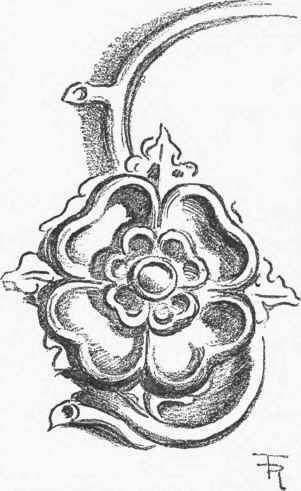
ROSE FROM MISERERE SEAT, AYLESBURY CHURCH, BUCKS.
The use of the rose in decoration was common throughout England during the latter part of the fifteenth century, and there is little doubt from traces which we find that these roses were coloured, probably in accordance with the political opinions of the families who owned them. When the parties were united in the persons of Henry VII. and Elizabeth of York, both colours were variously used on the same flower, sometimes one ring of petals in red enclosing another ring in white, or vice versa; or, again, as in the case of the badges exhibited in the windows of King's College Chapel, Cambridge, the rose was divided by a vertical line, one division being coloured white and the other red. The marguerite, or daisy, was also used in decoration, occasionally as a punning rebus upon the name of Margaret of Anjou, Henry VII.'s Queen.
Continue to:


My Books

