


Chairs. Part 3
Description
This section is from the book "Furniture Of The Olden Time", by Frances Clary Morse. Also available from Amazon: Furniture of the Olden Time.
Chairs. Part 3
Two banister-back chairs owned by the writer are shown in Illustration 139 and Illustration 140. It will be seen that the tops and one carved under-brace are similar to those upon cane chairs, while the legs of one chair end in a clumsy Spanish foot. The banisters which form the back are turned on one side and flat on the other. These chairs have the flat side in front, but either side was used in banister chairs, plainer types of which are found, sometimes with the slats not turned, but straight and flat. The chair in Illustration 140 was used for the deacon's chair in the old meeting-house in West-borough, Massachusetts, built in 1724, and it stood in "the deacon's pue," in front of the pulpit, for the deacon to sit upon, as was the custom. The deacon must have longed for the two hours' sermon to end, if he had to sit upon this chair with its high, narrow seat. There are several kinds of wood in these chairs, and when found they were painted black.

Illus. 139 and Illus. 140. - Banister-back Chairs, 1710-1720.
An unusually fine banister chair, from the Poore collection at Indian Hill, Newbury-port, is shown in Illustration 141, with carved top and under-brace and Spanish feet. The seat is rush, as it usually is in banister chairs. "Roundabout" chairs are met with in inventories from 1738 under various names, - "three-cornered chair," "half round chair," "round about chair," - but they are now known as roundabout or corner chairs. They were made in different styles, like other chairs, from the turned or the Dutch bandy-leg, down to the carved Chippendale leg with claw-and-ball foot.
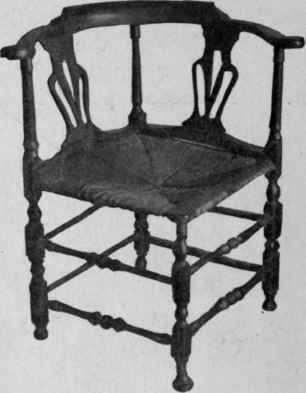
Illus. 142. - Roundabout Chair, about 1740.
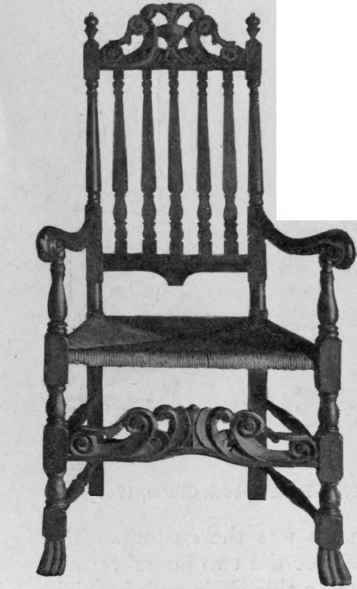
Illus. 141. - Banister-back Chair, 1710-1740.
Illustration 142 shows a roundabout chair with turned legs, the front leg ending in a Dutch foot. This is in the Whipple house at Ipswich.
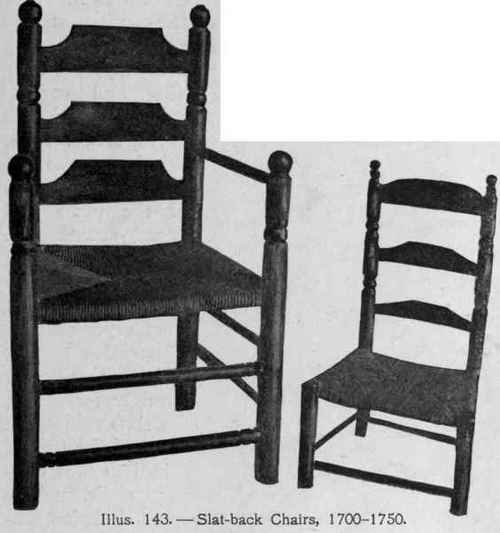
The most common chair during the first half of the eighteenth century was the "slat back," with a rush seat. The number of slats varied; three, four, and five slats being used. The slats were also made in different designs, those made in Pennsylvania being curved.
Two slat-back chairs are shown in Illustration 143 from the Whipple house in Ipswich. The large chair was found in the country, stuffed and covered with many layers of wadding and various materials. When they were removed, this frame was disclosed, but the tops of the posts had been sawed off. The back posts should terminate in a turned knob, like the Carver chair in Illustration 122, which this chair strongly resembles, the slats taking the place of the turned spindles of the Carver chair. The small chair is probably of later date, and was evidently intended for a child's use. Chairs with three-slat backs are in Illustrations 54 and 201.

Illus. 144. - Five-slat Chair, about 1750.
Illustration 144 shows a five-slat or five-back chair owned by the writer. It was made about 1750, and the rockers were probably added twenty-five or thirty years later. They project as far in front as in the back, which is evidence of their age. Later rockers were made longer, probably for safety, the short rocker at the back proving dangerous to the equilibrium of a too vigorous occupant of the rocking chair. This chair has never been restored and is a very good example of the slat-back chair. It is painted black with lines of yellow.
Illustration 145 shows an armchair with a five-slat back which is now the property of the Historical Society of Pennsylvania. The slats are the typical Pennsylvania ones, made to fit the back, with a deeper curve than some, and, as may be seen by comparing them with others illustrated, with a more decided curve to both the upper and lower edges of the slats. The stretcher across the front is turned and is unusually heavy.
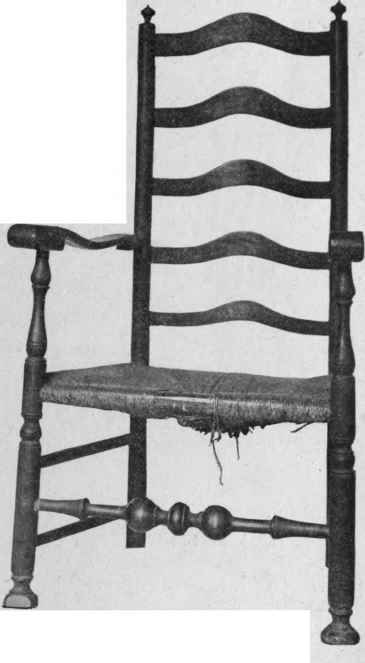
Illus. 145. - Pennsylvania Slat-back Chair, 1740-1750.
The type of chair succeeding the slat-back in popularity was the Windsor, which was made for years in large numbers both in England and America.
Windsor chairs made their first appearance in this country about 1730, in Philadelphia, and "Philadelphia made" Windsor chairs soon became very popular. Advertisements of them abound in newspapers up to 1800, and they may be found with the slat-back chairs in almost any country house, frequently upon the piazza, whence many a one has been bought by the keen-eyed collector driving along the road. The original Philadelphia fashion was to paint the chairs green, but after they were made all over the country they were probably painted to suit the taste of the buyer.
There is a story that the name Windsor was derived from the English town, where one of the royal Georges found in a shepherd's cottage a chair of this style, which he bought and had others made from, - thereby setting the fashion.
Continue to:


My Books

