


Chests, Chests Of Drawers, And Dressing-Tables. Part 4
Description
This section is from the book "Furniture Of The Olden Time", by Frances Clary Morse. Also available from Amazon: Furniture of the Olden Time.
Chests, Chests Of Drawers, And Dressing-Tables. Part 4
"But the old chest won't sarve her gran'son's wife, (For'thout new furnitoor what good in life ?) An' so old claw foot, from the precinks dread O' the spare chamber, slinks into the shed, Where, dim with dust, it fust and last subsides To holdin' seeds an' fifty other things besides."
But carefully wrapped up and tucked away in one of the small drawers were the torches for the upper and the acorn-shaped drops for the lower part. These drops were used as long as the curves followed those of the lower part of six-legged chests, but were omitted when more graceful curves and lines were used, as the design of high chests gradually differed from the early types.
The "low-boy," or dressing-table, was made to accompany every style of high chest. The low-boy in Illustration 19 shows the dressing-table which was probably used in the room with the bandylegged high-boy, flat-topped or with the broken arch cornice. It is lower than the under part of the high-boy, which is, however, frequently supplied with a board top and sold as a low-boy, but which can be easily detected from its height and general appearance. The measurements of this highboy and low-boy are high-boy, lower part
3 feet high
3 feet 1 1/2 inches long
21 inches deep
Low-Boy
2 feet 4 inches high 2 feet 6 inches long 18 inches deep
The high-boy measures seven feet from the floor to the top of the cornice.
High chests and dressing-tables were made of maple, often very beautifully marked, in the same style as the chests of walnut and cherry. The high chest was sometimes made with the drawers extending nearly to the floor, and mounted upon bracket, ogee, or claw - and - ball feet. This was called a double chest, or chest-upon-chest.
The double chest in Illustration 20 is in the Warner house at Portsmouth. It is of English walnut, and the lower part is constructed with a recessed cupboard like the writing-table in Illustration 106. The handles upon this chest are very massive, and upon the ends of both the upper and lower parts are still larger handles with which to lift the heavy chest.
A double chest which was probably made in Newport, Rhode Island, about 1760-1770, is shown in Illustration 21. The lower part is blocked and is carved in the same beautiful shells as Illustration 31 and Illustration 106. This double chest was made for John Brown of Providence, the leader of the party who captured the Gaspee in 1772, and one of the four famous Brown brothers, whose name is perpetuated in Brown University. This chest is now owned by a descendant of John Brown, John Brown Francis Herreshoff, Esq., of New York.

Illus. 20. - Walnut Double Chest, about 1760.

Illus. 21. - Mahogany Double Chest, 1765.
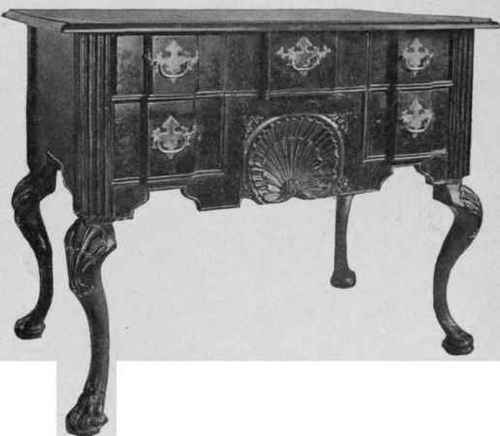
Illus. 22. - Block-front Dressing-table, about 1750.
A low-boy of unusual design, in the Warner house, is shown in Illustration 22. The front is blocked, with a double moulding upon the frame around the drawers. The bill of lading in Illustration 109 specified a dressing-table, brought from England to this house in 1716, but so early a date cannot be assigned to this piece, although it is undoubtedly English, like the double chair in Illustration 212, which has similar feet, for such lions' feet are almost never found upon furniture made in this country. The shape of the cabriole leg is poor, the curves being too abrupt, but the general effect of the low-boy is very rich. The handles are the orig-inal ones, and they with the fluted columns and blocked front determine the date of the dressing-table to be about 1750.
The low-boy in Illustration 23 is probably of slightly later date. It has the separated" double moulding upon the frame around the drawers, and the curves of the lower part are like the early high chests, but the carving upon the cabriole legs, and the fluted columns at the corners, like those in Chippendale's designs, indicate that it was made after 1750. Upon the top are two pewter lamps, one with glass lenses to intensify the light; a smoker's tongs, and a pipe-case of mahogany, with a little drawer in it to hold the tobacco. This dressing-table is owned by Walter Hosmer, Esq.

Illus. 23. - Dressing-table, about 1760.
The little chest of drawers in Illustration 24 belongs to Daniel Gilman, Esq., of Exeter, New Hampshire, and was inherited by him. It is evidently adapted from the high-boy, in order to make a smaller and lower piece, and it is about the size of a small bureau. The upper part is separate from the lower part, and is set into a moulding, just as the upper part of a high-boy sets into the lower. The handles and the moulding around the drawers are of the same period as the ones upon the chest in Illustration 20.
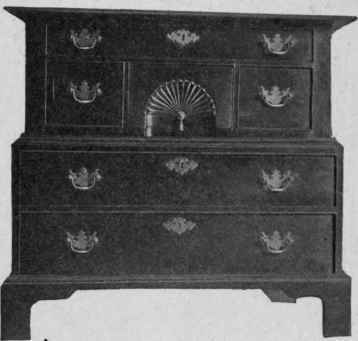
Illus. 24. - Chest of Drawers, 1740.
The furniture made in and around Philadelphia was much more elaborately carved and richly ornamented than that of cabinet-makers further north, and the finest tables, high-boys, and low-boys that are found were probably made there. They have large handles, like letter F, in Illustration II, and finely carved applied scrolls.
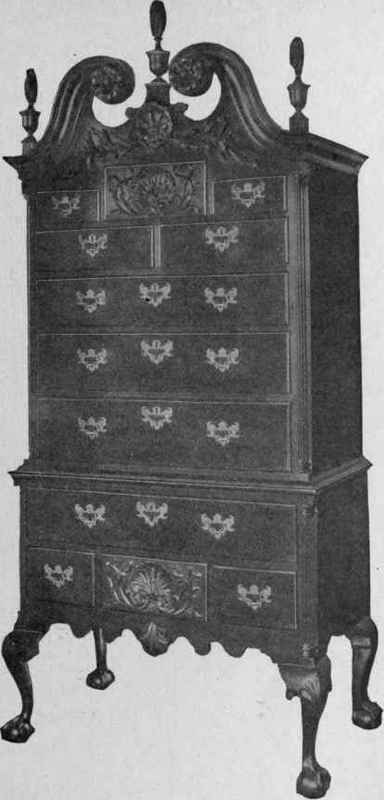
Illus. 25. - High Chest of Drawers, about 1765.
The richest and most elaborate style attained in such pieces of furniture is shown in the high chest in Illustration 25, which is one of the finest high chests known. The proportions are perfect, and the carving is all well executed. This chest was at one time in the Pendleton collection, and is now owned by Harry Harkness Flagler, Esq., of Millbrook, New York.
Such a chest as this was in Nathaniel Hawthorne's mind when he wrote: "After all, the moderns have invented nothing better in chamber furniture than those chests which stand on four slender legs, and send an absolute tower of mahogany to the ceiling, the whole terminating in a fantastically carved summit.",
The dressing-table and looking-glass in Illustration 26 are also owned by Mr. Flagler. The looking-glass is described upon page 385. The dressing-table is a beautiful and dainty piece of furniture of the same high standard as the chest last described. The carving upon the cabriole legs is unusually elaborate and well done. It will be noticed that the lower edge of these pieces is no longer finished in the simple manner of the earlier high-boys and low-boys, but is cut in curves, which vary with each piece of furniture.
In Illustration 365 upon page 378 is a low-boy of walnut, owned by the writer, of unusually graceful proportions, the carved legs being extremely slender. The shell upon this lowboy is carved in the frame below the middle drawer instead of upon it, as is usual.
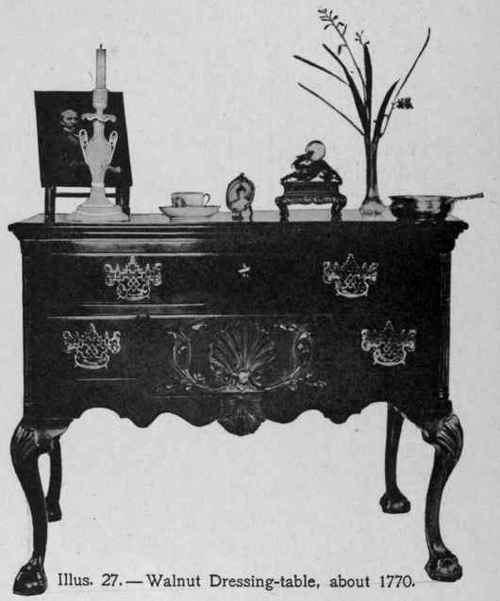
The dressing-table in Illustra-tion 27 also belongs to the writer. It is of walnut, like the majority of similar pieces, and is finely carved but is not so graceful as Illustration 365. The handles are the original ones and are very large and handsome.
High chests and the accompanying dressing-tables continued in use until the later years of the eighteenth century. Hepplewhite's book, published in 1789, contains designs for chests of drawers, extending nearly to the floor, with bracket feet, one having fluted columns at the corners, and an urn with garlands above the flat top. It is probable, however, that high chests of drawers were not made in any number after 1790.

Continue to:


My Books

