


Chippendale. Part 8
Description
This section is from the book "Style In Furniture", by R. Davis Benn. Also available from Amazon: Style In Furniture.
Chippendale. Part 8
In dealing with cabinet work Chippendale found that it was not so easy to impart to his productions the desired Chinese character as when dealing with chairs. The respective conditions controlling the construction of both were by no means the same. In chairs he had what was to all intents and purposes a mere framework of wood, the open spaces of which could be filled with any decorative detail that his fancy might dictate. This framing formed a perfect setting for the lattice work of which he made such good use. But with cabinets, chests, and other articles of that description the case was very different. In these, plain filled-in expanses had to be treated instead of open spaces, and for such the ordinary lattice, by reason of its very nature, was of but little use. Notwithstanding the fact that the lattice itself could not be requisitioned, it was obviously essential to secure a similar effect by some means or another if the Chinese character were to be retained. Chippendale surmounted the difficulty with great ingenuity. He sketched-out his lattice-like patterns for the enrichment of cabinet work, but made them much more delicate and intricate than those intended for the backs and arms of chairs; he then had them cut, by means of the fret-saw, in thin mahogany. This, of course, was far too fragile to stand without a supporting background of some kind; it was therefore "planted-on" or "applied" to the solid foundations afforded by the wood with which the spaces to be decorated were already filled-in, and was firmly fixed in position there by means of "pins" (tiny nails or "brads") and glue.
Although he had succeeded so far in securing a certain degree of the requisite flavour in his Chinese confections, Chippendale was not content until he had made it stronger. He turned his attention therefore to the pagoda - a form I need hardly say, essentially Chinese - and he was not to be baffled. Here was the very thing for his pediment; nothing could be better. They had to be touched up, of course, with a little coquillage; the inevitable C's were fitted in somehow here and there; top-heavy naturalesque bunches of flowers came in handy as finials; and the whole, with other nondescript detail, resulted in those strange medleys which we see in the pediments of the wall bookcases on Plates IV. and V., the two lower cabinets on Plate VI., and the hanging bookshelves on Plates X. and XI. To sum up briefly the total outcome of this experiment, the chairs proved to be a greater success than the cabinet work. They were quaint and not altogether unattractive in appearance; roomy, and, by the aid of a generous supply of loose cushions, might be made fairly comfortable. The cabinets, on the contrary, I am disposed to regard rather in the light of freaks; though we may perhaps say of them, as was said of the curate's egg, immortalised by our friend "Mr. Punch," that they are "good in parts."
"Chippendale." V. Plate 36
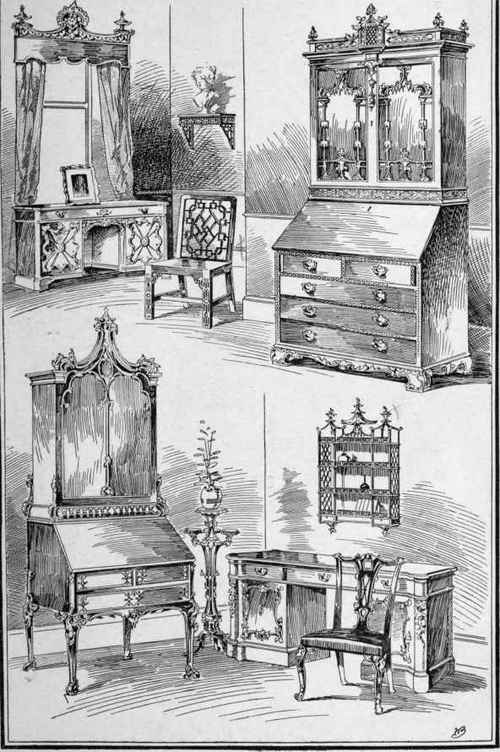
Reference In Text
Page | ||
Chairs. | See | 115 |
Wall bookshelves. | " | 117 |
Page | |||
Secretaires. | See | 124, | 245 |
Wall bracket. | " | 126 | |
But the applied fret was in every way too useful a means of enrichment to be confined to the Chinese productions exclusively; and, having once discovered and perfected it, Chippendale employed it freely in many designs other than those based upon the household gods of the "Celestials." It was, in the first place, most effective; and, what was equally important, the use of the fret-saw cost but little. The process of production was still further cheapened by clamping a number of the thin sheets or strips of wood together and piercing them all to the desired pattern at one and the same time. Indeed, they can not only be cut more expeditiously in this way, but even better than singly, for the saw obtains a surer "grip," and cuts altogether more satisfactorily.
There are few situations in which the applied fret cannot be used, so we find it introduced by Chippendale to square chair and table legs and similar supports, as shown in the accompanying illustrations, as well as to panels, pilasters, friezes, drawer-fronts, and the like.
In order to convey a more adequate idea of the character of these frets than we can glean from the necessarily impressionistic indication of them in the sketches of complete pieces of furniture, I have had a number drawn to a larger scale, and included with other characteristic detail on Plate VIII.
I have mentioned that this designer, during his search in all manner of different fields for ideas, coquetted now and again with the Gothic, or "Gothick" as he preferred to call it; but that old style failed to gain his favour to any great extent, or maybe it proved too severe for him, and unrelentingly resisted his advances. Be that as it may, he did not make much progress in that direction; but we must see what he did manage to do. In Fig. 12, Plate VIII., just the end of a "Chippendale-Gothic" commode appears, which, we must admit, is not altogether devoid of a certain quaint charm; while a touch of the same feeling is present in the press or cabinet on Plate VI. (as also in one or two other examples), though here it is mixed up with French and other detail of a hybrid nature. With these few pieces of "Chippendale-Gothic" before us, however, we do not experience any very keen regret that their originator did not proceed much further on those lines.
Continue to:


My Books

