


Empire. Part 4
Description
This section is from the book "Style In Furniture", by R. Davis Benn. Also available from Amazon: Style In Furniture.
Empire. Part 4
While dealing with models which we know from existing evidence to have actually formed part of the personal surroundings of Napoleon at home, the two beds, Figs. 2 and 4, Plate IV., must come in for a share of consideration. That shown in Fig. 4 is indeed simple to severity, and is more suggestive of the rigours of camp life than of anything else; but the one above it speaks more of the royal splendour of the palace, though it also is severe, but with the severity of the palmiest days of the "Greek." It is beautiful in the chaste simplicity of its scrolls and perfect restraint in the employment of the most refined decorative detail.
We will next take a glance at the "Empire" table; and in doing so we shall find that the top is almost invariably either circular or rectangular in form, is made either of wood or of some rare marble, and is supported by chimerical creatures inspired by the ancient sphinxes; by "trusses," or legs, shaped to resemble the legs and paws of animals - generally of the lion - or by heavy, and severely simple, turning. Of the first class we have examples in Figs. 1 and 5, Plate I.; of the second in Fig. 2 on the same plate; and of the third in Fig. 2, Plate II., Figs. 2 and 5, Plate III., and in the historic table upon which Napoleon signed his abdication, shown on Plate V. With regard to these I may point out at the moment that, in Fig. 1, Plate I., in addition to the protective chimeras, the "Roman" shield and bay leaf are introduced in order to heighten the martial feeling of the whole; and that, in the chimera of Fig. 6, we have the head and wings of the Imperial Eagle. The detail of the rest speaks for itself.
In studying the "Empire" with a view to tracing the influence which it exerted over early nineteenth-century English furnishings, special note should be made of the tables illustrated in Fig. 2, Plate II., Figs. 2 and 5, Plate III., and the "Table de l' Abdication," Plate V., for they are models that were seized upon, and "done to death," by the early Victorian cabinet makers of this country. There can, surely, be but few of my readers who have not met, at one time or another, with many descendants of these. The turned pillar, and particularly the base, of the last are familiar friends which in our childhood's days suffered the impress of our boots. The top of the "Empire" pier-table was, more frequently than not, supported by slightly tapered, but by no means slender, legs, surmounted by a classically conceived female head and bust - as in Plate V. - or by the heads of animals or birds. In the tables illustrated it will be noticed that the imperial initial again plays an important part. The dainty little piece which appears in Fig. 5, Plate IV., seems almost to have crept in by mistake, as there is nothing of the stately spirit of the "Empire" about it. It is Napoleonic, however, as regards period; was included in the furnishing of one of the royal residences; and was probably designed and made to please the more delicate tastes of poor Josephine, or of her successor Maria Louisa, to both of whom their imperious master's persistent craving after pomp and display must surely have proved not a little trying.
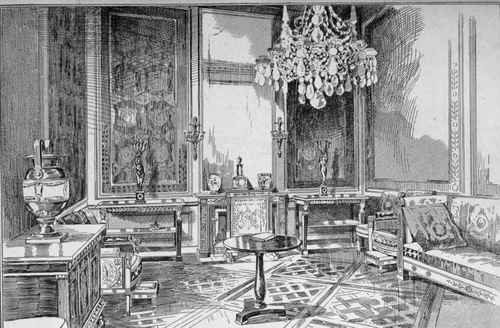
Room In The Palace At Fontainebleal Reference in Text. See page 274 "Empire." V. Plate 86 "Empire" 275
Leaving chairs, sofas, beds, and tables, it is time to note one or two examples of "Empire" cabinet work proper before concluding our consideration of this style; these will be found in Fig. 6, Plate I., Fig. 4, Plate II., Fig. 4, Plate III., and on Plate V. A knowledge of this phase of the subject is easily acquired, for "Empire" carcase work generally, no matter for what purpose it was intended, was, with the rarest exceptions, extremely severe in form, and depended almost entirely for its character on the detail with which it was enriched. Here the fondeur ciseleur again had his opportunity, and he made remarkably good use of it. Popular as modelled and chased brass mounts were during the earlier periods which we have passed in review, at the introduction of the "Empire" they were more extensively employed than ever. So important, indeed, was the part they played, that, without their presence, many a choice example of the style which is treasured in the most famous collections, and with which the proud possessors could never be induced to part "for love or money," would not attract a second glance. In order to illustrate this point, let the reader imagine Fig. 4, Plate II. - a piece worth many thousands of pounds - shorn of its brass work. My meaning will then be made perfectly clear. The effect of these mounts, severe in character, demonstrating to the utmost the rare possibilities of modelling, casting, and chasing, and standing out against their background of choice mahogany, or sombre ebony - almost invariably the former - is indescribably rich and truly regal. The details in these, and in all pieces conceived in the "Classic" spirit, to which the designer paid most particular attention, were the anthemion, the bay leaf arranged in wreaths and other forms; the laurel, the myrtle, and the oak leaf with acorns, similarly disposed; the heavy "Roman" acanthus scroll, foliated rosettes and "bosses";
"Classic" capitals - particularly the "Corinthian;" the "egg," and "egg-and-tongue" mouldings; "pearl" beading; the sacrificial heads - bullocks' rams', etc.; stiff festoons of drapery; sphinxes, lions, eagles, and other figures, mythological, animal, and human. The enrichment of Fig, 4, Plate II., is as comprehensive an object lesson in the decorative elements of this period as could well be found in a single example. In addition to the employment of brass in the form of mounts such as those illustrated and described, simple lines of the same metal were, very frequently, inlaid into the mahogany, with very chaste and pleasing results. Reverting, for a moment, to chairs and seats, I may mention that, when not made in mahogany, with brass mounts or gilded carving, they were painted in light' and subtle shades of cream, green, pink, or blue, and touched up here and there with gilt, the mouldings and ornaments generally being thrown into prominence in that way. Gilt, in one guise or another, was a very prominent feature throughout the Napoleonic furnishing era in France, which, from more than one point of view, may be, perhaps, regarded as an age of brass.
A word or two, in conclusion, with regard to the character of the design of the "Empire" textile fabrics used for furniture coverings and draperies. Sometimes they were bold, free, and floral in treatment, as in the coverings of Fig. 4, Plate I., and Figs. 1 and 3, Plate II., but more generally they were stiff and conventional, as in Fig. 3, Plate I., Fig. 6, Plate III., and Figs. 1, 2, and 6, Plate IV. The pattern was often composed solely of a "powdering," which consisted of a simple wreath, or even of the Imperial Bee alone, without any decorative accompaniment.
In taking leave of the "Empire," after having noted its historical associations and seeing what it eventually became, we cannot but arrive at the conclusion that, great and liberal as was the encouragement afforded by Napoleon to the arts and he could not well have done more in that direction than he did - he was fully repaid by the refined dignity and magnificence which were instilled into the material environment of his reign by the genius and instrumentality of such men as Percier, Fontaine, David, and their co-workers.
Empire." VI. Plate 87

Reference in Text. See pages 275-276
Continue to:


My Books

