


Heppelwhite. Part 3
Description
This section is from the book "Style In Furniture", by R. Davis Benn. Also available from Amazon: Style In Furniture.
Heppelwhite. Part 3
We have accepted it as a rule that, so far as the identification of style is concerned, the chairs of the eighteenth century are imbued with stronger and, therefore, more distinctive characteristics than other articles of household furniture of that period, consequently upon them we are able to utter a definite pronouncement with the greatest ease, and, at the same time, with the greatest degree of certainty.
To the chairs, then, we shall turn first. When we have to deal with cabinet work, on the other hand, we shall -find that the variations are most numerous, and far more subtle, and consequently more difficult to distinguish, depending as they do, for the most part, on slight differences in more or less minute ornamental detail rather than on form. However, that phase of our subject we shall discuss in its place.
The designs of Heppelwhite, it must be admitted, resem- . bled those of Chippendale, and differed from those of Sheraton, insomuch that, in his chairs, or, to speak with greater exactitude, in his chair-backs, he almost invariably avoided the straight line entirely, persistently excluding it from his schemes. But, though he did this, he never, under any circumstances, went the lengths to which his predecessor was led by his ever-present desire to be constantly producing "something fresh," and, moreover, "something French." It must not be inferred from this that Heppelwhite was one whit behind Chippendale in his desire to attain novelty; the very reverse was the case: but he seldom sacrificed good taste to secure it. Though he favoured the curvilinear so strongly, this designer, as will presently be seen, always kept his fancy well within legitimate bounds, and very rarely indulged in what might reasonably be termed extravagance. In all his work he gives evidence of the possession, in a high degree, of a love of daintiness and refinement, combined with a strict regard for constructional conditions; and I am very greatly inclined to the opinion that, in his eyes, such creations as the "Ribbon-Back," for example, ranked as positive abominations, and much of the quasi-Chinese cabinet work as not very much better.
It may be accepted as another rule, and one to which there are very few exceptions, that really pure and truly characteristic "Heppelwhite" chairs always have the "shield-shape" back, numerous types of which are shown on Plates I. and II. In studying these examples it must be specially noted that the curve at the top of the back is invariably unbroken; that is to say, it forms one graceful, sinuous sweep from one extremity to the other. I desire most particularly to emphasise this characteristic of the "Heppelwhite" back, because Sheraton occasionally adopted a form similar to the "shield shape," but, so far as I have been able to discover, he always interrupted, or "broke" - as it is technically termed - the top curve by a straight line, or rectangular panel, in the centre. Reference to Figs. 6 and 15, Plate II., in the following chapter will make this essential difference perfectly clear. Furthermore, in the two styles the junction of the back legs with the lower part of the sides of the shield differs in the manner indicated by the annexed sketch. This, it is true, is a minor detail, but in questions of identification minor details often go for much, and give, so to speak, the casting vote. It will be observed that Heppelwhite, more often than not "finishes off" the join by introducing a tiny scroll-head, sometimes with a rosette carved upon it, and sometimes quite plain; but this feature is never to be found in genuine "Sheraton."
It is not a little difficult to distinguish between many of the productions of these two designers, for the simple reason "Heppelwhite " support of "Shield-Back " that, in the first place, they both went to the same sources for inspiration, and, in the second, freely appropriated one another's ideas whenever they felt so disposed, or occasion demanded. On that account, if on no other, the minor distinctive features should be kept constantly in view, as a thorough acquaintance with them clears from the connoisseur's and collector's path many obstacles that would otherwise render the formation of a correct judgment extremely difficult.
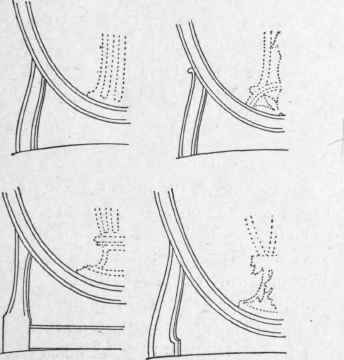
Sheraton support of Shield-Back (Seepage 138 for reference)
There is also more freedom, a greater "flow," if I may so describe it, and consequently more grace, about the chair backs as a whole of Heppelwhite than in those of Sheraton, whose determined, and almost unrelenting, cultivation of the straight line in preference to the curvilinear may perhaps reasonably be ascribed to the presence, in his mind, of a desire to escape, so far as it was avoidable, the charge of copying the lines originated by his popular contemporary.
Eight "shield-shape" chair backs, and one oval in form, are illustrated on Plate II., giving as complete an idea of Heppelwhite's preferences in this direction as can possibly be conveyed. To illustrate my assertion that these competitors for public favour - and, what was more important, patronage - did not by any means object occasionally to copy from one another's works, Figs. 8, 10, and 11 on the same plate, and Fig. 2 on the preceding one, are given. These examples were included in Heppelwhite's book, though they are not at all in his style. They were most probably included in order to indicate that the firm responsible for the publication of the work were quite able to satisfy the public demand for types created by Sheraton, as well as those on their own lines; for notwithstanding the fact that they are taken direct from "The Cabinet Maker and Upholsterer's Guide," they are in all respects foreign to the style whose principles are enunciated in its pages. In regard to such cases as this, perhaps it would be better to coin some such description as "Heppelwhite-cum-Sheraton," though it would be fairer and far more correct to describe them as "Sheraton" pure and simple, for it is evident that they partake far more of the latter style than of the former.
Continue to:


My Books

