


Other Georgeian Types. Part 2
Description
This section is from the book "Style In Furniture", by R. Davis Benn. Also available from Amazon: Style In Furniture.
Other Georgeian Types. Part 2
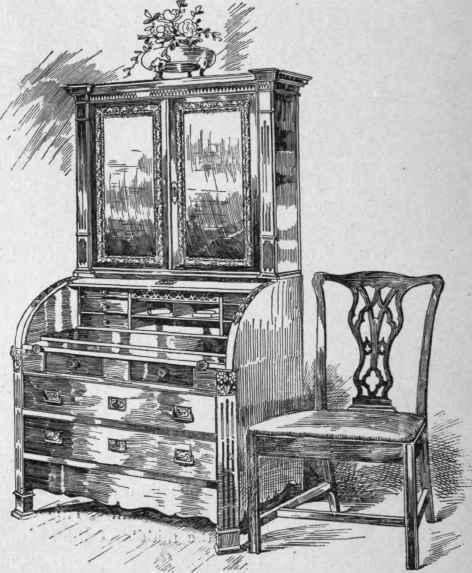
Georgeian Secretary and Early Chippendale Chair (See preceding page for reference)
Georgeian Types. I. Plate 62
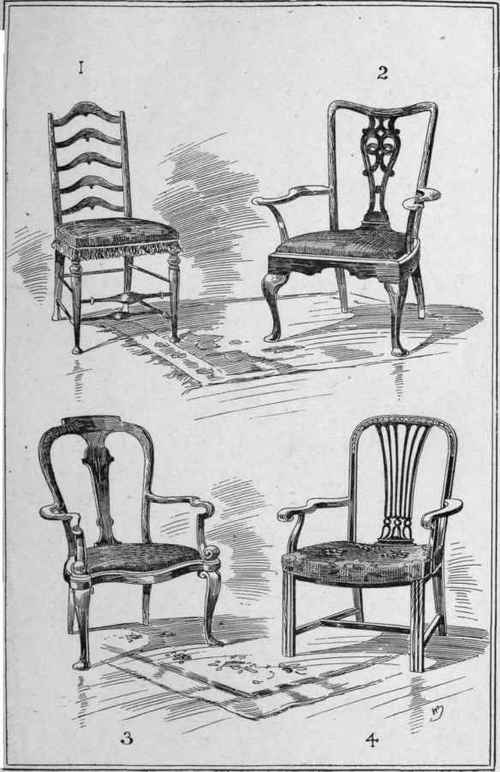
Reference in Text. See page 202
I have mentioned earlier in the book that the popularity of furniture enriched by dainty brush work - a popularity largely brought about by the example and advocacy of Heppelwhite and Sheraton - became so great that, for wealthy patrons, the services of leading painters of the day were requisitioned to add grace and charm to mahogany, and especially satinwood, furniture; and it is recorded that, among other artists of high repute, Angelica Kauff-mann and Giovanni Batista Cipriani, both of whom were members of the original "thirty-six" of the Royal Academy, were not above accepting such commissions. Of these two famous painters it is not necessary to say much here, as they shone more particularly in the field of fine art, though they turned their attention occasionally to the applied arts. I may, however, remind the reader that Angelica Kauffmann was the daughter of a Swiss artist, was born in 1742 and died in 1807, and that one of her greatest pictures - "Religion attended by the Graces" - is now in the National Gallery. Cipriani - a Tuscan - was born at Potoja in 1727, pursued his studies in Florence, came to England, made his mark here, and had many of his works engraved by Bartolozzi. He died at Chelsea in 1785. Per-golesi, too, did considerable work of the same kind, as well as for interior decoration.
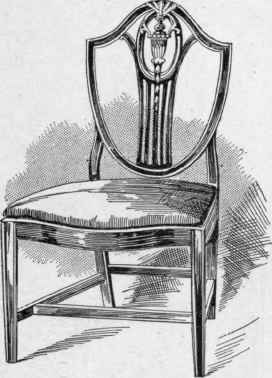
Heppelwhite Chair (With wheat-ear detail in hack) (See page 140for reference)
There is yet another feature associated with eighteenth-century furniture which must be mentioned, and that is lacquer as a decorative medium. The demand for this was, to a great extent, created by the importation into this country of Japanese and Chinese productions, in order to give "local colouring" to the quasi-Oriental interiors planned by Sir William Chambers and others who worked on similar lines; and it was employed, though not very extensively, for the enrichment of cabinets and similar articles - chiefly in the form of imported panels. In the case of such small pieces of cabinet work as tea caddies, jewel caskets, and the like, gilt lacquering - generally floral in design, but sometimes in diaper patterns - on a black or brown ground is often found; while, in exceptional instances, most elaborate schemes were rendered in this medium, which was used also as a foundation for the choicest brush work. The greater part of this old lacquer which survives nowadays dates from the later Georgeian period.

Georgeian Chair of the Heppelwhite Period
Georgeian Types. II.Plate 63
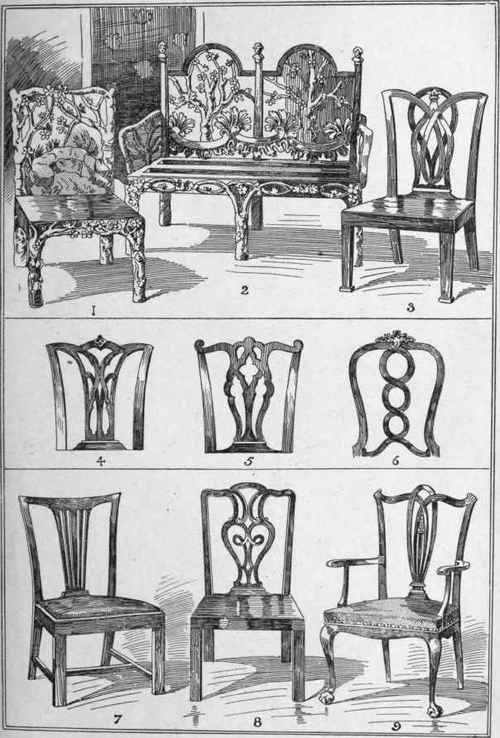
Reference In Text
Page | |||||
Figs. | 1, | 2. | See | 209 | |
" | 3-5. | " | 203, | 209 | |
Page | |||
Fig. | 6. | See | 202 |
" | 7-9. | " | 203 |
In fulfilment of my promise, given earlier in the chapter, to refer to eighteenth-century books other than those of Chippendale, Heppelwhite, and Sheraton, the following is a list which will, I am sure, be welcomed by a very large number of students. I may point out, too, that nearly all of them are to be found in the National Art Library at South Kensington.
"The Gentlemen's or Builder's Companion, containing variety of usefull Designs for Doors, Gateways, Peers, Pavilions, Temples, Chimney Pieces, Slab Tables, Pier Glasses, or Tabernacle Frames, Ceiling Pieces, etc." By William Jones, Architect. Published 1739. This contains a strange mixture of designs, from dignified architectural schemes of the heavy "Classic" order to caricatures of "Louis-Quinze" and "Louis-Seize " pier-tables; together with a series of "Classic" mantels that are truly terrible. There are one or two mantels of a better type which may almost be regarded as early heralds of the coming of the "Adam" style; while some of the mirror frames shown are on the lines of that illustrated on page 89 of this book.
"Some Designs of Mr. Inigo Jones and Mr. William Kent." Published 1744. "Classic" mantels of the Palladian School; some attempts at designing on "Louis-Quatorze" lines - embracing an arm-chair, vases, urns, candle stands, dish covers, and ceilings; and a telling (!) illustration of "Merlin's Cave in the Royal Gardens at Richmond."
"A New Book of Ornaments, with Twelve Leaves" - it may be well to explain that it is the book which has the "twelve leaves" - "consisting of Chimney Sconces, Tables, Spandle Pannels, Spring Clock Cases, and Stands." By M. Lock and H. Copland. Published 1752. Extreme Rococo throughout.
"A New Book of Ornaments." By Angelo Rosis, Florentine. Published 1753. Vigorous and florid Italian schemes for the interior decorator. Plump cupids, "feather-bed" clouds, heavy festoons and "swags," caryatides, atlantes, and the like.
"A New Book of Chinese Designs, calculated to improve the Present Taste, consisting of Figures, Buildings, and Furniture, Landskips, Birds, Beasts, Flowers, and Ornaments, etc." By Edwards and Darly. Published 1754. As this book appeared in the same year as Chippendale's, it is impossible to say which appropriated ideas from which, but there is certainly a remarkably strong resemblance between many of the "Chinese" conceits put forward by Messrs. Edwards and Darly and a number of those which appeared in "The Gentleman's and Cabinet Maker's Director." Some of the lattices in particular are almost identical.
"A New Drawing Book of Ornaments, Shields, Compartments, Masks, etc." By M. Lock. Published about 1660-1670. Extreme Rococo.
Continue to:


My Books

