


Queen-Anne. Part 4
Description
This section is from the book "Style In Furniture", by R. Davis Benn. Also available from Amazon: Style In Furniture.
Queen-Anne. Part 4
One of the first features that it is desirable to regard carefully, before deciding the question whether any chair is to be classed under this particular heading, is the leg; for by the introduction of the "Queen-Anne" - I must employ that title, as it has for so long met with general acceptance - the form of that structural detail was entirely changed from that which it had previously taken. Formerly, as I have pointed out, the chair-seat was, as a rule, supported by perfectly upright members, either turned, "square," or otherwise rectangular in plan - a rule, the following of which helped to give a distinctive character to the "Jacobean" type; but at the period at which we have now arrived, that rule obtained no longer. The interpreters of the new style would have none of it, but substituted a shaped member which was then, as now, designated the "cabriole." Of these there are many slight variations in form, but all resemble one another very closely in the essential particular, the differences subsisting simply in the degree of subtlety on the one hand, or boldness on the other, of the shaping. That presented in Fig. 4, Plate I., may be regarded as a standard, and thoroughly characteristic, model. To trace the "cabriole" back to its earliest origin, which, in the opinion of some, is to be found in the animal leg and claw of the "Classic," is a lengthy task which need not be undertaken here; neither is it necessary for us to go deeply into the philological derivations of the name; but I may point out that, just as we appropriated the form from the "Flemish" or "Dutch," so the originators of those groups of styles, in their turn, were indebted for it to the French. By way of illustrating this point, I have introduced Fig. 7, Plate I., a "Louis-Quatorze" model, in the legs of which may be noted one of the earlier developments of the "cabriole," which certainly grew in grace as years rolled on. But to return to Fig. 4. The back is more than a little reminiscent of the "Jacobean" "slat back" (of which an example is shown on Plate IV. "Elizabethan"), though the slender turning which is introduced and the framing-in of the "slats," again reveal the foreign influence. In the first place, then, the "cabriole" leg must be noted as a thoroughly distinctive feature, to be encountered throughout the style; and it now behoves us to study the most typical of the variations of that form which we are likely to find in the course of our investigations.
"Queen-Anne." V. Plate 26
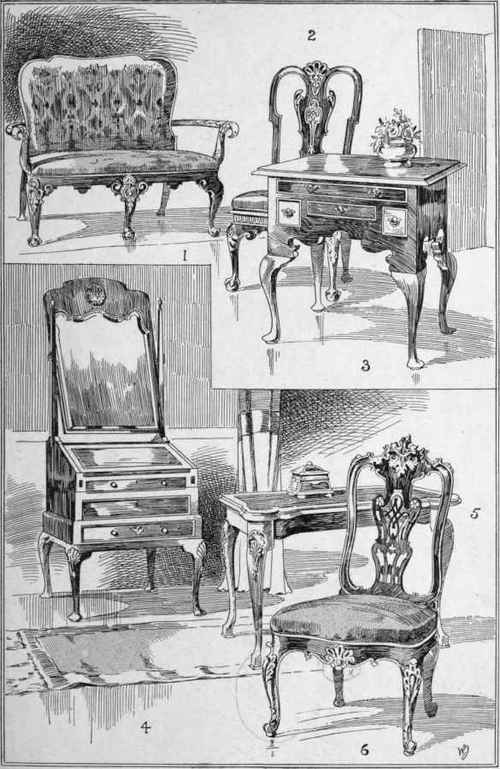
Reference In Text
Page | ||||
Fig. | 1. | See | 78, | 84 |
" | 2. | " | 78 | |
" | 3. | " | 85 | |
Page | ||||
Fig. | 4. | See | 86 | |
" | 5. | " | 85 | |
" | 6. | " | 78, | 81 |
In Fig. 1, Plate I., we see the shorter "cabriole " so adapted to answer the requirements of the couch, sofa, or any low seat. Here the proportions are altered, and the whole member becomes heavier in appearance, but even thus it is not without a certain amount of grace of line. This rendering of it is not only to be found in chairs and seats, but is often introduced into cabinet work in cases where the "carcase " is raised from the ground, but not to the same height as is the average chair seat (see Fig. 6, Plate I., and Fig. 5, Plate III.). In tables, again, where the length of the leg is always greater than that of the chair, the "cabriole" is elongated, as in Fig. 2, Plate I.; Fig. 5, Plate II.; Fig. 4, Plate III.; and Fig. 6, Plate IV. In these cases the proportions of the support are generally much lighter, and the curves far more subtle and often more graceful. If a chair which is "Queen-Anne" in character be found with straight legs, as in Fig. 6, Plate II., and Fig. 1, Plate III., we may be certain either that it is a very early example, or that it is more Flemish than English in origin. Where the straight-turned legs appear they are usually accompanied by under-framing, as in the two examples specified; and the same feature also occurs, but not invariably, in connection with the "cabriole" leg (see Figs. 1, 3, 4, Plate I.; Fig. 3, Plate II.; and Fig. 5, Plate IV.), consisting of slender, simple turning, interrupted by "squares" where the joints occur.
The "cabriole," as employed in the "Queen-Anne," is often, and more frequently in the less expensive models, perfectly free from enrichment of any kind, the shaping alone being relied on for effect (see Figs, 1 and 4, Plate I.; Fig. 3, Plate II., and other examples) but the temptation to "touch it up a bit" here and there was altogether too strong to be resisted by the carver, who soon commenced to exercise his chisel upon it. He proceeded carefully at first, and contented himself by making the curve at the top of the leg terminate in a simple scroll, and imparting to the toe somewhat of the semblance of an animal's paw. But this did not satisfy him. The top was further enriched by an indication of the Dutch "shell," and the members of the paw became more distinct, as in Fig. 6, Plate III. Sometimes the "shell" itself, in its entirety, was carved boldly on the " knee," as in Fig. 4, Plate V. The thin end of the wedge - or I should rather say "of the chisel" - having thus been duly inserted, further elaboration naturally followed, till the "knees" became as ornate as in Fig. 6, Plate I.; Figs. 1, 2, and 4, Plate II.; Fig. 2, Plate III.; Figs. 3 and 4, Plate IV.; and Figs. 1, 2, and 6, Plate V. The claws, also, of the paw, instead of being drawn in and resting on the floor, were made to grip a ball or small sphere of wood, as in Figs. 2, 5, and 6, Plate I.; Fig. 2, Plate II.; Fig. 4, Plate IV.; and Figs. 1 and 2, Plate V. Occasionally the shape of the paw was omitted altogether, the leg terminating at the toe in a scroll more or less enriched, as in Fig. 3, Plate IV.; and in Fig. 6, Plate V., the scroll usually being raised very slightly from the floor by a small block or "cushion" of wood, as shown. There is one example among those presented which almost suggests to one's mind the idea that a late, straight-legged "Jacobean" type, jealous of the capers cut - "cabriole" is French for "caper" - by its newly-imported rivals, determined to put its own " best leg foremost" in order to see what it could achieve in the same direction. The attempt was praiseworthy, but the results were slight, as Fig. 3, Plate III., will testify. Still, the effect was by no means ungraceful; and this leg, in its entirety, should be most carefully noted, as it is very often found at this period. It certainly does convey some suggestion of the "cabriole," but it is far less costly to produce, and so was greatly used in the cheaper class of furniture of the day. The carved enrichment on the table in question is, I need hardly say, unqualified and most typical "Jacobean." Later developments of the "cabriole," as it appeared when it was taken in hand by Thomas Chippendale, will be dealt with in the chapter devoted to the designs of that old master; but, in the meantime, the reader may compare the legs specified below:
"Queen-Anne." VI. Plate 27
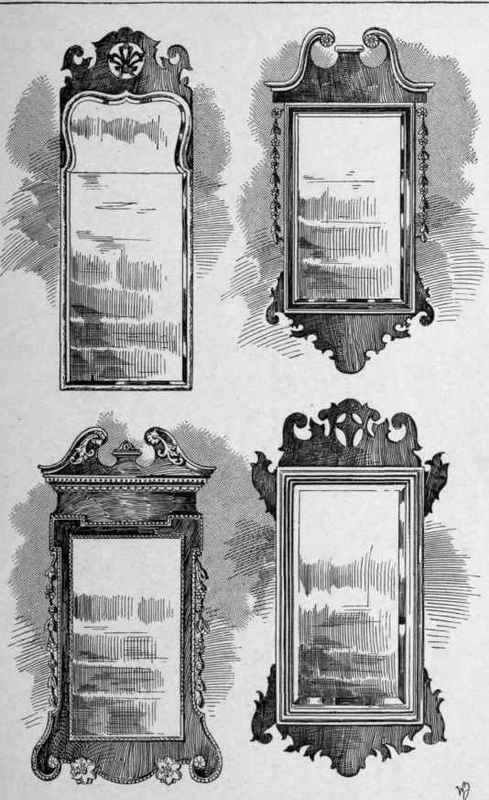
Reference in Text. See page 89 "Queen- Anne." Fig. 3, Plate I. " 3, " II " 3, " IV "Chippendale:' Lower chair, Plate I. Upper „ „ VI. » »» " " " " III Lower „ „ „ and a number of others.
So general did the employment of the "cabriole" form become that it even found its way into the kitchen dresser, as may be seen by reference to illustration on following page. I must point out, however, in reference to such old dressers as these, that, in most cases, the apartments in which they found a place were really the living rooms of the home, and were not for the use of servants only. Then, the housewife was proud to devote personal care to the cleanliness and protection of her plates and dishes, and was naturally desirous that an asylum as tasteful as possible should be provided for their reception.
Continue to:


My Books

