


The Louis-Seize. Part 3
Description
This section is from the book "Style In Furniture", by R. Davis Benn. Also available from Amazon: Style In Furniture.
The Louis-Seize. Part 3
This, and much more in a similar vein, was what there was to be symbolised, and it is this which accounts for the presence, indeed the predominance, in "Louis-Seize" decoration of almost every imaginable symbol and emblem that could suggest to the mind in the most delightful manner the cultivation of the arts of peace, and, to a still greater extent, the pursuit of pleasure rather than the suggestion of strife, conflict, and conquest. The spirit pervading the court was indeed caught and crystallised, if I may so express it, by the disciples of Watteau and Boucher; a spirit of dolce far niente, delightful enough to enjoy where circumstances will permit its indulgence, but which, under the social conditions prevailing in France at the time, could not but lead to awful disaster.
"Louis-Seize." IV. Plate 78
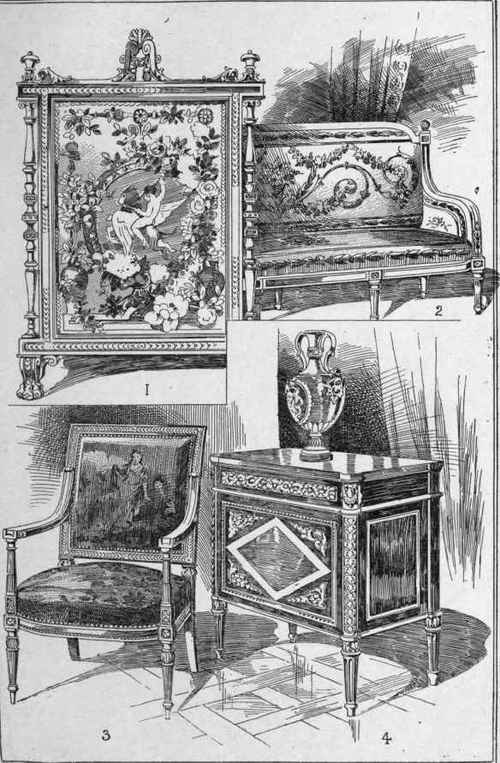
Reference in Text. See page 262
The foregoing remarks will make it clear that the transition from the "Louis-Quinze" to the "Louis-Seize" was not by any means a sudden one. The development was gradual. Determined as were the pioneers of the latter to bring about the existence of a completely new order of things, they were compelled to work in accordance with existing conditions, and saw clearly that an accomplishment of the complete change they had in view was a task whose execution must of necessity be a matter of time. At the death of Louis the Fifteenth, and when his successor came to the throne, most of the royal palaces were completely furnished and decorated, as we should naturally expect to find them, in the style popular during the preceding reign; and, before any appreciable change could be effected, much of that which was already in existence had to be done away with in order to make room for the practical demonstration of the ideas that were germinating. That was not to be accomplished in a single day, or even in a single year. To this time we find in one room, in many of the old palaces and chateaux, decoration and furnishing which show the characteristics of two or more distinct styles, indicating either that the means were not forthcoming to do away with the old altogether and replace it by the new, or that the old was regarded with sufficient veneration and admiration to preserve it from banishment. At the inception of almost every fresh style, the old and the new were, for a time, wedded in precisely the same way, one with the other; though one was "dying hard," as it were, and the other was barely yet possessed of sufficient independent and individual strength to stand alone. Minor details, novel in character, were grafted on to already existent and familiar constructive forms; slight indications of change at first, but growing aggressive by degrees, until the forms themselves were superseded, and others more in keeping with the taste of the times took their place.
In planning this review of the styles included in my scheme, I was forced to recognise the fact that to deal fully, in the space at my disposal, with every period of transition was out of the question; to follow such a course would necessitate the publication of many bulky volumes. Considering, then, what would be the best plan to adopt, I determined to deal, in the main, with each style at its fullest development, and to discuss the individual peculiarities of every one; feeling that then the recognition of transitional examples would involve but small difficulty. When we are familiar with the characteristic types of all the distinct styles, it is a very simple matter to distinguish when the decline of one set in and the birth of another took place, and, consequently, to classify correctly the somewhat hybrid productions that belonged to intervening periods.
I must now turn once again from mere generalisation to the more immediate discussion of the particular types I have selected for illustration, in order to make clear to the reader in what respect the "Louis-Seize" was really the foundation of much which was best in our own "Heppelwhite" and "Sheraton." In the first place, we may set ourselves to note the radical changes which were brought about in the .general forms of the furniture that drove the Rococo from its position of pre-eminence, and for a time completely took its place. Here we find a revolution indeed. While " Louis-Quinze" ornamentation, even at the best, was to a very large extent constructive - i.e. usurped the place of that which should have been construction pure and simple - that of the true "Louis-Seize" never, in any circumstances, transgressed beyond what were its legitimate limitations. It was designed entirely for, and regarded solely as, an enrichment for a foundation, or basis, already provided by the cabinet maker or chair maker for the carver, inlayer, or painter to beautify. This is a most important point for the student to bear in mind. In this style we have no longer to deal with a multitude of curves in the shaping, or an abundance of coquillage, apparently of the most fragile and unreliable description, and ostensibly serving to support weighty superstructures - a task for which, both in reality and appearance, they were utterly unfitted. In their place we have sensible, straightforward, honest construction, conveying every suggestion of stability, though, at the same time, light and graceful in proportion; satisfying to the eye, and altogether free from the suspicion of impending and imminent collapse, which is so often associated with the creations of the preceding mode. It may be true that, so far as form was concerned, novelty was consequently, in this way, constantly sacrificed to good taste; but novelty is not to be looked upon as "the be-all and end-all of our strange existence upon earth," and when it is attained at the expense of stability on the one hand, and good taste on the other, as so frequently is the case even to-day, the less we have of it the better. It is impossible to emphasise this point too strongly if the most distinctive features of the two styles are to be properly appreciated; and the student must thoroughly grasp the fact that while, in the one place, the "Louis-Quinze" designer was perpetually striving to make his decoration constructional, the great aim in the "Louis-Seize" was to decorate construction.
"Louis-Seize." V. Plate 79
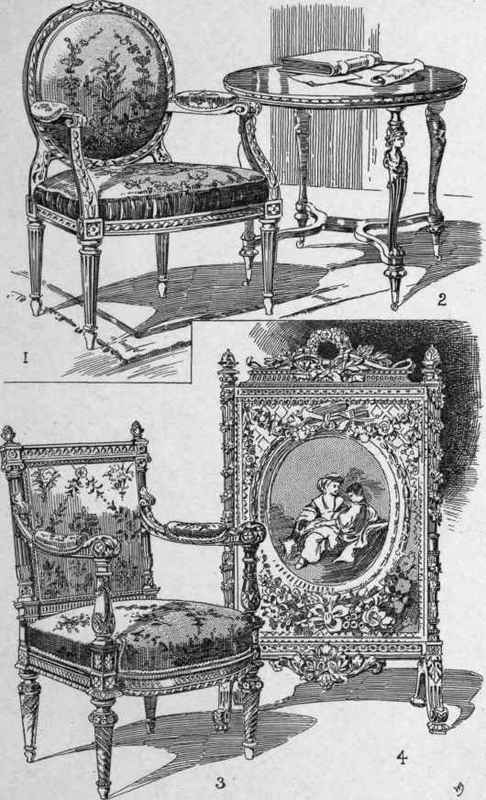
Reference in Text. See pages 262, 263
Continue to:


My Books

