


The New Art In France. Part 5
Description
This section is from the book "Style In Furniture", by R. Davis Benn. Also available from Amazon: Style In Furniture.
The New Art In France. Part 5
With all this present in our mind, it will readily be understood that the cultivation of "Applied," as distinct from "Fine," art is very far from being a simple matter; and that the life of its disciples is " not a happy one"; or if it should chance to be so, what happiness there is in it is not attained without protracted and conscientious labour and study; nor is it unmixed with anxiety and disappointment, even in the end. Even with artists of the greatest skill, ideas which appear to be practicable enough as finished designs on paper positively refuse to be "worked-out" in their entirety, with the result that modifications have to be made here and there, often necessitating the sacrifice of the most cherished features, and the consequent loss of much of their special character. Various details cannot be allowed, because their retention would, says the manufacturer, "cost too much"; they may not be "the sort of thing the public wants"; certain colours, upon which the entire beauty of the general effect would depend, cannot be produced in the particular material to be employed; or, if everything else be absolutely right and in order, the expenditure of many months' thought and labour may be, and indeed often is, brought to nought by a flaw in material, the over-heating of a kiln, the letting-out of a furnace, or some other unlooked-for and utterly unexpected contretemps. I have gone into these mattery at some length, for, as will presently become apparent, in considering the principles and practice of the "New Art" from the strictly critical point of view, it was quite impossible to avoid doing so if the subject is to be discussed with any measure of thoroughness.
How were these French art reformers situated, then, after all? They would not be bound by the vexatious conditions and restrictions inevitably involved by following any particular traditions, styles, or phases of taste except their own; they would be free, obeying no laws except those of Nature; and, as we shall presently discover, they were quite prepared, on occasion, to take considerable liberties with even those. Under these circumstances what occurred at the outset was inevitable. Having broken all the laws by which they had previously been restrained, and having completely thrown aside all their fetters, or rather fondly imagining that they had done so, they hied them away from the haunts and purlieus of towns and cities, leaving behind them all the old associations of urban life, with its bricks and mortar, to revel in the glorious freshness of the country - the very Temple of Nature herself, with its virgin wealth of unexplored treasures. The joy attendant upon their newly-acquired liberty proved altogether too much at first for brains so long unaccustomed to such an experience. Their mental balance was disturbed; the mistake of over-indulgence was committed; and, at the beginning, freedom was sadly abused. Liberty led to licence, and the abuse of licence brought about the existence of a condition of affairs that can only be described as absolutely chaotic. Sketch-books were filled with a multitude of studies of natural growths, forms, and colourings. The wildest and most fantastic imaginings, based upon them, were conceived and transferred to paper; imaginings which, it was fondly hoped, would startle the whole of the civilised world, and charm by their beauty, boldness of conception, and striking originality, when they grew into lasting and tangible form under the skilled hands of the craftsman, with his many and varied materials, and innumerable facilities for manipulation and transformation at his command. But here came the first command to "halt." Conditions and restrictions imposed by taste and style might be cast to the winds with impunity, without any one but those indulging in such a liberty either suffering, or reaping any benefit, thereby; and cast to the winds they were. But when it came to attempting to ignore the hard-and-fast technical conditions and restrictions inseparable from many processes of manufacture - processes of manufacture, it must be understood, upon which these enthusiasts absolutely depended for the practical interpretation of their ideas - where was the free, perfect, and unfettered liberty? It was found to be non-existent. Difficulties presented themselves at every step, and many of them proved to be altogether insurmountable, although there was a vast deal of kicking against the pricks, and the most ingenious expedients were tried to circumvent them, in order that the new school might be entirely free from all suspicion of convention. The attainment of that happy state defied the wit of man; and, in the end - not, however, until after an exceptionally severe struggle - some measure of resignation and obedience to the dictates of the inevitable had to be exercised, though it was almost invariably accompanied by a most emphatic and unmistakable protest.
When they stated their intention to follow Nature, and to obey Nature's laws alone, these artists, though really meaning to carry out their programme, quite neglected to bear in mind the important fact, that natural growths and forms, wondrously beautiful, and indeed incomparable, as they are amid their own proper surroundings, in the field, garden, meadow, and woodland; clothing the hills, and filling the valleys with verdure; were never intended, and are absolutely unfitted, for the performance of the thousand-and-one duties associated with the furnishings of the modern home. Primitive man might be, indeed had to be, content with the service of a tree-stump for a table, a log for a seat, the shells of nuts or rinds of fruit for his cooking and feeding utensils, and Mother Earth for his couch; but we are primitive man no longer. With every generation since Eve rejoiced over the advent of her firstborn, fresh needs, or supposed needs, have arisen or have been created. From the very first moment when man, as a "thinking animal," discovered that he was endowed with the inventive faculty, it has been his desire and endeavour to satisfy those needs, finding, as he has always done, that Nature makes but scant provision for them on her own account, preferring to leave the supply to the ingenuity of her children. It must be recognised that an overwhelming preponderance of those needs has been simply an accompaniment of advances in civilisation by which they have been created; they were never experienced, nor dreamed of, by man in his original and natural state; they are essentially artificial, and must, therefore, be provided for by artificial means. Nature supplied furnishings for the cave-dwellings of pre-historic periods - though even they had to be cut and hewn by mortal beings, and fulfilled fairly well the modest requirements of those days; but if she were looked to nowadays to fit out even the humblest cottage in the least pretentious manner imaginable, her resources would indeed be found sadly at fault. No. She provides the materials with a free and generous hand; the power to fashion them to our will is ours to a very great degree, and we are left to do with them the best that we are able. Nature will do many things, but design or provide our furniture ready-made for us she will not; neither need we look to her for models that will serve as object-lessons to show us how that task is to be accomplished, unless we are content to return to primeval ways of living, and to sacrifice many of the actual necessaries and nearly all the luxuries of modern life. Those who are prepared to do this are, of course, absolutely at liberty to do so, if they can find a place sufficiently far removed from civilisation to permit of it; and no one will say them "nay." Let them, by all means, if such be their inclination, look to Nature for instruction in the art of furniture designing, and return actually to first principles; but they must not expect every one else to share their tastes and opinions.
"New Art" (French). I. Plate 88
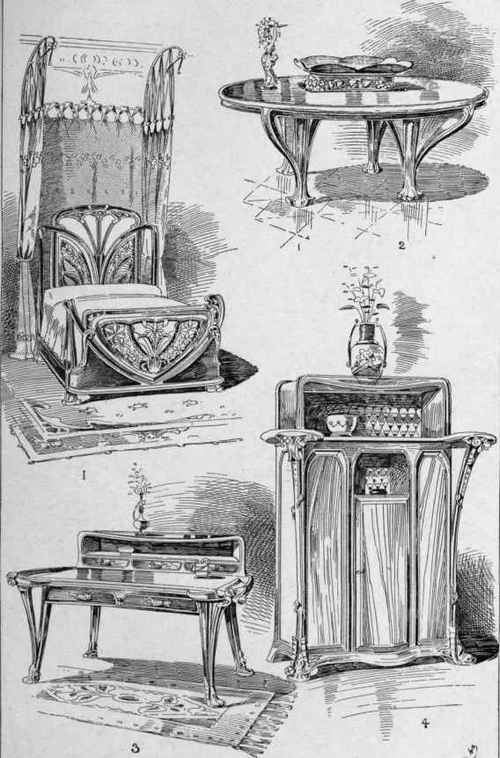
Reference in Text. See pages 302, 303
Continue to:


My Books

