


Gas-Pipes And Gas-Fixtures. Continued
Description
This section is from the book "The Care Of A House", by T. M. Clark. Also available from Amazon: The Care Of A House.
Gas-Pipes And Gas-Fixtures. Continued
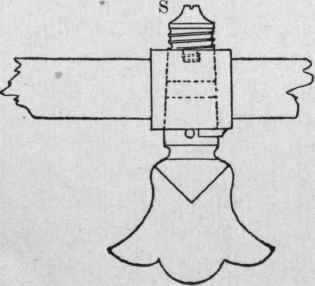
Fig. 30.
Leaks in fixtures.
Gas-keys.
The joints of swing gas-brackets are made with a tapered plug and spring in the same way; and, as these are not usually subjected to much wear, an occasional tightening of the screw should keep them perfectly tight.
The keys of gas-fixtures are liable to an accident of a very dangerous kind, which should be guarded against. It is obvious that, if the gas is shut off by turning the key so that the hole in the plug is at right angles with the bore of the fixture, it may be let on again by continuing to turn the key in the same direction. It is difficult to judge in a dark room whether the key is left exactly at right angles with the pipe or not, and in order to stop it at the proper point o a peg is inserted in the tapering plug, which strikes against a shoulder on the fixture when the key is turned to the desired angle, and prevents it from going farther. In most cases this peg is nothing but a bit of wire, inserted in a hole drilled for it, and it often falls out, or is knocked out by rough handling of the key, removing the only safeguard against turning the key too far, and thus letting the gas on again, after turning it off. As the light is, of course, extinguished by turning the gas off, that which escapes when it is let on again by turning the key too far passes unburned into the room, rapidly poisoning the atmosphere. Hundreds of people have been killed in this way, particularly in hotel rooms, where the peg of the gas-fixture, in consequence of the rough handling to which hotel furniture generally is subject, has fallen out, so that strangers turning off the gas, expecting to feel the key stopped at the proper point by the peg, and unable in the darkness to see whether it is at the proper angle, have turned it on again, to perish later in their sleep through the slow diffusion of the poison in the room. Some fixtures are made with a solid projection, which cannot be knocked off, instead of a peg; but this adds a few cents to the cost of the key, and it is not likely to be found on fixtures unless specially required. In ordinary fixtures, if the peg is found to have fallen out, so that the key can be turned beyond its proper angle, a bit of wire of the proper size can be driven into the hole, or a small screw firmly inserted. Either of these will make the fixture safe.
Joints in fixtures, other than at keys, often leak slightly. Such leaks can generally be stopped, at least temporarily, by an application of soap. Any hard soap will answer, and it is usually sufficient to put a little around the place where the smell of gas indicates a leak, and work it into the joint with the fingers. In course of time the soap dries and crumbles away, but a fresh application is easily made. Even keys, if they cannot be kept from leaking except by making them inconveniently tight by means of the screw, may often be advantageously treated with soap in the same way.
Gas-fixtures should be well cared for, as the charge for taking them down, after they have become dingy, refinishing them, and putting them up again, is apt to be extortionate, sometimes exceeding the original price of the fixtures. Except the very costly specimens plated with pure gold, nearly all gas-fixtures are made of brass, covered with shellac varnish, to keep it from oxidation. The brass is finished in a variety of ways before lacquering, some fixtures being highly polished, giving what the dealers call a "gold" finish; while others are rubbed with emery cloth to impart to them an "antique" character; the appearance of antiquity being often heightened by touching the crevices and hollows with black varnish, to simulate the accumulated dirt of centuries. Some fixtures are brought to a beautiful blue or purple "steel finish," by means of antimony solution, before lacquering; and others are colored in imitation of bronze, while occasional specimens are painted, in black, blue, red, or other colors to suit particular requirements. Many of the so-called "wrought-iron" gas-fixtures are really of painted brass; but fixtures can be had of true wrought iron, as well as of glass, the latter, however, being simply of pieces of glass, in balls, prisms, Venetian flowers or other forms, strung on brass piping, which is plated with nickel or silver when balls or prisms of clear glass are to be strung upon it. The glass fixtures are beautiful and durable, and also very expensive. The iron ones are very durable, and for some purposes beautiful; but the black color generally put on them does not harmonize with delicate decorations, and they do not often look well painted in other colors; so that the great majority of fixtures are of brass.
Leaky joints.
Care of gas fixtures.
So long as the lacquer remains on the fixtures, to protect them from the air, they do not corrode, but the color gradually changes, and they may acquire an unpleasant appearance from fly-specks; so that the common practice of covering them in summer with netting has something to recommend it. The bronze and steel finished fixtures, being darker, show stains much less; but, when they finally become shabby, they are not so easily restored, as the colored finish must be taken off and renewed.
Where the fixtures are of plain brass, the ingenious householder may save himself a good deal of money, and obtain a tolerably satisfactory result, by rubbing them, after they have become unbearably dingy, with fine emery-cloth, followed, perhaps, by crocus-cloth, to give greater smoothness. This treatment will give only the "antique finish"; but, as the antique finish is fashionable, the experimenter need give himself no anxiety on that account; and he will often find that his fixtures please him better in that condition than when glittering from the buffing-wheel.
After the brass has been cleaned in this way to the satisfaction of the operator, it is desirable to protect the work from the air by a fresh coat of lacquer. Brass finishers usually employ for this purpose a thin shellac varnish; but the brass must be heated before the shellac is applied, to prevent it from "chilling," and forming dull spots; so that, for the amateur, the best lacquer is the celluloid varnish known as "Zapon," which can be used on metal at the ordinary temperature, and may be applied with a brush. If lacquer of any sort is unattainable, the brass may be left without it, but the cleaning will soon have to be repeated; while a coat of good lacquer will preserve the brightness of the metal for years.
Lacquering.
Continue to:


My Books

