


Of The Strain Upon Beams Laid Horizontally
Description
This section is from the book "Elementary Principles Carpentry", by Thomas Tredgold. Also available from Amazon: Elementary Principles Of Carpentry.
Of The Strain Upon Beams Laid Horizontally
44. As the principle of the composition and resolution of forces enables the carpenter to determine the direction of the strains on a beam or combination of beams according to position, the application of the principle of the lever will enable him to ascertain the strains within the beam itself as well as the resistance which it offers to these strains.
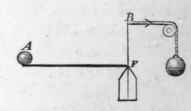
45. Let APB (Fig. 27) represent a lever in which F is a fixed point, usually called the fulcrum, on which it can move freely. To balance the lever on the point F, each arm should be loaded in the inverse ratio of the horizontal distance of the centre of gravity of the load from F; that is to say, the lighter load should be placed on the longer arm, and the heavier load on the shorter arm, and the loads should be so proportioned that the lighter multiplied by the longer arm should be equal to the heavier multiplied by the shorter arm. The results so found are called the moments of the loads or forces about the point F. No difference would be caused in this relation if the lever were bent or cranked, as in Fig. 28, and the force at B, caused by a weight moving over a pulley, or by any other equivalent force whatever. In applying the principle of the lever to determine the strength to beams and girders, the moment of the load is usually called the moment of rupture, and sometimes the bending moment, and that of the forces tending to prevent rupture is called the moment of resistance.
Fig. 27.
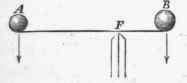
Fig. 28.
46. A beam projecting from a wall (Fig. 29) may be considered as a lever, in which the length A F is one arm, and the depth F B the other arm, the load at A being resisted by the strength of the fibres of the beam between F and B. The moment of rupture M of a beam in this position is therefore W x A F = M; and generally, the moment of rupture at any section C is equal to the load multiplied by the distance of its centre of gravity from that section.
Fig. 29.

Fig. 30.
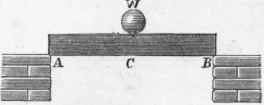
47. If a beam be placed on two supports (Fig. 30) and loaded on the middle, the moments will be the same as in two bent levers meeting at C, the long arms of which are A C and C B, the short arms being the depth of the beam, as in Fig. 29.
It will make the application of the principle of the lever more clear to the reader, if instead of the weight at C we assume that each support presses the beam upwards at A and B with a force equal to half the weight when the centre of gravity of the load is at the middle of the beam; it will then be easily seen that the moment tending to cause rupture at C is equal to half the length of the beam, or A C multiplied by half the load W; or M = WxAB/4
48. When a beam is laid in a horizontal position, as in Fig. 26, and a load is uniformly distributed over its length, or the beam is only loaded by its own weight, the strain upon the beam is the same as if half the weight were acting at its centre of gravity.
But if the weight be distributed over the beam it must be of a yielding nature, otherwise this rule will not hold good. If a strong short beam be laid upon the first beam, and the weight upon that, the strain upon the lower beam would be removed to the points where the ends of the short beam would rest upon the longer one, and the effect of the weight on the longer one would be decreased.
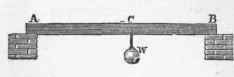
49. When a beam is supported at the ends, as in Fig. 31, the stress arising from any weight, W, produces the greatest strain when it is applied in the middle of the length. When the load is placed at C (Fig. 31) the strain or moment of rupture at that point will be equal to the portion of the weight on either of the points of support (as found by Art. 43) multiplied by the distance of the weight W from that point of support,, or M =WxACXBC/AB
And, if w be the greatest weight the beam would support in the middle, the greatest weight W that it could support at any other point C, will be found by the following proportion:
As the distance A C multiplied by the distance B C, Is to the square of half the length of the beam; So is the weight w, that could be supported in the middle, To the weight W that could be supported at the point C. For if M be the moment caused by the weight w but M1 = M and WxAC/BC/AB = wxAB/4
M1 = w(AB/2)2/AB = w AB/4
Fig. 31.
... Wx ACxBC = w(AB/2)2 ... ACxBC:(AB/2)2::w:W.
From whence it appears, that a beam 20 feet long will bear double the weight, at 3 feet distance from one end, that it would bear in the middle of its length. Consequently the farther a load can be removed from the middle of the beam the better; and when it is necessary to place the stress at or near the middle, it is of great importance to cut the timber as little as possible with mortises at the point where the stress acts, and the piece should be as free as possible from knots in that point.
50. If w be the greatest weight a beam whose length is L .will support in the middle, and the beam be required to support a greater weight W, the maximum distance at which it may be placed from the ends of the beam is
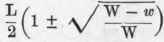
= the distance of the point C from the ends. The positive sign gives the distance from one end, and the negative sign gives the distance from the other end. For we have (Art. 49) w/W = ACxBC/(L/2)2 =(L-BC)xBC/(L/2)2
BCxL-BC2 = (L/2-BC)2xw/W-(L/2-BC)2 =(L/2)2x(w/W-1)

51. The moment produced in any point C of a beam by a load W placed half way between the supports (Fig. 32) is equal to one-half of the weight multiplied by the distance B C from the nearest pier, i. e.
M =WxBC/2
52. If the load W be removed to C (Fig. 32), the moment of rupture at any other point A' will be equal to the weight multiplied by its distance from the pier B and by the distance of the point A' from the other pier A, and divided by the total length of the beam, or
M=WxCBxAA'/AB 53. The moment at any point arising from two or more weights placed on a beam supported at both ends is equal to the sum of the moments in that point found for each weight separately. (Art. 52.)
Continue to:


My Books

