


Flower Stands, Vases, Etc. Continued
Description
This section is from the book "Rustic Carpentry", by Paul N. Hasluck. Also available from Amazon: Rustic Carpentry: Woodworking with Natural Timber.
Flower Stands, Vases, Etc. Continued
Fig. 30. - Large Hexagonal Vase.
Fig. 29 shows a square vase constructed from elm boards l 1/4 in. thick. A fair size for the sides will be 1 ft. 8 in. at the top and 1 ft. 5 in. at the base by 2 ft. high, including the 2 1/2-in. plinth. The split twigs forming the decoration are 11/2 in. wide, and spaced about 2 in. apart edge to edge. The vase shown by Fig. 30 is hexagonal in shape, the sides being 1 ft. 8 in. high by 1 ft. 2 in. wide at the top edge, and 1 ft. Oh in. at the base. The sides and bottom of both vases are connected as in Figs. 21 and 22. Five 1-in. holes are bored for drainage. The short feet having been secured with screws driven from the inside, the split rustic work is bradded on in the same order as that described for Fig. 20.

Fig. 31. - Large Plant Vase with Claw Foot.
The stands and vases should be given two coats of oil varnish, allowing the first coat to dry before applying the second.
A big plant vase made from half a paraffin cask is illustrated by Fig. 31. An ordinary 40-gal. cask stands, roughly, some 3 ft. high, has a diameter of some 2 ft., and is made of good stout oak. Sawn through the middle, the paraffin barrel makes two admirable tubs. One such half is shown in Fig. 31. This it is proposed to render suitable for some large bushy plant, so it will have to be mounted on legs. The legs shown are simply so many pieces cut from rough branches. From a heap of stuff one can generally choose pieces sufficiently adapted to the purpose, though their exact contours will, of course, vary. Oak branches, technically known as "bangles," from which the bark has been taken to make tan, will do well; or if the bark is liked, apple-tree or elm boughs will be suitable. That these sticks should be rough and gnarled and knotted adds to their effect. As the tub will be only partly covered with rustic mosaic work, it will be well before nailing anything upon it to paint it. A good dark brown or chocolate will go well with the natural bark. The rustic pieces will have to be cut through with the saw, the lengths being too great to be safely split with the hatchet - that is, with the exception of those round the lip, which are of thicker rod than the zig-zags; say, 1 1/2 in. as compared with 1 in. In the zig-zags the light central strip is supposed to be of peeled withy, the darker ones on each side having the bark on, and being probably of hazel. Generally speaking, wrought brads are to be recommended for fixing rustic mosaic, but where, as in the present case, the strips have to be bent over a curved surface, small wire nails will be found more secure. Groups of fir cones, as shown, will prettily ornament the triangular spaces.

Fig. 32. - Foot of Rustic Table.

Fig. 33. - Garden Plant Tub.
A style of foot suitable for a one-leg flower stand or table is illustrated in plan and part section by Fig. 32.
Fig. 33 shows the other half of the cask arranged for, say, a dwarf shrub, an orange-tree, or the like. In small town or suburban premises, such tubs are specially useful where there is a back court into which anything green cannot otherwise be introduced. In this, it will be seen that by way of variety the tops of the staves have been sawn to a zig-zag line, which is followed a little below by a moulding of split rods. Alternative styles of moulding are shown by Figs. 34 and 35. Half-way between this and the bottom a band of mosaic is arranged in light and dark strips of withy and hazel. The bits filling the diamond-shaped centres of this pattern are cut from thicker stuff than the rest, so that they may project as bosses beyond the general level. Over the unavoidable iron hoop at bottom, from which place short strips would, if nailed, be often detached, a rough "dry-cask" wooden hoop has been fixed. At the sides two pieces of rough branch stuff have been placed to serve as handles, and to resist strain these should be secured from within by strong screws.

Figs. 34 and 35. - Alternative Mouldings.

Fig. 36. - Ornamental Plant Vase.
The vase shown by Fig. 36 is intended for a somewhat low-growing flowering plant - say, a large bushy geranium. In its original character it is an American lard pail. As in the last tub, the staves have been sawn to a more ornamental outline, and they have also been perforated. The ornamental strips of split rod have been arranged in straight vertical lines, to avoid the difficulty of bending and keeping them in place if bent round so small a vessel. The bottom of the pail is screwed down to an octagonal slab of wood, to the under side of which four short bits of rough bough are nailed as feet. As neither this nor the last tub is wholly covered with mosaic, they should, of course, first be painted. The slab at bottom will look very well rough, as shown, but if painted it will be improved by strips of split rod nailed round its edges.
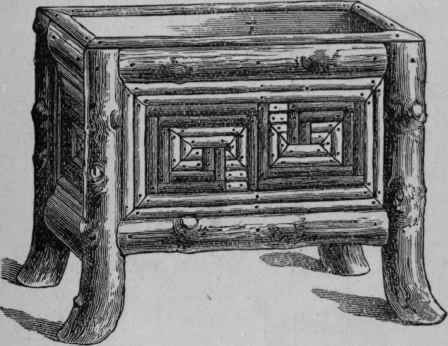
Fig. 37. - Rectangular Garden Plant Stand.
A garden plant stand, made from a soap box and mounted on legs is shown by Fig. 37. The easiest way to fix one of these legs on is to saw the piece of stuff in half to a distance from the top equal to the depth of the box, and then to cross-cut and remove one half. The corner of the box will be c brought to the middle of the cross-cut, and the leg nailed on to the side of the box. The piece which has been sawn off will then be cut through (quartered), and the proper quarter replaced and nailed to the end of the box. Frets, such as those shown in these two examples, are patterns of a kind well adapted to be worked out in rustic mosaic.

Fig. 38.
Fig. 39.
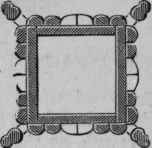
Fig. 40.
Figs. 38 to 40. - Elevation, Section, and Horizontal Section of Rustic Pedestal.
A pedestal for a sundial or flower vase is shown by Figs. 38 to 40. It is a box of 1-in. elm boards, the top being a 2-in. thick slab.
Suitable dimensions are 3 ft. 6 in. high, and 1 ft. square, the top being 16 in. square.
A design for a rustic flower-pot stand in imitation of bamboo is represented by Fig. 41. The height should be about 2 ft. 6 in. to the top, and the length from 3 ft. to 3 ft. 6 in. The box at the top may be about 9 in. wide and 8 in. deep. Care must be taken when putting the work together to get the frames true and square. Slovenliness in construction will completely spoil the appearance of the finished article. The box at the top is made to fit inside, and should be lined with a zinc tray. The outside may be covered with glue and brown sawdust.
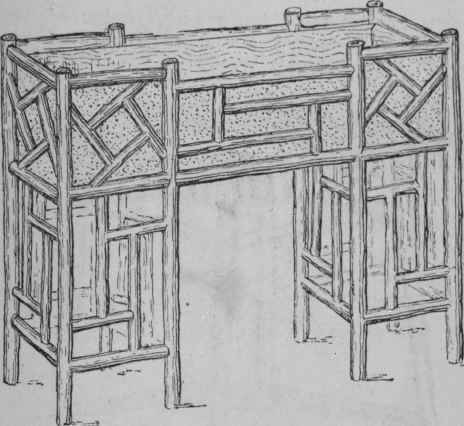
Fig. 41. - Rustic Flower-pot Stand in Imitation of Bamboo.
Continue to:


My Books

