


French Nails
Description
This section is from the book "Manual Instruction: Woodwork. The English Sloyd", by S. Barter. Also available from Amazon: Manual Instruction: Woodwork.
French Nails
fig. 33. These nails are made of round wire, pointed, and with a large round flat head which projects rather considerably. They are not punched in, but allowed to lie flat on the surface of the wood. These nails, like the steel brads, are very strong and tenacious, but the heads are unsightly, and their use is usually confined to rough, strong work, like packing-case making.
Screws of various kinds are used for very many purposes. They are much too numerous to be touched upon here in detail, except the usual flat and round-headed wood screws - the only kinds required for a woodwork manual training room.
Though the general appearance of screws is familiar, the great assistance of the tapering spiral point in making a first entry into the wood may not be fully realised till compared with the old-fashioned screw, which was blunt, and required great effort to make it enter.
It will be noticed (fig. 34) that the screw is only cut into a 'thread' for about two-thirds its length, as this is all that is really requisite. Further threading would only weaken the lateral strength of the screw.
Round-headed Screws are useful for ornamental purposes, and are usually made of brass. They are used in exposed parts of fine work, where the flat head of the iron screw would mar the appearance of the article.
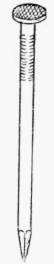
Fig. 33.

Fig. 34.
Continue to:


My Books

