


Rasping Tools. Saws
Description
This section is from the book "Manual Instruction: Woodwork. The English Sloyd", by S. Barter. Also available from Amazon: Manual Instruction: Woodwork.
Rasping Tools. Saws
Saws are used to cut timber both across and with the grain, with the smallest possible amount of waste and the greatest economy of power.
A simple cutting edge, like an axe or a chisel, can only be used across the grain with great exertion; and owing to the fact that these tools cannot, by any possibility, be used at any depth below the surface, without steps being taken to remove the damaged and bent fibres on each side of the cut, in order to make a fresh attack on the timber, great waste of wood arises. Even when, by the agency of a chisel or an axe, a piece of wood is separated across the grain, the ends of the two portions are not by any means level, and will require a great deal more effort and some waste, to render them true and level.
It is clear, therefore, that some instrument is necessary which will make at the commencement a cut wide enough to admit the entire blade, and which can operate at any depth in this cut. The saw fulfils this requirement. A succession of teeth are cut out of the smooth edge of a plate of steel, and, when rubbed across the wood, cut or break the fibres in contact with them, somewhat in the same manner as a file. The waste timber is, of course, pushed along by the succession of teeth, and the small particles of wood are carried out at each end of the cut at every stroke, the saw gradually sinking into the wood in the direction of the planes of its surfaces. The guiding of the tool, in order to ensure a true cut, which is straight in its length, and leaves an even surface on each side when the cut is finished, is clearly an important point, and stability and weight in the saw are also requisite. To meet these requirements saws intended to cut large pieces of timber are long and deep. This evenness of the surface of a saw is so important that the slightest 'buckle' is a serious defect, and if badly crippled in this way the tool is useless, the saw always being liable to double up in use, and never cutting freely.
Each tooth is subject to great strain in its forward movement, the degree of the resisting pressure varying with the density of the material to be cut, the amount of pressure used in sawing, and the speed of the movement.
Now it is clear that the front edge of the saw-tooth, if inclined towards the front of the saw, as in fig. 65, will cut faster than if upright; but these teeth have a weaker base than those with a less acute angle, as in fig. 66, and are, therefore, more liable to break. Moreover, teeth of this kind have a constant tendency in use to sink into the material, clogging the spaces between the teeth with the destroyed fibres of the timber. On the other hand, saws which have teeth like those in fig. 66 are apt to rise out of the wood, and require constant downward pressure to make them cut.
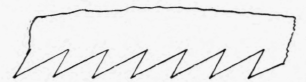
Fig. 65.
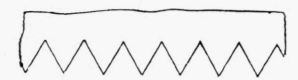
Fig. 66.
On the whole the teeth of all saws for use in cutting with the grain will be found to work best if the front edges are nearly upright, and the backs are inclined to the surface of the timber at a rather smaller angle, as in fig. 67. For sawing hard woods and across the grain, the front edge is still more inclined. The angle of inclination of the back of the teeth is regulated by the degree of stability requisite for them, and by the amount of space necessary between each tooth for the accumulation of the sawdust.
Thus in the ripping saw the teeth are usually like those in fig. 70, for, as this saw cuts faster than any other woodworking saw used by hand, the amount of sawdust made is commensurately greater. In this case, too, the resistance being generally slight, teeth are not wanted so close together as in saws intended for other purposes, where the strain is much greater. Another important characteristic which will be noticed in examining any saw is the lateral bending of each tooth. It will be observed that they alternately project to the right and left, giving a double line of cutting points.
This 'set' to the teeth makes the path of the cut slightly wider than the thickness of the saw, and enables the blade to slide freely, minimising the friction and heat of the sawing. Indeed, if the teeth were not 'set' at all, the resin and other substances in the timber, and the natural pressure of the rough ends of the bent fibres, in their attempt to regain their original position, would, after very little progress had been made, cause an almost complete stoppage in the sawing. There would be great risk of buckling the saw, too, when this difficulty arose.
The wider space obtained by the setting of the teeth for the clearing of the sawdust is another important reason for bending the teeth slightly. The amount of 'set' should not be too great, as the work is unnecessarily increased, and the tendency to deviation from the direct course of the sawing would be greater. Proceeding with the examination of the teeth of the saw, it will be noticed that the front of each tooth is sharpened like a chisel on the outside edge, and the inner corner of the point is thus removed.
Continue to:


My Books

