


An Electrical Paradox
Description
This section is from the book "Handy Man's Workshop And Laboratory", by A. Russell Bond. Also available from Amazon: Handy Man's Workshop And Laboratory.
An Electrical Paradox
With comparatively little apparatus, it is possible, apparently, to set Ohm's law at naught by lighting an ordinary electric light having a considerable resistance, to full incandescence while on a heavy short circuit. All that is required is a medium-size induction coil, giving, say, a four-inch spark, provided with a pair of spark balls, a source of current for it. a glass condenser or Leyden jar of suitable capacity, a miniature incandescent lamp having a resistance of from 5 to 10 ohms, and about a meter (39.37 inches) of heavy bare brass wire.
The brass wire is to be bent into a long U about eight centimeters (3.15 inches) wide, and the ends inserted into an insulating base. The lamp is then to be arranged so that it can be slid to any position between the parallel sides of the U.
If the several parts of the apparatus are now connected as shown in the diagram, and the knife switch is thrown, the usual heavy discharge across the spark gap, due to the energy momentarily stored in the condenser, will take place, and at the same time, the lamp will be found to light up quite as well as if connected to the battery alone. Upon sliding the lamp, the light will be found to become dimmer, while it will grow brighter as the bottom is approached, Indeed, if the lamp is small, it will be well to place it close to the top at first, and then slide it down until full candle-power is reached, otherwise it might be burned out from excessive current. The experiment is particularly striking if the operating apparatus is concealed, and a fairly heavy piece of bare copper wire substituted for the "short circuit." A small gage of wire should then he used for leads for the lamp, for, curiously enough, a fine piece of wire connected across the terminals of the lamp will extinguish it altogether. That is, a small wire conducts this peculiar current with more facility than one of larger diameter.

Fig. 252 - Apparatus for performing the electrical paradox.
The brass wire may he touched without fear of a shock, for while the current which it conducts is of a very high voltage and appreciable amperage, its extremely high frequency renders contact harmless.
Although the fundamental law of electrical engineering has seemingly been defied, really it has only been modified by a factor which does not enter into the computation of ordinary electric currents. From the behavior of the light at different points on the wire, it can be seen that the current shunted through the filament of the lamp is still proportional to a resistance, though obviously of a very different nature. If the effect of various sizes of wire on the current passing through the lamp is studied experimentally it will be found that in general the current is not proportional to the square of the wire, but is more nearly proportional to the diameter. That is to say, this resistance is a matter of perimeter and not of cross-sectional area, and since the current flows over the wire and not through it, hollow wires would conduct as well as solid ones.
The phenomenon is essentially one of impedance, and due to the large inductance which the brass wire offers to alternating currents of this character which have a very small time rate of change.
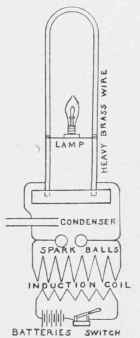
Fig. 253 - Diagram of connections.
Continue to:


My Books

