


How To Cut Wood With Paper
Description
This section is from the book "Handy Man's Workshop And Laboratory", by A. Russell Bond. Also available from Amazon: Handy Man's Workshop And Laboratory.
How To Cut Wood With Paper
A tallow candle bullet can be fired through a board. A straw driven by a cyclone will penetrate a tree. A stream of water, under high pressure, will tear the skin off a man's hand. A copper disk rotating slowly can be cut by a steel cutting tool; but if rotated at high speed it will turn about and cut the tool. These facts suggested the following experiment on the cutting ability of paper. Everyone knows that the hand can be badly cut with paper; but the experiment was undertaken to discover whether hard substances, such as wood, could be cut with paper.
A page of the Scientific American was trimmed to the form of a disk, 10 or 11 inches in diameter, and a wooden spool was glued to the paper at its center. An electric fan was dismantled of its fan and guard and the spool was bored out to fit snugly on the armature shaft. A wood screw with its point blunted was threaded through the spool and against the shaft to fix the disk securely thereon. Then the current was turned on and a pencil was held lightly against the edge of the spinning paper. Although the paper bit into the wood the centrifugal force was not sufficient to hold the paper rigid, and instead of making a clean cut it scratched the wood as if by a file. The fan was making about 2,000 revolutions per minute, but the speed should have been doubled for so thin a paper. Better results were obtained by pasting the paper on a disk of cardboard of smaller diameter, so that the edge of the paper projected half an inch over the periphery of the cardboard. With this a clean cut was made into the wood of the pencil.
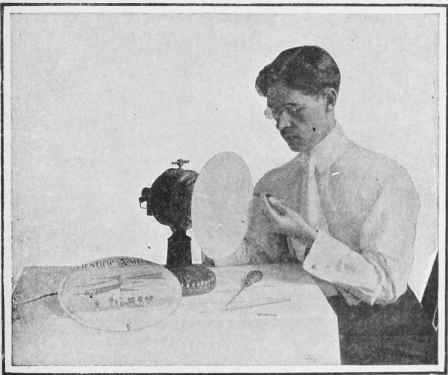
Fig. 180 - Cutting a pencil with a disk of Bristol board.

Fig. 181 - The Scientific American as a cutting tool.
But the best cutter was made out of a sheet of three-ply Bristol board, the kind on which drawings for the Patent Office are commonly prepared. With this stiff paper the pencil was cut into very quickly, and the cut was exceedingly fine and clean. When the lead of the pencil was reached, the progress of the cutter was much slower because the graphite acted as a lubricant. Neither the paper nor the Bristol board showed any material wear with use. Fig. 181 shows the Bristol-board cutter making a cut, while in the foreground is a pencil which has been cut in two by the paper.
Continue to:


My Books

