


17. The Two Copies Of The Manuscript
Description
This section is from the book "Two Years' Course In English Composition", by Charles Lane Hanson. Also available from Amazon: Two Years' Course In English Composition.
17. The Two Copies Of The Manuscript
Although it is important to acquire facility in writing good compositions1 without copying them, for some time you will do well to make two copies of the papers you write outside the classroom.
In preparing the first copy there are two steps:
1. Write rapidly. 2. Revise slowly.
a. See that every paragraph is indented.
b. See that every sentence has a subject and a predicate.
c. See that every sentence is punctuated (I) at the end; (2) throughout.
d. See that every word is correctly spelled.
In making the second copy there are three things to remember: (1) neatness; (2) margins; (3) heading.
Exercises
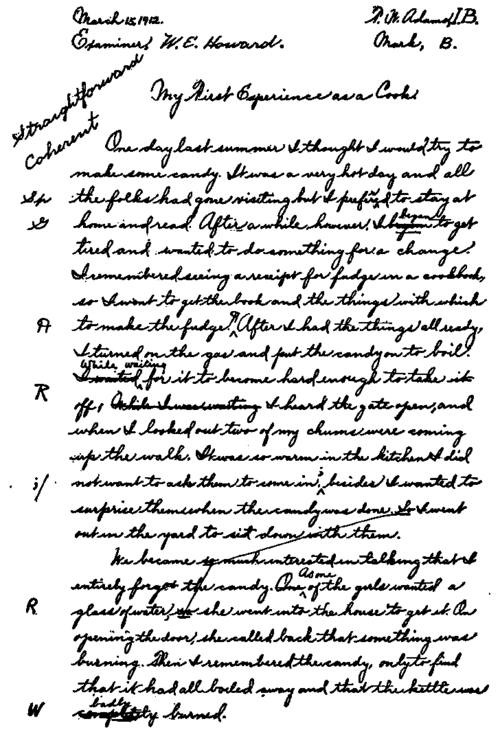
27. Study the model on page 25, and be prepared to explain to the class how to prepare manuscript.
28. Read the corrected paragraphs in the model on page 25 (1) as they stood originally, (2) as they stand now. Explain every criticism and, if possible, give a reason for every correction. (See p. 28).
1A written composition is sometimes called a theme, and both terms will be used in this book.
29. Write a brief account of something you have seen happen. Prepare two copies of the manuscript, as indicated above.
30. In class, exchange papers,1 the second copies prepared in Exercise 29, and, as examiner of the paper of one of your classmates, criticize the work under the following heads: (1) neatness, (2) margins, (3) heading (including wording of title), (4) indention of paragraphs, (5) sentence structure, (6) punctuation, (7) spelling, (8) interest. Write your report and see that each of your sentences has a subject and a predicate. The following form will serve as a model in making your report, and may be used in other exercises of this kind.
Criticism of "A Runaway," by A. F. Brown.
1. The page is neat and attractive.
2. The margins are straight and of the right width.
3. The heading is complete and the title appropriate. No space is left between the title and the opening sentence.
4. Three paragraphs have been made, but I see no reason why there should be more than one paragraph.
5. The fourth sentence has no predicate.
6. There is no punctuation mark at the end of the first sentence.
7. The words "Tuesday" and "village" are misspelled.
8. The story is exciting.2
Mary A. Taft, Examiner.
31. Taking advantage of all the suggestions given by your classmate, revise your paper. If you think best, rewrite it; that is, if, in the judgment of your teacher, interlinear corrections of the original paper are not sufficient.
32. Write about another incident which you have seen. Follow the directions given for preparing the preceding paper.
1 By examining one another's papers - one day passing them forward, another day passing them backward, then to the left, to the right, to the second pupil in front, etc. - the members of the class can be of great service in pointing out certain improvements to one another.
2 See p. 246 for helpful, specific words.
33. In class, exchange papers and act as examiner as before.
34. Revise your paper, and if there is sufficient reason, rewrite it.
Continue to:


My Books

