


The Word - Signs
Description
This section is from the book "Haven's Complete Manual Of Practical Phonography", by Curtis Haven.
The Word - Signs
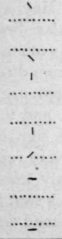
Of To
Or
But
The
On An
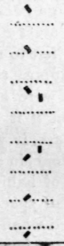
All
Two
Too
Already
Before
Ought
Who
Whom
The above list of word-signs, being entirely arbitrary, students must not expect to find in them any element of previously explained principles - that is, they must neither expect them to agree in position with their vowel sounds nor their outline to be composed of any portion of the consonants of the words they represent, the instances in which previously explained principles will be recognized being very few.
Commit the list of word-signs thoroughly to memory in the manner described for memorizing the Visible Alphabet and repeatedly test your ability to write the proper signs without referring to the list. In the list of word-signs, the signs are placed beneath, on or over dotted lines. These dotted lines must not be mistaken to be a part of any of the signs. The dotted lines are supposed to be the lines of the paper on which one is writing, and are merely placed there, as in the Exercises of these lessons, to show that the same word-sign, in order to represent different words, is sometimes written on, above or under the line, as in the case of the indication of invisible vowels. Thus, students find that, in phonography, words are sometimes denoted by position in the same manner that a vowel sound of a word is generally indicated by the position of a consonant.
No difficulty need be apprehended in regard to deciphering such signs when met with in regular sentences. They will never be mistaken for halved characters, nor for any of the small letters of the Visible Alphabet, which they may seem to resemble, as their uses are entirely different. They are not in same positions when written alone, and when used in sentences words preceding or following them are always perfect keys to them. It is well, however, to explain clearly their particular uses.
In the list of word-signs there is one representing the article the. It is the fifth one of the light outlines presented in the list. Particular attention is called to that sign because it looks like the letter Hay, and because, for that reason, it must always be written in a particular direction, that is, upwards, from left to right. As the outline stands alone in the list, the student may suppose that it does not matter in which direction it is written, and if it were always written alone in actual use it would not matter; but even if it be but occasionally joined and then joined upwards, as is the case, it would be better to write the sign upwards even when written alone, in order to form the habit, for very rapid writing is greatly a matter of habit. And, as it is particularly necessary, both for the purpose of speed and for legibility, that this sign for the be written always joined when possible, it will be understood how important it is at the outset to form the habit of writing the sign for the upward.
The main object, in fact, of all the fifteen word-signs in Haven's Practical Phonography, is to facilitate junctures with each other, forming a principle of phrasing-viz, writing two or more words connectedly without lifting the pen - a principle which means a great deal in point of speed in writing shorthand and can be made an efficient aid to reading one's notes if the simple directions in regard to junctures are carefully observed.
Commencing with sign 1 in Exercise, some three lines of said Exercise will be seen to be devoted to illustrations of how these fifteen word-signs are joined into beautiful little phrases, which, by their brevity, give much speed, and, because of the fact that they look nothing like anything but what they mean, are also an important aid to legibility. By looking carefully at these first three lines of our Exercise, it will be noticed that the word-signs are joined to other characters. For instance, in sign 1, the word-sign for of has the letter a joined to it, the juncture forming the phrase of a. In sign 4 the word he is joined to the word-sign for all, the word he being expressed by the letter Hay, the combination making the phrase all he. In sign 6 and is joined to all, the word and being expressed by the & or Ai of our Visible Alphabet, the phrase thus formed representing all and. In sign 12, the personal pronoun I is joined to the word-sign for or, making the phrase or I.
Thus, by these four instances just noted, we have introduced the four words, I, he, a and and into the phrases, these four words not being needed in any list because a, I and and were given in the Alphabet in Lesson II (Timely Suggestions), and the word he is, of course, naturally spelled with the letter Hay of the alphabet. In the same manner as the word he is spelled, we we can also spell the words we and you, the word we being spelled with the letter Way, and you by either of the signs for U or short-u of the Visible Alphabet, according to whichever of those two signs of U joins easiest. This gives us six words which we can join to these word-signs, and a peculiarity of all six is that they are attachable in any position, those six words when joined taking the position occupied by the other words to which they are joined. This is also the case with the word-sign for an and the word-sign for the of our list, so that those eight words, namely, the conjunction and, the articles a, an and the, and the four pronouns I, he, we and you, should always when possible be joined to other words in the sentences in which they occur, and they may be joined in any position, remember.
In the list of word-signs, the sign for the is placed on the line, and the sign for an is placed under the line, but those positions are intended only for instances where it might be impossible to make a juncture, and where those words would have to be written alone, in which seldom-occurring instances, to read them, it is necessary they should have their own positions. They should always be joined when possible, in which cases position does not need to be observed. Now, while position does not need to be observed in those eight words above-named when joined to other words, yet there are three words whose particular direction of writing must be observed, and these simple rules here given, if observed strictly, will make them always clear in their meaning, where a violation of the rule would cause uncertainty. The three words referred to are the, he and I.
Continue to:


My Books

