


Final Hook For N
Description
This section is from the book "Phonetic Shorthand", by William W. Osgoodby. Also available from Amazon: Phonetic Shorthand.
Final Hook For N
Sec. 16. A small final hook, on the R-hook side of straight stems, and on the inner side of curves, indicates an added N.
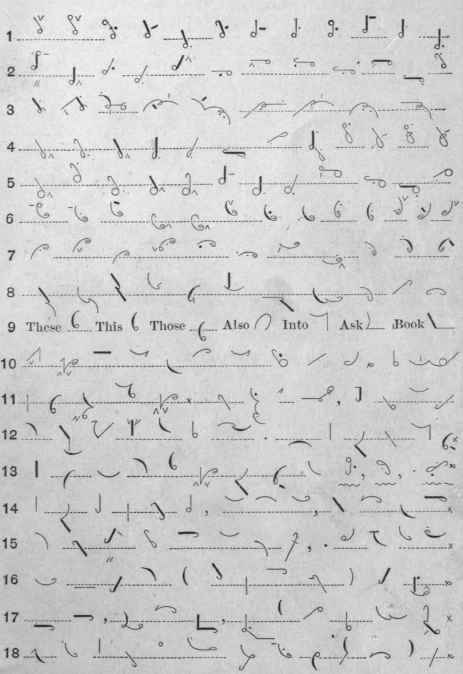
a. The N-hook is always read after the stem to which it is attached, and after any vowel or initial hook written to the stem, but before a final circle. When N is the last consonant sound of a word and is followed by a vowel, the stem is used. and not the hook. {Lines 11-14.) b. If two vowels occur between N and a preceding stem, the N-stem must be used, excepting such words as criterion, in which the hook is used. (Line 15.)

Word-Signs

c. The N-hook on a straight stem, when changed to a small circle, indicates Ns or Nz. If a back hook be added, it indicates Nsn, and a circle may be written within the back-hook for a final S. (Lines 1-3.) d. The N-hook, on a straight stem, when changed to a loop, indicates Nst. If the loop be lengthened and widened, it indicates Nstr. A circle may be added to either loop, for a final S. (Line 4.) e. The N-hook, on a straight stem, changed to a large circle, indicates N-ses or N-sez. (Line S.) f. S is added to the N-hook on curves, by writing the circle within the hook. (Lines 6, 7.) g. Phrasing. - The N-hook adds to a word-sign the word
An, And, Not, Own, or Than. (Line 8.)
Key to Line 8. - About-an-hour. Half-an-hour. By-and-by. Off-and-on. You-and-i. Did-not-know. Cannot-be. Have-not-known. Our-own. Their-own. More-than.
N-Hook Contractions
Note. - The N-iiook may be used before K, in many words, instead of the Ng-stem, as shown in the following illustrations:

Write Exercise XIII. of the Speed-book.

Continue to:


My Books

