


Reading Exercises - Early Reporters
Description
This section is from the book "Phonetic Shorthand", by William W. Osgoodby. Also available from Amazon: Phonetic Shorthand.
Reading Exercises - Early Reporters
Webster's Reply to Hayne

Reporting from Memory
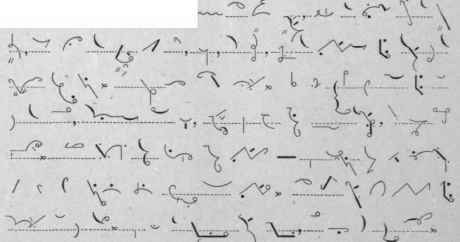
A Doctored Speech

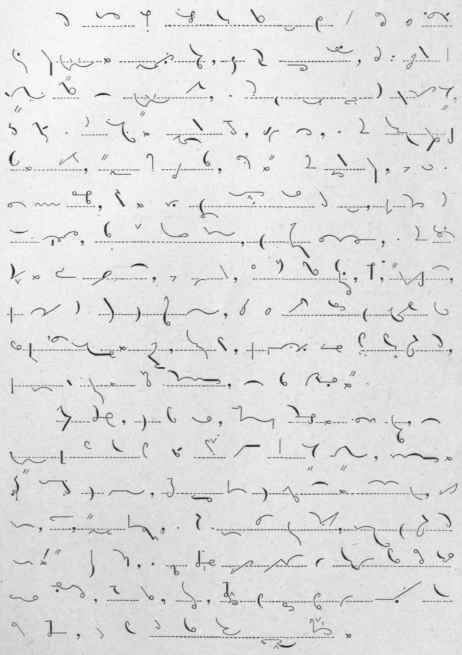

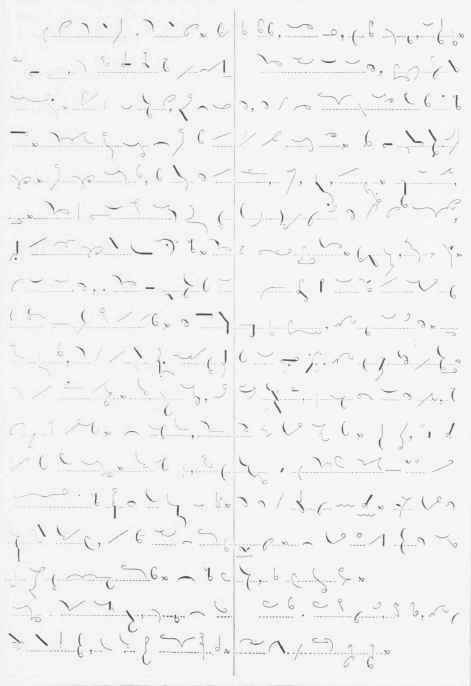
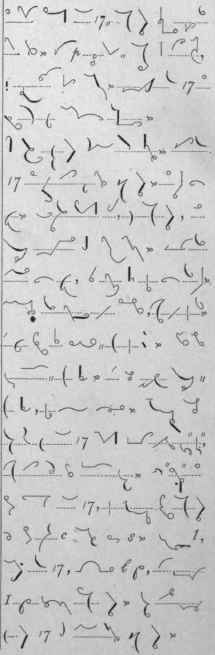
Charge To A Jury


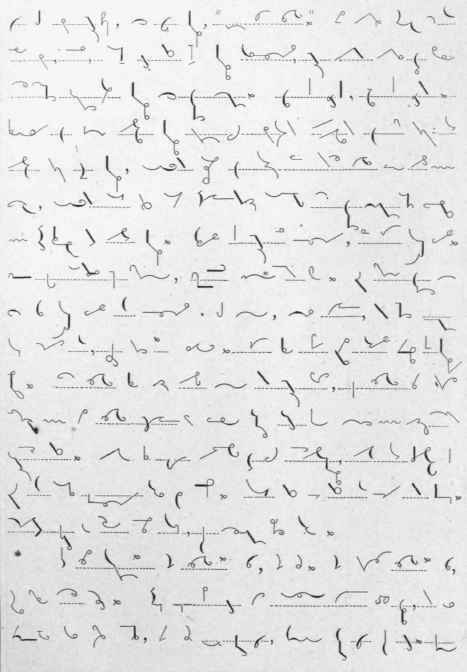

Writing Exercises
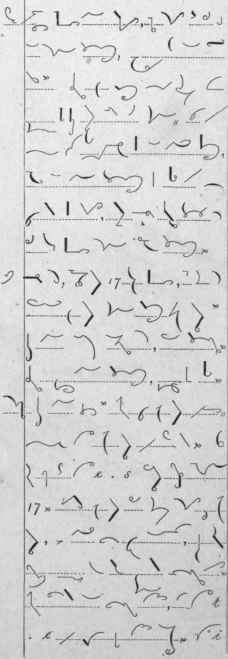
Stenographers In New York.*
There are many hundred stenographers in New York city, and the number is pearly increasing. Most of them find employment as private secretaries and in offices and business houses, at salaries ranging from twelve to fifteen dollars a week; or as reporters of law cases tried before the numerous referees, at a compensation of from ten to fifteen cents a folio of one hundred words. Occasionally, an expert is hired at a stated salary by some litigant who does not care to depend upon the official stenographer for transcripts of the proceedings in trials of his cases. During the well-known trial of Sharp, the defendant employed two stenographers for forty days, whom he paid at the rate of five dollars an hour.
Official stenograpliers in the New York courts are paid a salary of $2,500 a year, with additional fees for transcripts of their notes, making about $5,000 a year - and they earn it. The work is very severe, in long trials, for the record of a day's proceedings must be written out before the opening of the court on the following day. As soon as the court adjourns, the stenographer hastens to his office with his notes. Of course, it would be impossible for him to transcribe them himself, within the time required, but if he writes a legible hand he can turn over his original notes to several trained copyists, who make short work of it while he seeks the rest he so much needs to prepare him for the next day's work. Few of the older stenographers are able to do this, however, on account of careless habits of writing induced by the defective systems of shorthand they employ and which they learned long before the present improved and logical systems were published. Such stenographers are compelled to dictate portions of their notes to several other stenographers, who in turn dictate their own notes to rapid typewriters, the official stenographer dictating the last portion of his notes to another typewriter; and the click of the machines and the weary monotone of the stenographers' voices may be heard far into the night. Men can stand a few weeks of such work at a time, but it is sure to wear them out at last.
Some of the New York lawyers are very rapid speakers, and the best stenographers are taxed to their utmost to report them. It is said that many average nearly two hundred words a minute. To report such speakers for any length of time, becomes a question of endurance, and many of the best stenographers have not the physical strength to do it.
*Words-signs and contractions are printed in Italic.
It is not strange that mistakes should occasionally be made by stenographers - indeed, it would be strange if they were not. They generally occur from misunderstanding the words of a speaker, or from misreading the notes in the hurry of transcription. The latter is most likely to cause such mistakes, especially where it is necessary to dictate the notes to other stenographers. Probably, the most dangerous mistakes are occasioned from writing the same outline for two of more words which the context will not aid in distinguishing. Some systems of shorthand furnish many opportunities for such mistakes, as where the words at all and until are written alike. If a witness should testify, for instance, "I was not in Brooklyn until the first of March," the most expert reporter or copyist from such a system might readily fall into the error of writing, "I was not in Brooklyn at all, the first of March." The result to the witness might be by no means pleasant, if he should be indicted for perjury for making the statement thus attributed to him.
Closely associated with the stenographers in their work is a vast army of typewriters, most of them ladies of education and culture. They have their offices, make very good incomes, and live well. They have a uniform scale of prices, charging five cents a folio for a single copy, eight cents for two copies, and ten cents for three. Some of them become very expert in the use of the typewriter, and often write at the rate of seventy-five words a minute, but of course such a speed cannot be kept up for any great length of time. Many of these ladies are experts in shorthand, and are able to take dictation from official stenographers, and even to occupy responsible positions as reporters. They are able to earn a good income, frequently as high as from $1500 to $2500 a year. Their work, like that of official stenographers, is often tedious, but it is generally very pleasant and satisfactory.
The Use Of Simple Words
Through life, we all teach and we all learn. This-world is-a great school, where we-find what-is-good and-what-is-bad, and-thus are made-ready to act in-another-sphere. What-we-are at-the end of-this life, we-shall-be when-the next50 begins. We-must-therefore spare no-pains when we-teach others or ourselves. We-teach ourselves in-our thoughts, others by-our words or acts. We-must take care to think and-speak in-a-way so-clear that-we do-not-cheat or mislead ourselves by vague and-hazy100 ideas. We-must learn to think in words, and we-must get a-habit of-using them in thought with-the-same care with-which we-speak or write to others. Words give-a body and-form to-our thoughts, without which they-are apt to be so-dreamy and-unreal150 that-we do-not-see where they-are weak or-false. If-we put-them into-words, we-shall learn how-much-of truth there-is-in-them. When in-that form, we-can turn them over in-our-minds. If-we write-them out, we-find that in-many-cases200 the ideas we-thought-we-had hold of fade-away under-the test. If-they-do prove to be of-real value, they-are thus not-only made clear to-us but-they-are in-such-shape that-we may-make-them clear to others. When ideas float'250 in-our-minds and we-are in-doubt about-them, our doubts may often be-solved by talking with-others, for if-we state-them clearly we-see-the-truth at-once. It-is what-we-say to others, in-most cases, that settles our doubts, not what-they-say to-us.300
Continue to:


My Books

