


Chapter 7. Maintaining
Description
This section is from the book "Michael Raduga", by School of Out-of-Body Travel. A Practical Guidebook. Also see: Adventures Beyond the Body.
Chapter 7. Maintaining
The General Concept Of Maintaining
Phase maintenance or "maintaining" refers to techniques that allow a practitioner to remain in the phase for the maximum amount of time possible. Without knowledge of "maintaining" techniques, the duration of the phase will be several times shorter than it could otherwise be. The shortest phases last just a few seconds. Beginning practitioners usually fear not being able to exit a phase; this shouldn't ever be a concern because the real challenge is being able to maintain the phase state, which is easily lost unless phase maintenance techniques are used.
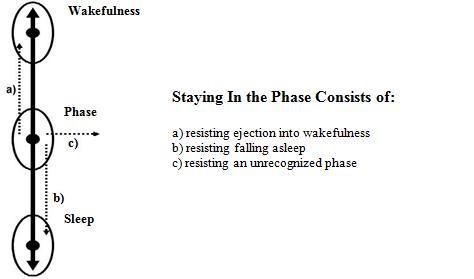
Phase maintenance consists of three primary principles: resisting a return to the wakeful state (known as a foul), resisting falling asleep, and resisting a false exit from the phase. As a rule, the first two problems (return to a wakeful state, or falling asleep) are often encountered by beginners, but the third difficulty (false exit) manifests at later stages of practice.
Resistance to returning to the body is self-explanatory, whereas resistance to falling asleep is unclear to many. Not everyone knows that almost half of phase experiences usually end in a quite trivial way - falling asleep. A person usually looses attentiveness, his or her awareness dissipates, and everything around gradually looses clarity and turns into what is for all intents and purposes a usual dream.
Resisting a false exit from the phase is a lot more surprising and dramatic. Sometimes a practitioner detects an impending exit from the phase, subsequent deepening techniques fail to work, resulting in what seems to be a return to the body and physical reality. Sure that the phase has ended, a practitioner may stand up and the fall asleep after perceiving a few steps. In such cases, falling asleep most often happens without any movement, but while still lying in bed. The problem is that the difference between the phase and reality can be so subtle that in terms of internal or external indicators, the phase practically can't be distinguished from reality. Therefore, one must know the necessary actions to take in the event that the phase ceases, since the end of a phase could actually be a trick and purely imagined.
There are specific solutions for the three problems described in addition to general rules that apply to any phase experience. Studying these rules should be given just as high a priority as studying the specific solutions, since only some of them, when applied separately, may help one to remain in the phase several times longer than usual.
In some cases, techniques for maintaining are not applicable. However, knowledge of how to maintain is useful for the majority of experiences. Also, there might be situations when someone need only resist a foul, while someone else may need to resist falling asleep. All of this is very specific to each case and can be determined only in practice.
With perfect knowledge of all the techniques for maintaining, a phase may last two to four minutes, which doesn't sound like an extended duration, but really is. A particularity of the phase space is that achieving something and moving around in it takes a minimum amount of time, mere seconds. Thus, so much can be done during 3 minutes in the phase that one literally needs a list, so as not to waste any time.
There are theories that have neither been proven nor disproven claiming that time in the phase contracts and expands relative to real time. Thus, one minute of real time while in the phase may feel much longer in terms of phase time.
Perception of time varies from practitioner to practitioner. Novices especially perceive a real minute as more like five to 10 minutes in the phase. This is determined by the particularities of individual psychology, state of mind, and the type of events that occur in the phase.
In order to understand how long a phase really lasted, one does not need to try using a stopwatch in the real world. It is better to count how many actions took place in it and how much time each of them could have taken. The result will differ from one's first rough estimate several times over.
The maximum duration the phase varies depends heavily on the ability to apply phase maintenance techniques. Some practitioners have difficulty breaking the two-minute barrier while some find it easy to remain in the phase for 10 minutes or longer. It is physically impossible to remain in the phase forever because even a 20-minute phase is unheard of.
Continue to:


My Books

