


Directions For Placing The Planets In The Horoscope
Description
This section is from the book "A Manual Of Astrology, Or The Book Of The Stars", by Raphael. Also available from Amazon: A Manual Of Astrology; Or The Book Of The Stars.
Directions For Placing The Planets In The Horoscope
In the right hand page of "White's Ephemera", the exact copy of which we hare given, as the best mode of explanation, the student will observe that the true places of the different planets are calculated to each day throughout the month at noon, or 12 o'clock in the day. Consequently, when a "theme of heaven" is erected precisely for noonday, their places in the Ephemeris are to be taken out without any calculation. But as the heavens and heavenly bodies are in perpetual motion, it is obvious that if their places in the Ephemeris are calculated for a given hour of the day (which in this instance is always made for noon) to be correct, the proportional distance each planet has moved since that period, must be added to, or subtracted from the given time, according as they may be best taken from the preceding or succeeding noon.
In the foregoing scheme of nativity, which is set for April 17,1824, llh. 43m. morning, or seventeen minutes before noon of that day; we find, that on that day at noon, the  is in 27° 23' 52" r (see the second column headed
  's longitude) or rejecting the seconds, in 27° 24', and as the figure is set before noon, we find the
  's diurnal motion, by subtracting his place on the 16th day from the 17th to be 58° 32" which in every ease, where the seconds exceed thirty, may be counted as a minute instead; we will therefore take his diurnal motion as 59 minutes, which divided by 24 (the Astronomical hours accounting from noon to noon) gives about 2' 30" for every hour of his motion through the sign he is in, and consequently we subtract about 40 seconds for the motion of the 17 minutes in time which the figure wants of noon, which taken from his place in the Ephemeris, leaves the
  's true place in the heavens, viz. 27. .23 r. Having thus found his place equated to the hour of birth, the student must next refer to the figure, and place the planet therein, either near to, or far from that house of heaven which has the sign the planet is in on its cusp; thus in the present instance, on the tenth house we observe r22° O', and consequently the
  is in that house, where we place him, and not far from the cusp, as he is within five degrees thereof in the zodiac.
In the third column of the Ephemeris is found the  's true longitude, which at noon, on the 17th April, is 15° 19'
  , and by subtracting her place on the 16th from her place on the l7th day, thus:
| on the 17th | day at noon | 15° | 19' |
|
| on the 16th | do. | - 2 | 25 | |
12 | 54 |
|


Shows us that in the twenty-four hours her motion in longitude was 12° 54', which is about thirty-two minutes per hour; consequently we have eight minutes longitude to subtract from her place at noonday, (the equation for the seventeen minutes which the figure is set before noon) and this gives her true place in the horoscope, viz. 15° 11'  ; and by reference to the scheme, we place the
  in the fifth house (as that sign is on the cusp thereof,) and with the degrees and minutes before found, not far from the cusp of the house in question, her distance therefrom being about eight degrees.
In the fifth column of the Ephemeris is found the place of  , which by the same mode of calculation is found to be 23° 20'
  ; and as the sign
  is intercepted (in the figure) between the tenth and eleventh houses, We place him in the middle of the tenth house. In the next columns we have the places at noon of
 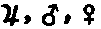 , and
, and  , which by the very same process are found to be,
  in5°l'
  ;
;  26° 37
  ;
;  0° 9'r; and
  3° 5'
3° 5'  ; accordingly we find what houses in the horoscope they should occupy, and place them accordingly. These are the whole of the planetary places except
  , and his place is found in another part of the Ephemeris (on account of his extraordinary slow motion) page 32; and in the present instance
  is in 15° 45'
  , we place him therefore in the sixth house of the horoscope, as that house has
  on the cusp.
The next thing usually taught by Astrologers is to place, the Moon's nodes, or the dragon's head and tail in the horoscope. In the fifth column of the Ephemeris", Pl. 's node" is mark-, ed, which is the place of the north node or dragon's head, the opposite to which is the dragon's tail, these are calculated in the same way as all the planets; but as these points ,together with the
  , are by the author of this work deemed as useless superfluities, the relics of the superstitious absurdities of the dark ages, (invented probably to serve the vacuum in the art, created by the, non-discovery of
  ) and can be dispensed with; the author deems it irrelevant to his present system of starry science, to intrude on the reader's time and patience by a useless and unintelligible array of words and signs without meaning. - The figure is therefore complete, except placing therein the principal fixed stars which fall near the ecliptic; and consequently are presumed to have certain influences in nativities (or genitures,) according as they may be found within five degrees of the cusp, of any house, or within, five degrees of the place of any planet in the scheme.
The table subjoined contains a true calculation of their places in the heavens, up to the year 1828, with their different mag-nitudes and natures, according to the cleverest authors.
" I'll not believe that the Arch-Architect With all these fires the heavenly arches deck'd Only for show; and with these glittering shields To amaze poor shepherds watching in the fields. I'll not believe that the least flower which pranks Our garden borders, or our common banks, And the least stone that in her warning lap Our mother Earth doth covetously wrap, Hath some peculiar virtue of its own, And that the stars of heaven have none.'"
Du Bartas.
Continue to:


My Books

