


Snowberry
Description
This section is from "The American Cyclopaedia", by George Ripley And Charles A. Dana. Also available from Amazon: The New American Cyclopædia. 16 volumes complete..
Snowberry
Snowberry, the common name for a native shrub, given on account of its large, very pure white berries, which ripen in autumn and remain after the leaves have fallen. The genus symphoricarpus (Gr. συμφορέιν, to bear together, and καρπός, fruit, from the clustered berries), to which it belongs, is exclusively North American, extending from British America to Mexico, and contains about six species; it belongs to the honeysuckle family, and differs from the honeysuckle (Lonicera) itself in having a regular corolla and a fewer-seeded berry. All are small branching shrubs, with ovate entire (or sometimes wavy-toothed), opposite leaves, and small, bell-shaped, four- to five-lobed, white or rose-tinted flowers in short spikes or clusters. The snowberry (S. racemosus) is found from Vermont westward to Oregon, and as far south as Pennsylvania; it is one of the most common garden shrubs, and is cultivated for its white berries. The wolfberry (S. occidentalis), growing from Michigan westward, has also white berries.
The Indian currant or coralberry (S. vulgaris), found from western New York to Texas, and sometimes cultivated, has small dark red berries in dense clusters.
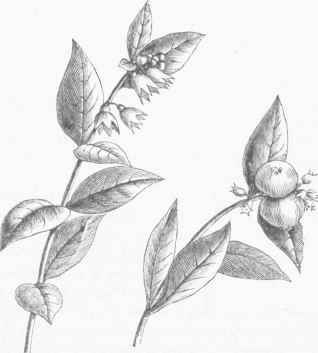
Snowberry (Symphoricarpus racemosus).
Continue to:


My Books

