


Ware-Robivr
Description
This section is from "The American Cyclopaedia", by George Ripley And Charles A. Dana. Also available from Amazon: The New American Cyclopædia. 16 volumes complete..
Ware-Robivr
Ware-Robivr one of the common names, especially in the southern states, for ariscema triphyllum, which is also called jack-in-thepulpit and Indian turnip; and the name is also applied to species of trillium. (See Trillium.) Ariscema belongs to the family araceoe; this includes endogenous plants with an acrid juice; the flowers in a fleshy head or spadix, which is usually surrounded or subtended by a large, showily colored or peculiarly shaped bract or spathe; the calla lily, or lily of the Nile (Richardia), a popular house plant, is a representative of this family. The arissemas have a tuberous rootstock, or corm, from which rises a simple scape, which is sheathed by the stalks of one or two compound, veiny leaves, and bears a large greenish or purplish spathe, enclosing the spadix, at the base of which are clustered usually two kinds of naked flowers, which are sometimes in separate plants; the sterile flowers consist each of a cluster of anthers, and the pistillate, placed below the staminate, are reduced to a one-celled ovary, with a depressed stigma, which ripens into a one- or few-seeded red berry.
There are three species in the United States; the one called wake-robin receives the specific name triyhyllum from its three ovate, pointed leaflets; it usually has but two leaves, their stalks green or striped with purple. The spadix, mostly dioecious, is club-shaped, naked above, and included in the large spathe, which is incurved and hood-like above; it presents a great variety in color and markings, being sometimes pale green, more or less marked with purple, and sometimes dark purple with whitish stripes and spots. It is found over a wide extent of country, and extends even to South America. The corm, or "turnip," is flattened, an inch or two in diameter, brownish externally, and white and fleshy within; its taste is exceedingly acrid, producing when only touched to the tongue the sensation of scalding; this acridity is dissipated by heat and by long drying; the recently dried root, much less acrid than the fresh, is sometimes used as an expectorant and general stimulant of the secretions. From 10 to 17 per cent, of the corm is pure starch, which when separated is tasteless and may be used as a substitute for arrowroot; in England what is known as Portland arrowroot is made from a related plant, arum rnaculatum. - Another species of ariscema (A. dracontium) is known as green dragon, or dragon root; it is widely distributed, but less common, and its usually solitary leaf is 1 to 2 ft. long with 7 to 11 leaflets; the greenish, tube-like,. pointed spathe is shorter than the spadix.
A third species, A. polymorphum, found in the mountains of North Carolina, is much like the first named, but its solitary leaf has 3 to 5 leaflets, variable in shape and often lobed.
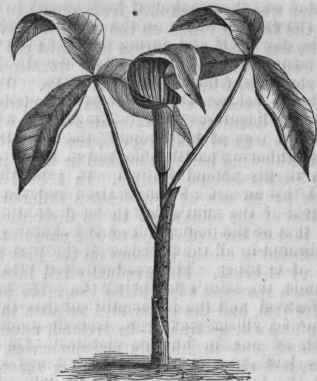
Wake Eobin (Arisaema triphyllum).
Continue to:


My Books

