


Wire Worm
Description
This section is from "The American Cyclopaedia", by George Ripley And Charles A. Dana. Also available from Amazon: The New American Cyclopædia. 16 volumes complete..
Wire Worm
Wire Worm, a name applied to the myriapod animals of the genus lulus (Latr.), to the larva) of several of the spring beetles, and to the caterpillars of many owlet moths of the family agrotididce, the last more properly called cut-worms. (See Cut-Worm.) The characters of the order of myriapods have been sufficiently given under Centipede. The genus iulus may be taken as the type of the subdivision chilognatha, popularly called millepedes from the great number of feet. The body is long and cylindrical, consisting of numerous horny, arched segments, most bearing two pairs of feet ending in small single hooks, the last having none; antennae short and sevenjointed; jaws rudimentary, suited for feeding on soft or decaying vegetable substances instead of the living prey of the chilopod centipedes. Their movements are very slow and worm-like; when in danger the body is rolled into a spiral ball; they undergo a kind of metamorphosis, having at first only three pairs of feet, and attain their full growth only after several moultings extending over a period of two years, showing an affinity to the insects proper; the reproductive season in Europe is from December till about the middle of May; they lay a great number of eggs in the ground.
They are common in damp earth and moss, and sometimes on or under the bark of trees; they are harmless, and actually beneficial in warm climates by consuming decomposing vegetable substances; they have been considered injurious to vegetation in temperate regions, probably erroneously. The Canada wire worm (I. Canadensis, Newport), so common in Canada and about the falls of Niagara, is 1½ in. long, with 43 smooth shining segments; it is reddish flesh-colored, with black lateral spots beneath a longitudinal series of white patches. In Europe the most common are the I. sdbulosus and terrestris (Linn.), about 1¼ in. long, brownish variegated with yellowish, and with about 120 legs on a side. The largest species is the I. maximus (Linn.), 6 or 7 in. long, and a native of woods and retired places in South America. - The larvae of the spring beetles (elater, Linn.) are called wire worms from their slenderness and hardness; they are said to live in the larva state five years, during most of which time they feed on the roots of wheat, rye, oats, and grass, causing sometimes nearly a total destruction of the crop; they are especially injurious in gardens recently converted from pasture lands.
The best known European wire worm is the elater (agriotes) segetis (Bierk.), the cataphagus lineatus (Steph.) according to some entomologists being the same; the larva when full-grown is about seven lines long, very narrow, yellowish, hard and shining, with 12 segments, the last two indented with dark specks, head brown, and end of jaws black; it is very destructive to grain and culinary vegetables. The E. (agriotes) mancus (Say) is about ½ in. long, stout, dark brown covered with dirty yellowish gray hairs, and punctured thickly above; from April to June numbers may be seen among the roots of grass and on rails and fences; the larvae have six legs on the first three segments, and beneath the tail a short retractile wart or prop-leg.
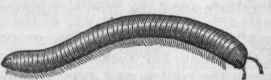
Canada Wire Worm (Iulus Canadensis).
Continue to:


My Books

