


Wolf Fish (Anarrhichas Lupus Linn)
Description
This section is from "The American Cyclopaedia", by George Ripley And Charles A. Dana. Also available from Amazon: The New American Cyclopædia. 16 volumes complete..
Wolf Fish (Anarrhichas Lupus Linn)
Wolf Fish (Anarrhichas Lupus Linn) a spiny-rayed fish allied to the blenny family, and inhabiting the seas of northern Europe and America. It attains a size of 3 to 5 ft. or more; the color is purplish brown above, with 10 to 12 transverse black or brown stripes extending more or less over the whitish lower parts; the dorsal fin extends from behind the head almost to the caudal, and the anal is half as long, bringing the vent very far forward; the pectorals are very large, the caudal rounded, and the ventrals absent; the body is compressed, with small scales covered by a slimy skin; head cat-like and rounded in front; the stomach is short and fleshy, the diameter of the intestines uncommonly large, the gall bladder enormous, the brain very small, and the air bladder absent. The teeth differ from those in most other fishes, not being attached directly to the jaws, but to bony processes connected with them by suture, and are therefore easily broken off; they are strong, conical, and like canines in front, and rounded tubercles posteriorly and on the vomer and palate; the tongue is thick and angular, adapted for directing the food between the powerful jaws; the lips are loose and fleshy. Few fishes have so savage an appearance, and few fight so fiercely when caught; they live a long time out of water.
Their food consists of crustaceans, mollusks, and echinoderms, whose shells are easily crushed and are voided almost unchanged; they swim rapidly along the bottom, with an undulating motion, and are very active and destructive to nets. In the European seas the wolf fish is found from the English channel northward, being very abundant about Iceland; its flesh is said to be exceedingly good, much like that of the eel, and is highly esteemed in Iceland, where it is used fresh and salted; the skin is converted into a kind of shagreen used for bags and pouches, and the bile is employed as soap. The generic name is derived from the unfounded supposition that it climbs rocks by its fins and tail. - The American species, found from New York to Greenland, has been considered distinct by Agassiz, and named by him A. vomerinus, from the different number and disposition of the teeth on the vomer. It grows from 3 to 5 ft. long, with a weight of 5 to 30 lbs.; it is caught all the year round by the cod fishers, but mostly in the winter, and especially on the Cusk rocks between Boston and Cape Ann; the fishermen generally call it " sea cat." Though its hideous appearance and slimy skin lead to its being in many instances thrown away, specimens from 5 to 10 lbs. are very fine eating, especially when broiled after the skin is removed; many are split, salted, and smoked for future use.
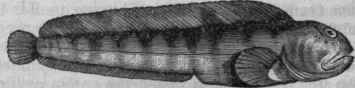
American Wolf Fish (Anarrhichas vomerinus).
Continue to:


My Books

