


Yew
Description
This section is from "The American Cyclopaedia", by George Ripley And Charles A. Dana. Also available from Amazon: The New American Cyclopædia. 16 volumes complete..
Yew
Yew (A. S. iw; variously written by the old authors ewgh, ugh, and U, and in French if), the common name for species of taxus (the ancient name, supposed to be from Gr. a bow), especially T. baccata. The yew is so unlike in its fruit to other genera of the pine family (coniferce) that some have placed it and its allies in a separate order, but botanists at present include these in coniferoe, as a very distinct subfamily or tribe, the taxineoe. This subfamily includes, besides the yew, Torreya, Salisbiirla or gingko, and cephalotaxiis, with a few other rarer genera. The yews are trees of medium size, with evergreen leaves, which are linear, flat, rigid, pointed at the apex, and mostly arranged in two rows. The flowers, usually dioecious, but sometimes monoecious, are axillary from scaly buds; the sterile aments are small, globular, and consist of a few stamens, each with three to eight anther cells beneath a shield-like scale (connective); the fertile flowers are solitary, and consist of merely a naked ovule, erect and sessile upon a ringlike disk, beneath which are several scaly bracts; after the ovule is fertilized and begins to develop into a seed, the disk upon which it is placed begins to grow, becoming cup-shaped, and gradually covering the ovule, and by the time the nut-like seed is ripe the disk has enclosed it, except a small opening at the top, and at the same time become fleshy, appearing like a pulpy (usually) red berry, which gives the specific name T. oaccata.
The common yew is a most variable tree, and in its typical form is known in this country as the English yew, though it is found all over central and in the mountains of southern Europe, and in Siberia, on the Himalaya, and in other parts of Asia; it presents numerous varieties, one of which is North American. The tree, though living to a great age, is seldom more than 30 ft. high, with a wide spread of branches and a very thick trunk; in England are many specimens remarkable for their age and great size, some now living being estimated at from 700 to 1,000 years or more old; biographies of a number of these are given by Loudon in his Arboretum et Frutieetum Britannicum; one of the finest is the Darley yew, in the churchyard of Darley in Derbyshire; this has the unusual height of 5o ft. with a spread of branches of 70 ft.; the trunk is 19 ft. 3 in. in diameter, and its age, as estimated from the diameter, over 1,300 years. The wood of the yew is very heavy, fine-grained, elastic, and durable; the heart wood is of a fine orange red or a deep brown, and the sap wood, which is very hard, is pure white, with different shades where the two join, and both are susceptible of a fine polish.
Specimens containing the two are used for ornamental cabinet work, a purpose for which the wood is much employed; tables and other work made from it are considered more beautiful than those of mahogany; it is employed in the form of veneers, and used solid for various articles of turnery; its great strength adapts it for axle trees and other work where this quality is required; when set in the ground for fence and gate posts, it is practically indestructible, and it is never attacked by insects. Before firearms were introduced yew was in great request for bows, and various laws were enacted to preserve a supply of the material for military puposes; it has been suggested that the general planting of the tree in churchyards was for this reason, but it is more probable that, on account of the longevity of the tree, it was used by the Celtic priests as an emblem of immortality. In the ancient style of gardening, when trees were clipped into unnatural forms, the yew was a favorite subject for topiary work; at present it is used in England for screens and in groups, but its association with graveyards is still regarded by some as an objection to planting it as an ornamental tree. In this country it is not hardy in the northern states.
The leaves are poisonous to man, and cattle have been killed by eating them; but the berries are generally regarded as harmless, though ill effects have been ascribed to them. The tree has produced many sports, and the lists of the European nurserymen give numerous varieties, differing in habit and color. - Our native yew, formerly regarded as a distinct species, taxus Canadensis, is now placed as var. Canadensis of T. baccata, and is known as the American yew, but more generally as the ground hemlock; its stem is prostrate and trails upon the ground or runs just below the surface, the branches straggling, ascending, and rarely more than 3 or 4 ft. high; in some localities it forms the principal undergrowth, and presents a pleasing mass of vivid green. Sometimes the branches grow in a circle, with an open space in the centre, as regularly as if they had been trained; in cultivation the fertile plant, with its abundant scarlet fruit in contrast with the dark green of the foliage, is a most beautiful object. Another variety (var. fastigiata), known as the Irish yew, has erect branches, and has proved in this country more hardy than the type. The yellow-berried yew differs only in the color of its fruit. The upright yew (var. erecta) is more hardy than the species.
There are several dwarf, weeping, and variegated forms, among which there is none so beautiful as the golden yew (var. variegata aurea), in which the young growth in spring has its leaves edged with a bright golden yellow; there is also a silver-leaved variety, more hardy than the species, and producing a brilliant effect when planted in contrast with other evergreens. The Florida yew is a tree 10 to 20 ft. high, growing in middle and western Florida; it has very narrow, distinctly petioled, pointed leaves, which are revolute on the margins; it is not known to be hardy in more northern localities. The western yew of the Pacific coast (T. hrevifolia) is found from Vancouver island to nearly the southern boundary of California, especially on the Sierra Nevada; it grows from 50 to 75 ft. high; some have regarded it as a form of the European yew, from which it mainly differs in its narrower, shorter, and thinner leaves, which are abruptly pointed, and have distinct petioles; it differs from the yew of the east in always assuming a tree-like form; its wood resembles that of the European yew; this is called T. Lindley ana in some English works. The Mexican yew, T. globosa, is a small tree with somewhat curved leaves, ending in a stiff, sharp point.
This with two from Japan completes the list of species. The yews are propagated both by sowing the seed and by cuttings.
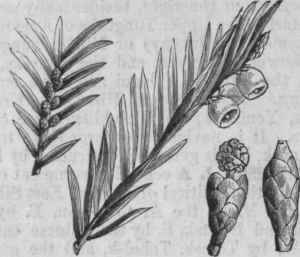
Yew (Taxus baccate).
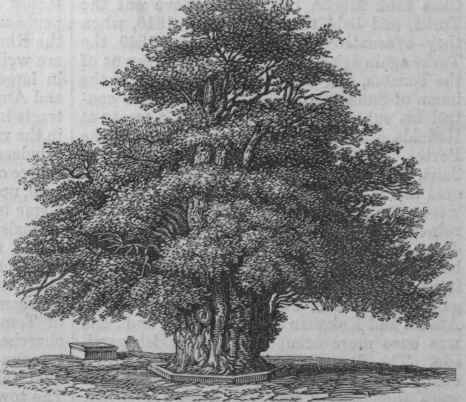
Yew Tree at Darley, Derbyshire, England.
Continue to:


My Books

