


Ckamouny Chamouni
Description
This section is from "The American Cyclopaedia", by George Ripley And Charles A. Dana. Also available from Amazon: The New American Cyclopædia. 16 volumes complete..
Ckamouny Chamouni
Ckamouny Chamouni, or Chamonix, a picturesque Alpine valley of France, between the Graian and Pennine Alps, in the department of Haute-Savoie, over 3,000 feet above the Mediterranean, and about 2,000 feet above the lake of Geneva, watered by the river Arve. It is more than 13 m. long and 2 m. broad, and is bounded N. by Mont Brevent and the Aiguilles Rouges, N. E. by the Col do Balme, S. W. by Monts Lacha and Vandagne, and S. by the chain of Mont Blanc, whence rise enormous glaciers. The largest of these, the Mer de Glace, is broken by many deep crevices disclosing the remarkable purity and deep blue coloring of the frozen mass. The winter, which lasts from October to May, is very severe; snow lies three feet deep in the lowest part, and the routes over the mountains are altogether impassable. The short summer, however, is warm. In July commences the dangerous labor of driving cattle across the Montanvert and the Mer de Glace, to pasture on the mountains beyond; and the occasion is made a holiday. One man is left on the other side of the glacier, to guard the cattle till autumn. The soil, though naturally barren, yields when carefully cultivated good crops of grain and fruit, and affords pasturage for cattle.
The rearing of bees is one of the principal industries of the valley, and the white aromatic honey of Chamouni is renowned. Fancy articles of carved wood are manufactured, and the inhabitants are also engaged in spinning and weaving. Numerous excursions are made from Chamouni to the Montanvert, leading to the Mer de Glace; to the Pierre Pointue and glacier des Bossons, the Flegere, and the Brevent; to the Jardin, a flowery island in the midst of a sea of ice; to the Grands Mulcts, and to Mont Blanc. The finest views of the latter mountain chain, of Mont Maudit and Mont Blanc du Tacul, and other conspicuous scenery, are from the Brevent, and from the Flegere, the peak of the former mountain. About 300 horses and mules and many skilled guides are at the disposal of tourists, under strict regulations of the authorities and of the Alpine clubs. The first recorded visit to this region is that of a bishop of Geneva in 1443. Philip of Savoy, count of Geneva, licensed fairs here in 1530; and the mountains have been explored occasionally by Swiss and Germans. But the glaciers inspired so much dread that the valley was believed to be covered with snow in order to punish the inhabitants for their sins; and they were styled les montagnes mauditcs, the accursed mountains.
In 1606 St. Francis de Sales visited the valley, which was within his diocese of Geneva. In 1741 the attention of the English was attracted to the region by the reports of Wyndham and Pococke; and an inscription on a block of granite, popularly known as the English stone, on the spot near the Mer de Glace, where these travellers were erroneously supposed to have passed the night, having been accidentally destroyed, has been restored on Mont Montan-vert. De Saussure made his first visit to the valley in 1760, and Bourrit in 1775. In December, 1859, Tyndall explored the Mer de Glace, and crossed the channels of its avalanches in the deep snow, encountering perils which are great in winter, although in summer the passage is comparatively safe. There are several villages in the valley, with an aggregate population of about 2,000. The principal of these is Chamouni, on the right bank of the Arve, about 22 m. S. E. of Bonneville, at the foot of Mont Blanc. The distance to the nearest railway station, at Martigny, is about 22 m., which may be traversed on mules in nine hours by the passes of the Tete Noire or the Col de Balme. The village is also known as Le Prieure, from a Benedictine priory established by a Genevese count, with the sanction of Pope Urban II., toward the close of the 11th century.
An English chapel was opened in 1860. In August and September the place is overcrowded with visitors, and presents a bustling appearance. Flax and honey are exported, and there are a mine of anthracite, called Du Coupeau, and mineral warm baths. The origin of the name Chamouni is traced to champs munis, or fortified grounds, in allusion to the natural fortifications formed by the mountains.
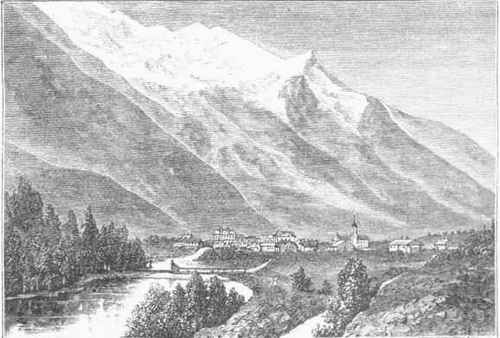
Chamouni, with Mont Blanc in the distance.
Continue to:


My Books

