


Coach-Whip Snake
Description
This section is from "The American Cyclopaedia", by George Ripley And Charles A. Dana. Also available from Amazon: The New American Cyclopædia. 16 volumes complete..
Coach-Whip Snake
Coach-Whip Snake (psammophis flagelli-formis, Catesby; genus masticoyihis, B. and Gd.), an American species characterized by a long and narrow head, projecting upper jaw, superior orbital plates large and projecting much over the eyes; nostrils large, lateral, and near the end of the snout; eyes large, iris dark gray; neck small, body long, and tail attenuated like a whipcord, which it also resembles in the braided appearance produced by the arrangement and dark border of the scales. The scales are smooth and usually have two points at the apex; on the neck they are small, on the fore part of the body narrow and rhomboidal, on the tail short and broad. The color of the head, neck, and one-third of the body is glossy black, becoming paler toward the tail, which is tawny brown; the scales on the tail have dark margins: the lower surface in front is bluish slate, behind white clouded with brown; the colors vary in their shades, but near the head it is always black. In a specimen 01 in. long, and 2 1/4 in. in circumference, the head was 1 1/4 in., the body 44 in., and the tail 16 in.; the abdominal plates were 203, and the sub-caudal scales 109 pairs. It sometimes attains the length of 7 ft.
It moves with great swiftness, and feeds on young birds and small animals; though inoffensive to man, it defends itself bravely, twining its long folds around its enemy. This species is rare, and appears to be confined to South Carolina, Georgia, and Florida. In its general form, in the scales, and in the plates on the head, it somewhat resembles the black snake. It receives its popular name, not from the small size of the body and tail, but from the imbricated disposition of the caudal scales.
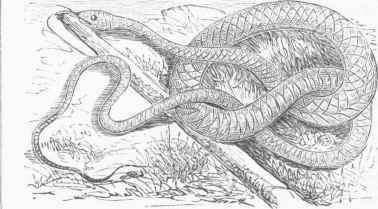
Coach-whip Snake.
Continue to:


My Books

