


Cross
Description
This section is from "The American Cyclopaedia", by George Ripley And Charles A. Dana. Also available from Amazon: The New American Cyclopædia. 16 volumes complete..
Cross
Cross (Lat. crux; Fr. croix), a sacred symbol in the Christian and more ancient religions. While the use of the cross as an ornament or as a religious emblem is traced to a remote antiquity, its employment as an instrument of punishment is scarcely less ancient; but until the time of Christianity there was no known connection between the two. The many varied shapes in which it appears may be resolved into four simple forms. The cross of four equal arms meeting at right angles,+, commonly called the Greek cross, is found on Assyrian tablets, on Egyptian and Persian monuments, on early Asiatic and Greek coins, and on Etruscan pottery. In Egypt this cross, enclosed in a circle, was the symbol of Kneph; on eastern monuments it appears often beneath a circle or globe. In its oblique form, called by Lepsius crux decussata, and vulgarly, although on no good grounds, St. Andrew's cross, it is no less common in ancient sculpture.
The Latin cross, or crux immissa, is also found on coins, medals, and monuments anterior to Christ. The cruciform sceptres in the hands of Astarte on Asiatic medals, and the symbols in the mysteries of Venus and of Mithra, have been supposed to bear some relation to the four elements which, in the hands of the divine creators, were the agents of creation.
The crux commissa or patibulata, sometimes called the tau cross from its resemblance to the Greek letter of that name, is a mystic symbol of very ancient and very uncertain origin. Some archaeologists consider this the oldest form of the symbolic cross, and that the Greek cross is only its double. In its most ancient use it was probably a phallic emblem, the type of the active principle of nature. In the crux ansata,
 the Egyptian symbol of life, in which form it most frequently appears, some see the union of Osiris and Isis, the active and passive elements. Sir Gardiner Wilkinson notes the remarkable resemblance of the Egyptian word signifying life (onh) to the yohni lingam of the Hindoos. By others it is regarded as the symbol of eternal life, or the new life promised to neophytes after initiation into the sacred mysteries. Whatever may have been its hidden meaning, the crux ansata is a common figure on Egyptian monuments, and is constantly seen in the hands of Isis, Osiris, and other divinities; Layard found it on the sculptures of Khorsabad and on the ivory tablets of Nimrud; and it is carved on the walls of the cave temples of India. When the Serapeum at Alexandria was destroyed by order of Theodosius, the Christians saw in this figure, which they found sculptured on the stones, a sign prophetic' of the coming of Christ, and they modelled on the same type the symbol of redemption.
After this time the crux ansata appears occasionally on Christian monuments, and some have believed it to be the origin of the monogram of Christ; but that is undoubtedly of an earlier date than the destruction of the temple of Serapis. The cross was a common symbol among the British, Irish, and Gallic Celts. The shamrock of Ireland derives its sacred-ness from its resemblance to it in form; and in the mysticism of the druids the trefoil had a peculiar significance. In Scandinavian mythology the hammer of Thor, the terrible mjolnir, sometimes used to bless the marriage tie, was the cross. Among the stone implements found in the shell mounds of Denmark are cruciform hammers, with the hole for the haft at the intersection of the arms, which are of equal length. These were probably used in the sacrifice of victims to Thor, but the cross of Thor is usually represented as cramponnee, This is a symbol of wonderful diffusion. It is the sacred emblem of Vishnu and the swaslilca of the Buddhist; it is found on Celtic monuments, on Etruscan cinerary urns and those taken by Cesnola from the Phoenician tombs of Cyprus, and on the oldest Greek coins, notably those of Chalcedon, Syracuse, and Corinth. The Spanish conquerors of the new world found crosses of stone and of wood erected in Mexico and Central and South America. The Muyscas and the Mayas reverenced it, and among the Toltecs it was called the "tree of nutriment" or "tree of life." In the ruins of Palenque and in those of some of the Central American cities, of unknown antiquity, it is often met with on sculptured stones, with surroundings which prove its sacred character. - The cross was an instrument of punishment among nearly all ancient nations, its use for this purpose having been suggested probably by the practice of tying criminals and captives to trees for torture or death. It was also frequently set up in ter-rorem in public places, like the gallows in later times. Its simplest form was an upright stake, on which the malefactor was sometimes impaled and sometimes fastened with cords or nails.
Of the compound cross, besides those already mentioned, other forms were occasionally used: on one, the person was sometimes suspended head downward; on another,
 he was hung by fastening a hand at one corner and a foot at the other; and on still another,
 the body was placed on the central upright, and the arms and legs were stretched to the two parallel beams. The cross often had a small projection on which the body rested as on a seat, and sometimes a kind of shelf for the feet. The transverse beam was frequently separate from the upright, and it is probable that this was the only part borne by the criminal to the place of execution. The form of the cross on which our Saviour suffered is not known, but it is generally supposed to have been the crux immissa. On a design re-' cently discovered on a wall in a palace of the Caesars on the Palatine, supposed to belong to the beginning of the 3d century, some pagan in derision of the Christians (who were supposed to worship an ass's head) had drawn the figure of one crucified with an ass's head. The cross is the crux patibulata or commissa, and over the head of the crucified is fixed an upright rod to support the inscription. (See Garucci, 1l crocifisso graffito in la casa dei Ce-sari.) This form is also frequent on early Christian tombs.
In a sepulchral marble of the 3d century (De' Rossi, Bollettino, 1863, p. 35), found in the cemetery of Callistus, is this word: IRETNE. De' Rossi affirms that no monument earlier than the 5th century offers any other form of the cross than the crux commissa. St. Jerome compares it to a bird flying and to a man swimming, and it is represented in the commonly received form on coins and monuments. The inscription too was placed over his head, which would seem to imply that the upright extended above the transverse bar. The church soon learned to look upon the cross as an emblem no longer of disgrace but of victory, and it became the chosen symbol of Christianity. About the beginning of the 2d century a particular efficacy began to be ascribed to it, and it was regarded with a kind of veneration. Its image was to be seen everywhere in Christian communities, fashioned in wood, stone, and metal; it was placed on tombs, altars, and religious structures, and sometimes on the front of dwellings; and the faithful, not content with beholding its visible form, marked it with the finger on their persons, the sign of the cross being introduced into the ritual and used in baptism, in confirmation especially, and the Lord's supper.
In the Roman catacombs have been found many interesting examples of this early use among Christians of symbolical crosses, some dating from the 2d century. They are frequently accompanied by other sacred emblems, such as the dove, the serpent, the circle typical of eternity, the anchor, the alpha and omega, and the fish. The latter derived its significance from the fact that the letters of the Greek word for fish are the initial letters of
 "Jesus Christ, Son of God, Saviour." The cross was also frequently interwoven with the Greek X and P (
 V the first two letters of
 thus forming a monogram of our Lord's name or, according to De' Rossi, another monogram,
 composed of I and X,
 .
.
Constantine the Great, to whom when marching against Macentius a flaming cross is said to have appeared in the heavens, adopted the sign of salvation, and from his time the symbol, once accursed in Roman eyes, glittered on the shields and standards of the imperial armies. - In the Roman church the cross is endued with much significance. The pope has the sacred symbol borne before him everywhere; patriarchs anywhere out of Rome; primates, metropolitans, and those who have a right to the pallium, throughout their respective jurisdictions. The papal cross, carried only before the pope, has three bars, signifying, like his triple crown, his ecclesiastical, civil, and judicial supremacy; the patriarchal cross has two bars, the second being perhaps only an exaggeration of the inscription placed over our Lord's head; the archbishop's cross has but one bar. The cross worn by the crusaders was originally red, but various colors were eventually adopted by different nations. The festival called the "invention of the cross," instituted in honor of the finding of the cross in 326 by the empress Helena, the mother of Constantine, is celebra-, ted on the 3d of May. The story of the discovery is related by Socrates, Sozomen, Rufi-nus, Theodoret, Paulinus, Sulpicius Severus, St. Cyril of Jerusalem, and Chrysostom; but Eu-sebius is silent regarding it.
When Helena visited the scenes about Jerusalem, it is said that every trace of the great events which hallowed the environs had been obliterated by the heathen, and a temple of Venus stood upon Mount Calvary; but a Jew, who had treasured up what traditions he could gather, pointed out the probable place of Christ's sepulchre. The spot being excavated, three crosses were discovered, and the title which that of Jesus bore was found lying by itself. It is related that the cross of Christ was distinguished from the other two by miraculous cures wrought by touching it. A church was built over the spot and a part of the sacred relic was deposited in it; a part was sent to Rome and placed in the church of Santa Croce in Gerusalemme, built to receive it; and the rest was put by Constantine into the head of a statue of himself in Constantinople. The first was carried away by Chosroes, king of Persia, in 614, but was afterward recovered by the emperor Heraclius, who restored it to its former place in 629. In the time of the crusades it was borne to battle by the Christians, and was captured by Sala-din in 1187, in his great victory near Tiberias. What is asserted to be a piece of the true cross is still shown at Rome; another was preserved in Poland till the 17th century, when it was presented by John Casimir to the princess palatine Anna Gonzaga, who bequeathed it to the monks of St. Germain in Paris; and innumerable small reputed fragments are held by Catholics throughout the world.
The feast of the "exaltation of the cross," kept Sept. 14, is in commemoration of its restoration by Heraclius; according to other authorities, it was instituted in the Greek church in honor of its appearance to Constantine. The ceremony of the "adoration (or more properly kissing) of the cross," which takes place in Catholic churches on Good Friday, consists in presenting the feet of a crucifix to the lips of the people. - Architectural crosses were of several kinds, the principal being boundary, market, preaching, and memorial crosses. The first defined civil and ecclesiastical limits, and were sometimes endowed with the privilege of sanctuary. Market crosses were built partly to afford shelter in wet weather, and partly in token of the rights of neighboring monasteries to which belonged the tolls of the market. They are still to be seen in many parts of England. At preaching crosses sermons were delivered and proclamations read. Memorial crosses marked the scenes of battles, murders, and other events. In Alpine regions they denote the most danger-oiTs parts of the mountain roads.
Fifteen beautiful memorial crosses were built by Edward I. at the places where the body of his queen, Eleanor, rested during its removal from Grantham to Westminster. Of the few of these that remain, the Gothic cross at Waltham, which has been restored and carefully preserved, is the most famous. The principal temples of India, those at Benares and Muttra, are cruciform, and some of the druidical monuments take the same shape. - The cross is used extensively as a charge in heraldry. Berry, in his "Encyclopa3dia of Heraldry," enumerates 385 different varieties.
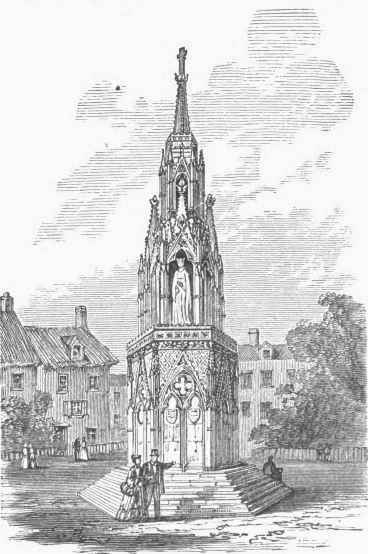
Waltham Cross, restored.
Continue to:


My Books

