


Crossbill
Description
This section is from "The American Cyclopaedia", by George Ripley And Charles A. Dana. Also available from Amazon: The New American Cyclopædia. 16 volumes complete..
Crossbill
Crossbill, a bird belonging to the order passeres, tribe conirostres, family fringillidae, and genus loxia (Linn.) or curvirostrata (Geoff.). The bill in this genus is moderate, broad at the base, with the culmen much curved, and the sides compressed to the very acute tip; the mandibles cross each other, having their lateral margins bent inward; the wings are moderate, the tail short and emarginated; the tarsi short, robust, and feathered below the knee; toes short, hind one with its claw very long; claws curved and sharp. These birds are found in the northern parts of both hemispheres, occurring in flocks in the forests of pines and firs, the seeds of which they eat; by means of the powerful bill and its peculiar construction, they pry asunder the scales of the cones; they also do much mischief in orchards by tearing open apples and pears in order, to get the pips. The European species is the L. cur-virostra (Linn.) The American crossbill is the C. Americana (Wils.). The length of the latter is 7 inches, and extent of wings 10 inches; the bill is brown, lighter on the edges, darker at the tip; iris hazel; general color a dull light red, inclining to vermilion, darker on the wings; quills and tail brownish black; the abdomen paler red, passing into whitish.
The young males have tints of yellow and green, mixed with brown; in the female the upper parts are grayish brown, tinged with green, and the rump grayish yellow, as are also the lower parts. They are found in Maine and Canada even in midwinter, and on the shores of Lake Superior are seen in large flocks in the coldest weather, about the mining locations; they are also met with as far south as Pennsylvania. They fly quickly in an undulating manner, making considerable noise; they are easily domesticated, and in their wild state seem not to fear man. The eggs are four or five, of a greenish white color, thickly covered, especially at the large end, with dark brown spots. The white-winged species (C. leucop-tera, Wils.) also inhabits the northern pine and spruce forests, the whole breadth of the continent, probably up to 68° N., where the woods terminate; it only resorts to temperate climates when forced by severe weather. The principal difference consists in the more slender bill, and in two white bands on the wings, formed by the secondary and first row of small coverts; the habits of the two species are the same.
The singular form of the bill in this genus is a striding example of the adaptation of means to ends, which everywhere meets the student of natural history.
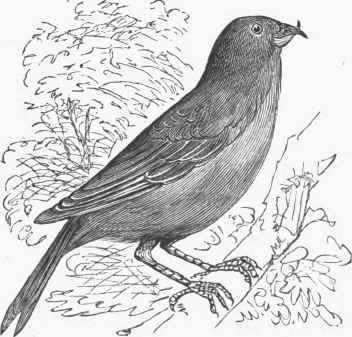
American Crossbill (Curvirostrata Americana).
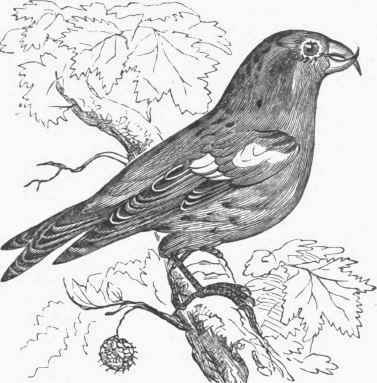
White-winged Crossbill (Curvirostrata leucoptera).
Continue to:


My Books

