


Diatomaceae,
Description
This section is from "The American Cyclopaedia", by George Ripley And Charles A. Dana. Also available from Amazon: The New American Cyclopædia. 16 volumes complete..
Diatomaceae,
Diatomaceae, minute plants growing in moist situations, in collections of fresh water or in the sea, consisting of frustules of various forms, the walls of which contain a large quantity of silex, and are often beautifully diversified and marbled by strife or by dots. Notwithstanding the general resemblance of these curious vegetations to the species of desmidieae, they are clearly made distinct by the flinty fronds, singular striation, and absence of green coloring matter. Agardh asserts that many of these organisms have as much affinity with the mineral kingdom as with the vegetable, being in fact vegetable crystals, bounded by right lines and collected into a crystalliform body, and having no other difference from minerals than that the individuals have the power of again separating from each other. As in the case of the desmidieae, there are solitary species, and others grouped so as to form lines and membranes. In some, the production of new plants from spores presents the same dissimilarity between the young and the adult forms. There are also numerous genera which can be accurately distinguished not only by the difference of form or outline, but by their own peculiar' striations, markings, and dots.
In both the single and the associated species there is a distinct pellucid peduncle or footstalk. This is sometimes considerably dilated above, or else forked, sometimes repeatedly. In this case each frustule remains attached, the base dilating as may be required. This arrangement gives a fan-like appearance of great beauty.
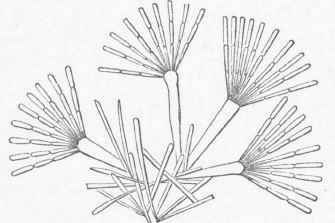
Echinella flabellata, a fan-like marine diatom.
But in the thread-like species it is only the corners that remain attached; as no stem or footstalk is visible here, it has been conjectured that it exists only in those plants which have grown from spores or in the seedling forms. Certain channels or apertures are so arranged as to convey the water to the inner cellular membranes, and thus to afford nutriment. The same curious conjugation to be seen in other algae has been detected in the diatomaeeae by Thwaites, and has been confirmed by Berkeley and Broome. It is computed that vast areas of solid earthy matter are due to the growth, presence, and decay of these minute organisms. Many of the most beautiful are found in the guano of commerce, doubtless swallowed in the food of birds, and still remaining in perfect preservation. In the United States, masses of several inches in thickness are found on the bottoms of ponds, composed of myriads of these organisms, which on being exposed to desiccation become as white and friable as chalk. Even peat bogs and meadows abound with them. The polishing powders sold under the name of tripoli are composed of these natural, silicious fragments.
The soundings on the shores of Victoria Barrier, Australia, in water whose average depth is 1,800 ft., were found by Dr. Hooker to be invariably charged with diatomaceous remains. These fossil species are often so identical with recent ones, that it would be scarcely too extravagant to admit the assertion of Ehren-berg, that species are to be found in a living state in situations where they have been propagated from times far anterior to the existence of man. The United States are rich in the diatomaeeae, both fossil and living. In the tertiary infusorial stratum of Richmond, Va., Ehrenberg detected 20 genera and 46 species, of which all were also European excepting two. This group of American forms is of peculiar interest, because the strata at Richmond are decidedly of marine origin, and consequently give at once a general view of these marine microscopic forms along the North American coast. Of the perfectly free diatoms we have many species of navicidaceoe remarkable for beauty, symmetry, or delicacy, or else for their striations. The largest, most common, and most easily distinguished is navicula viridis, of an oblong outline, found in every ditch and pond. It can be detected in great abundance in the ashes of peat, and in the deposits of infusorial earths.
Its length is about 1/96 of a line. Several of a sigmoid outline are very remarkable for the delicacy of their stria?, of which may be mentioned pleurosigma Baltica, P. hippocampus, but more particularly P. angulata. The lines of striation upon Nitzschia sigmoidea are about 1/100,000 of an inch apart. In fragilaria we have long threads of frustules adhering with considerable firmness at their commissures; but in diatoma they adhere only at a single point, so as to form curious chains of divided or separated joints. Prof. Bailey describes bacilaria paradoxa as a very interesting species, presenting by its curious motions and its paradoxical appearance an object well calculated to astonish all who behold it. At one moment the needle-shaped frustules lie side by side, forming a rectangular plate; sudden-ly one of the frustules slides forward a little way, the next slides a little also, and so on through the whole number, each, however, retaining a contact through part of its length with the adjoining ones. By this united motion the parallelogram is changed into a long line; then some of the frustules slide together again, so that the form is then much like a banner. Similar motions are constantly going on, and with such rapidity that the eye can scarcely follow them.
The cause of this motion is wholly unknown, but it is probably mechanical and not vital. Mr. Smith, in his work on the diatomaeeae, estimates this motion as being 1/200 inch per second. In meridion vernale We have one of the most beautiful of the freshwater diatoms. It consists of spiral or helicoi-dal chains, to perceive which the specimens must be tilted on edge. It occurs in immense quantities in mountain brooks, covering every submerged stone, or twig, or spear of grass, in the early days of spring. Among the groups with vittate or ribbon-like fronds, we may notice stri-atella arcuata, occurring in vast quantities on the filiform marine algae, and covering them so much oftentimes as to make them glitter in the sunbeams as if invested with crystals. In still another natural group, where the striae are no longer visible in the frustules or fronds, we find a multitude of microscopic objects, furnishing sources for fresh admiration whenever they are examined. In some of these the fronds, which are disciform, are marked with radiating lines, of which co3cinodiscus, very common in a fossil state in the Richmond earth and elsewhere, is most beautiful.
In C. lineatus the cellules of the frond form parallel lines in whatever direction they may be viewed, and G. oculus iridis gives curious colored rings. When perfect, the disk of coscinodiscus is covered with circular spots in rows corresponding with the radii. In consequence of this arrangement they also form beautiful spiral rows in other directions, so that the curves present no inconsiderable resemblance to patterns produced by engine-turning; at other times the spots are found to form three sets of linos, making angles of 60° and 120° with each other; and on others the spots are disposed without much apparent regularity, frequently having a star-like figure in the centre. The spots are so small on some of the disks as to be almost invisible even by the highest magnifying powers; on others they are quite large and hexagonal. In podiscus Rogerii (Bailey), the whole surface is so beautifully punctate that no engraving could do it justice. • The most complicated markings on the coscinodiscus scarcely rival the elaborate ornaments of this truly elegant organism. It has proved very common in Virginia and Maryland in a fossil condition. The beauty of isthmia obli-quata, detected in the mud of Boston harbor, can only be appreciated by ocular examination.
The diatomaceae enter largely into the food of the moliusca. Dr. Hooker found dictyocha aculeata in the stomachs of salpae taken off Victoria Land, and remains of diatomaceae occurred in the same ascidiums examined between the latitudes of the N. tropic and 80° S. The medusas are also in particular often filled with these forms. - See Bailey in "American Journal of Science and Arts," vols. xli., xlvi.;
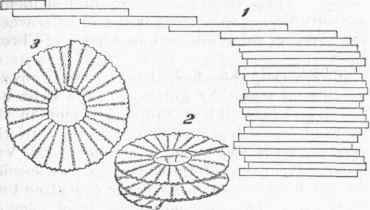
1. Bacillaria parndoxa. 2. 3. Meridion vernale.
"Proceedings of the Essex Institute," vol. i., pp. 33-48, and vol. ii., pp. 70, 71; Kutzing's Species Algarum (Leipsic, 1849); Smith's "British Diatomaceae" (2 vols. 8vo, London, 1853-'6); and Berkeley's "Introduction to Cryptogamic Botany " (London, 1857).
Continue to:


My Books

