


Dog,
Description
This section is from "The American Cyclopaedia", by George Ripley And Charles A. Dana. Also available from Amazon: The New American Cyclopædia. 16 volumes complete..
Dog,
Dog, a digitigrade carnivorous mammal, belonging to the genus cants, and to the family canidoe, which also include the wolf, fox, and jackal. The species of this family are • so nearly alike in structure that the genera canis, lupus, vulpes, etc, have been established on characters which are considered of inferior importance in other families; even the intellectual and instinctive faculties have been employed by F. Cuvier. and others in distinguishing the species, the domestic dogs being regarded as derived from several distinct though nearly allied wild canines. Except in the size of the bones, there is nothing in the osteology of this family which can bo made characteristic of the wild species or of the domestic races when compared with each other, though as a family group they are quite distinct from other digitigrades. In the skulls, the several species of wolf differ more from each other than do many domestic dogs from the wolves; as a general rule, the cranial cavity bears a greater proportion to the face as the intelligence of the animal is more marked.
The teeth of dogs, which are largest in the wild species, consist, in the upper jaw, of six incisors in the intermaxillary bones; two canines, strong, curved, and separated by an interval from the incisors; and six molars on each side, the first three, in interrupted series, being small, but with cutting edges, and called also false molars; the fourth or carnivorous tooth is bicuspid, with a small tubercle anteriorly on the inner side; the fifth is less cutting, bicuspid, with a large internal tubercle; the sixth and last is small and tubercular. In the lower jaw there are six incisors; two canines, continuous in the series, and seven molars on each side, of which four are false, the fourth being bicuspid; the fifth or carnivorous tooth has its tubercular third lobe entirely posterior; behind this are two tubercular teeth, the last being very small and frequently absent in the adult animal. The incisors are regular, the outer being the largest, and nearly perpendicular in the upper jaw; the lower canines shut in front of the upper; the tubercular character of the other teeth indicates a less carnivorous propensity than in the cat family, and that their natural diet is not exclusively animal, being better suited for carrion and broken bones than for the flesh of a living prey.
In some species, as the buansuah and the dhole, the second tubercular tooth is constantly wanting, according to Hamilton Smith. The brain cavity is comparatively small; the crests of the skull and the large temporal fossae indicate powerful muscles of mastication; the eyes are directed forward; the nostrils are largely opened in a movable glandular muzzle; the tongue is soft, thin at the edges, and capable of consid-derable extension beyond the teeth, as is seen during rapid breathing in warm weather; the pupil is round, as in other diurnal canidoe. The fore feet have five toes, the hind feet four or five; the two middle toes are the longest and equal; the fifth toe, when present, does not reach the ground; the claws are blunt, strong, not retractile, and formed for digging; the soles are furnished with tubercles, and in some arctic dogs with hair. The hair is soft and woolly near the skin, longer and coarser externally; some of the dogs of India have the skin entirely naked, this condition originating probably from some mangy disease. The tail is generally long, and is curled upward. The number of mamma3 varies from six to ten; the size, form, and color are different according to the variety.
The young open their eyes on the 10th or 12th day; the first teeth begin to be shed at the fourth month, and the growth ceases at about two years of age; gestation is about nine weeks, and the duration of life is about 10 years, though sometimes prolonged to 20. Though strong, they are not courageous in proportion to their strength; hearing is acute, and smell and vision are proverbially delicate, the former in the bloodhound, the latter in the greyhound; taste is so dull or perverted that even luxuriously fed pets will not disdain a meal of decaying flesh. Dogs are not so cleanly in their habits as cats; they drink by lapping, require water often, and turn round frequently before lying down; their bark is very different from the howl of wild canines, and expresses by its intonation fear, sorrow, anger, joy, and other feelings. All canines seem to have a natural antipathy to the cat family; and all, both wild and domesticated, and the nearly allied hyaena, are subject to hydrophobia. - There are several species of wild dogs in different parts of the earth, all of which may have been pressed into the service of man; the crossings of these with each other, with the wolf in the north, the jackal in the east, the aguara canines in the south, the fennec in Africa, and the fox everywhere, with the care of man to develop special breeds according to his wants, are sufficient to account for all the varieties of our domestic dogs.
Dogs differ in stature, in the shape of their ears and tails, and in the number of their caudal vertebras; some have an additional claw on the hind foot, or an extra false molar tooth on one side; the hair differs in color, texture, and length; and all these differences may remain as permanent varieties, like some human races, as long as the circumstances which gave rise to them continue essentially the same. When restored to the wild state, they approximate more or less closely to their original type, whether it be wolf, fox, jackal, or other wild canine. Hamilton Smith classes dogs according to their apparent affinities with wild canines in corresponding latitudes: the arctic dogs with wolves; the dogs of the south with the jackal in the old world, and with the aguara canines in South America. The Indian dogs may be traced to the prairie wolf and the Mexican coyote, and in Asia to the jungle koola. Whatever may have been their originals, it is altogether probable that the primitive dogs; like the other domestic animals, were very different from any of the present races, and perhaps from any now existing canines. - The first genus of wild dogs is lyciscus (Smith), embracing the prairie wolf and coyote of North America, and the koola of India; the head is broad, the muzzle pointed, ears erect, fur short, tail bushy; stature about 26 in.; the disposition is more peaceable than that of the wolf; the voice barking; they are gregarious and live in burrows.
It is probable that the aboriginal Indian dog is derived from the first two; the color is ashy gray, with some white on the tail and breast; when hunting in packs, these animals are hardly to be distinguished from domestic dogs. They are named L. latrans, L. cagottis, and L. tigris. The red wild dogs, forming the genus chryseus (Smith), are found in the warmer parts of Asia, Africa, and the Australian islands; the muzzle is less pointed than in lyciscus, and the tail less bushy; they are shy and fierce, seldom burrow, hunt in troops, and bark, and arc about 24 in. high; they want the second tubercular tooth in the lower jaw, and are said to have hairy soles; they destroy many of the young of the larger cats; they differ from wolves and jackals in their habits and instincts, and approximate the domestic dog in the small size of the anal glands. The buansuah of Nepaul (G. primoevus, Hodg.) is of a deep rust color above and yellowish below; it is intermediate in size between a wolf and a jackal, hunting by day or night by the scent chiefly, in small troops; there are several varieties in the wooded mountains of British India. (See Buansuah.) The dhole of India (G. scylax, Smith) is more slender than the buansuah, higher on the legs, with a sharper muzzle, long close-haired tail, and large dark ears; the color is a light bay.
The dhole of Ceylon (C. Geyloni-cus, Shaw) is an allied, if not the same species. The pariah cur dogs of India are not merely degraded mongrels, but are the offspring of an indigenous wild species living in the jungles and in the lower Himalaya range; this resembles the jackal more than the wolf, but is more bulky in body and lower on the legs; the voice is yelping and howling. Other red wild dogs are found in Sumatra and Java. The Australian dingo (G. Australasioe of authors) is a wild dog which has been partially domesticated by the natives, and is no doubt an indigenous inhabitant, not introduced by man; in its native wilds it howls in a melancholy manner, and it • is more than a match for a domestic dog of the same size; it hunts in small packs, sometimes in pairs, and is very active and fierce. It stands about 2 ft. high; the color above is fulvous spotted with white, paler on the sides and throat, and whitish below; it carries the tail horizontally, and runs with the head high and the ears turned forward.
The genus thous, of which the typical species is the wild dog of Egypt (C. anthus, F. Cuv.), resembles the wolf on a small scale, being not more than 18 in. high, of a light structure, with rather short tail, close, ochry fur, barred or pencilled with black and white; the species do not burrow, and are not gregarious, seldom howl, and have no offensive smell; they all have the tip of the tail black, and prefer rocky, sandy districts, where there are bushes and water. Hamilton Smith is of the opinion that the greyhound of the desert was originally derived from one of the species of this section. It is found from Egypt and Arabia to the Cape of Good Hope. South America when first discovered by the Spaniards had its indigenous canines, all with a tendency to elliptical pupils, though less so than in true foxes; among these are the aguara dogs, genus dusicyon (Smith). These are between the wolf and the fox in form, with bulky body and short legs; they burrow and are more social and gentle than the aguara wolf (C. jubatus, Desm.). This group seems to represent the thous of the old world, though the forehead is more rounded, and the tail consists of an imperfect brush; the prevailing color is fulvous brown, often with a hoary tinge; the face looks like that of the fox; they are not very shy, and are capable of being domesticated; they are great thieves, with a propensity to conceal objects of no use as food; besides the usual articles of diet, they will cat fish, crabs, reptiles, insects, small birds, and even mollusks and berries; they are generally silent and hunt by day or by moonlight; they are good swimmers.
Several species are described, ranging from Surinam to the Falkland islands; the domesticated specimens differ hut little from the wild originals, except in the tail being less bushy; the average height is 15 in.; there are five toes to each foot, and the gape of the mouth is large and wolf-like; they hunt pacas, agoutis, and wild gallinaceous birds. All these wild dogs cross with the domesticated ones of the country, forming the most complicated intermixtures. - Certain varieties have relapsed into a wild state. In Asia Minor there is a race of these feral dogs (as Hamilton Smith calls them), of nearly the size of the local wolf, and resembling the shepherd's dog except that they have a more bushy tail, sharper nose, and the fur reddish gray, and that they hunt in packs in open day. A smaller breed is found in Russia. In Santo Domingo there is a large feral dog of the race of hounds formerly used by the Spaniards in their western conquests; it is about 28 in. high, with a head like a terrier, and the general color pale bluish ash; its scent is very fine, and it follows its prey with great speed, attacking it with ferocity; flocks sometimes suffer from its depredations; it is believed that it was introduced into Spain from the north, such is its resemblance to the Danish dog.
In the pampas of South America are troops of feral dogs, a mixture of all the breeds of the country; their ears are erect as in true wild canines; they are bold and cunning, destroying many of the young of the wild herds of cattle and horses; when redomesticated, they are remarkable for their courage, sagacity, and acute sense of smell. - Of the true domesticated races, the arctic dogs of both hemispheres are large, of wolfish aspect, with pointed nose, erect ears, and long hair of mixed black and white; they are fierce, bold, and strong; they swim excellently, burrow in the snow, and will drag the native sledges for hours at a time several miles an hour. The arctic voyages have made readers familiar with the habits, appearance, and valuable properties of the Esquimaux clog; this species (C. borealis, Desm.) is probably the same as the Siberian dog. The Hare Indian dog (G. lagopus, Rich.), according to Sir John Richardson, is peculiar to the region of Mackenzie river and Great Bear lake; it is intermediate in size between the wolf and fox, has erect ears, bushy tail, and a general gray color, with white and black markings; the hair is long, and at its base, as in all arctic dogs, is a thick wool; it is about 14 in. high, and is used for hunting and not for draught; it is playful and affectionate, though not very docile.
In the Hudson Bay territory, in Canada, and in the Lake Superior mineral district, there is a mongrel race of dogs which take the place of horses during winter; they are hardy, easily managed, strong, bearing abuse, scanty food, and fatigue without murmur; they are invaluable to the hunter, Indian, half-breed, and traveller in these snow-clad regions; no particular breed is sought for, the only qualities valued being strength and endurance. The Newfoundland dog (C. Terras Novoe, Smith) seems to be indigenous to America; it is longer than the Esquimaux dog, less compact, with a wider muzzle, drooping ears, and long hair disposed to curl; it is a handsome and powerful dog, very intelligent, trusty, and kind; the pure breed is almost semi-palmated, making them the best water dogs; crossed with the hound, they attain an enormous size; the general color is black, with some fulvous about the eyes, nose, throat, and joints, and white about the feet and end of the tail. Anecdotes of the sagacity of this well known breed are innumerable.
The Nootka dog (C. laniger, Smith) is noted for its thick and matted fur, which the natives mix with wool and make into garments; the describer of this species thinks it indicates that the Esquimaux and Newfoundland races were derived from Asiatic originals, perhaps from the dog of Siberia. At the head of the list of the domestic canines of temperate Europe stands the shepherd's dog (C. domesticus, Linn.), still with the wolf-like stature, head, and hair; its appearance is rather unpromising; its shaggy hair is generally varied black and gray, the ears are short and erect, and the tail is bushy and curved; having been trained from time immemorial to the care of flocks, its peculiar faculties seem to be instinctive, and its sagacity, fidelity, and courage are not excelled by any species of dog; the height is not quite 2 ft., but the form is very muscular. This breed is confined to temperate and southern Europe. The true shepherd's dog attends the flocks, keeps them together, and protects them from violence. A variety called the drover's dog, somewhat larger and more rugged, is of great assistance in driving sheep and cattle to market.
The great wolf dog (C. Pomeranus? Linn.) has all the sagacity of the shepherd's dog, with a strength which enables him to resist successfully the attack of a wolf; it is large, whitish clouded with brown, with pointed nose, erect ears, and long silky hair; it is most common in southern Europe. The Alpine or St. Bernard dog is universally known; the old race resembled the Newfoundland dog, but the present dogs are short-haired, with very broad feet, and generally of a fawn color; their bark is uncommonly loud and deep. They are trained to carry food, wine, and warm coverings, attached to their bodies and necks; they depart in the morning, after violent snow storms, in search of lost travellers, and are followed by the monks. Many lives have been saved through their instrumentality; but now that the roads are better and more easily followed, and the inhabitants in the upper valleys more numerous, their services are less frequently called for. In the Subdivision of the watch dogs of F. Cuvier are found some of the largest canines, and especially the fierce races mentioned by ancient authors; they have short hair and a wide muzzle, but in their skulls they resemble the wolf; the typical color is rufous, which is more or less mixed with black and white; occupying the northern temperate zone, they are probably descended from the lyciscan dogs, mixed toward the south with the mastiff race.
They are less docile and sagacious than the former groups, but more watchful and noisy, and have considerable courage, and are therefore generally kept by the humbler classes to protect their farms; from this cause they are greatly crossed, and are doubtless the progenitors of the mongrel races of western Europe; from their moderate powers of smelling they are of little use in hunting. The Suliote dog (C. Suillus, Gmel.), sometimes called boar hound in Germany, is one of the largest and fiercest breeds; it is sometimes nearly 4 ft. high at the shoulder. Resembling this is the Danish dog (G. glaucus, Smith), but smoother, with shorter ears, and of a slaty blue color. The matin dog (G. laniarius, Linn.) has the head elongated and the forehead flat, the ears pendulous at the tips, the hair rugged, of a yellowish fawn color with blackish rays; the height is about 2 ft.; being bold, strong, and active, it is valuable for a house and sheep dog. The Poe dog (C. Pacificus, Smith) seems to be indigenous to the South sea islands, and once was very abundant in the Hawaiian group; the muzzle is pointed, the ears erect, the back long, the limbs crooked, and the hair smooth and tan-colored; its food is vegetable, with a little fish, and it is much esteemed by the natives as an article of diet; the aboriginal race is now lost, from mixture with the imported dogs of Europe. The dogs of Patagonia are as large as fox hounds, and wolf-like in appearance; those of Tierra del Fuego are smaller, resembling a cross between the fox, shepherd's dog, and terrier.
Their dogs are of great value to the natives of these regions. In France and several other countries, especially Holland, dogs are frequently employed as draught animals, and in Kamtchatka and Greenland almost exclusively for the same purpose. - Cuvier has asserted that the dog was perhaps necessary for the establishment of human society; though this may not be apparent in the most highly civilized communities, a moment's reflection will convince us that barbarous nations owe much of their elevation above the brute to the possession of the dog. That man has been able to make such extensive use of this animal must depend on innate qualities in the races, as, for instance, keenness of scent and the desire to chase, in the hound; the impulse to seek objects, in the spaniel and pointer; the tendency to watch and guard in the shepherd's dog and mastiff. The activity of their brain is shown by their proneness to dream. It is said that the ancients were fond of the flesh of dogs; it is well known that the Polynesians, Chinese, and American Indians consider it a great delicacy; when fed principally on vegetable food, it is palatable and nutritious. - The monuments of Egypt show that dogs, like men, were as distinct in their races thousands of years ago as now; and it becomes interesting to inquire if there are fossil dogs.
Fossil canines have certainly been found, but these have been referred without examination as a matter of course to wolves, foxes, and jackals, and not to dogs; they are chiefly met with in the pliocene caves, in the drift, and in the alluvium. The fact has been already mentioned that it is very difficult to distinguish the different species of canidoe by their skeletons, except by the size of the bones. The domestic dogs have the last tubercular tooth wider than that of the wolf, and the teeth of many of the cave dogs differ from those of the domestic races only in being larger. Dr. Lund discovered fossil dogs larger than any now living in the caves of Brazil, associated with an extinct monkey; a similar association has been found in a stratum of marl, under compact limestone, in the Pyrenees. Dr. Schmerling has described several fossils of the true dog, evidently belonging to two distinct varieties, differing in size from those of the wolf and fox found in the same locality. Cuvier says of the bones of a fossil canis from the cave of Gailenreuth, that they resemble those of the dog more than the wolf, yet he does not positively declare them to belong to the former.
Marcel de Serres has described two species of dogs found in a marine tertiary limestone, one resembling the pointer, the other much smaller. The frontal elevation in the skull of the dog is greater than that of the wolf, and the skull of a small canine with this character strongly marked, from a bone cave in England, was pronounced by Mr. Clift that of a small bulldog or a large pug. Distinct traces of at least four types of dogs have been found in a fossil state, the Canary dog, the pointer, the hound, and the bulldog, with a smaller one classed by Schmerling with the turnspit; and as many of these are known to be hybrids, the list must probably be further enlarged. The certain antiquity of these bones, whether they have been referred to the proper race of dogs or not, is sufficient to destroy the claims of the wolf, jackal, or fox to the exclusive paternity of the domestic dogs. As there are undoubted wild canines which are true dogs, there is no improbability that some of these fossil remains may have belonged to such prior to their subjugation and domestication by man; and there is no more necessity of referring the fossil canines to a single species than the domesticated ones.
The size of the fossil dogs is no greater than that of some living races mentioned in the text. - Those desirous of pursuing the subject of dogs more fully are referred to the writings of Buffon, Frederic Cuvier, and Col. Hamilton Smith. See also Beagle, Bloodhound, Bulldog, Greyhound, Hound, Mastiff, Pointer, Spaniel, and Terrier.
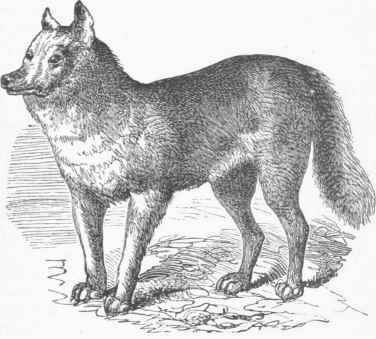
Dingo.
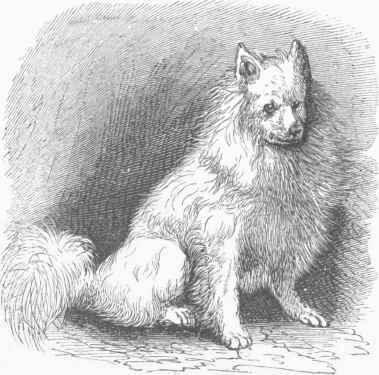
Esquimaux Dog.

Newfoundland Dog.

Shepherd's Dog.

St. Bernard Dog.
Continue to:


My Books

