


Emu
Description
This section is from "The American Cyclopaedia", by George Ripley And Charles A. Dana. Also available from Amazon: The New American Cyclopædia. 16 volumes complete..
Emu
Emu (dromaius Nova IIollandioe, Latham), a bird closely allied to the cassowary, a native of Australia and the adjacent islands. The emu differs from the cassowary in its broader bill, in its head covered with feathers above, and in its smaller and more obtuse claws; as in the latter, the cheeks and sides of the neck are naked, the legs long and robust and protected by strong scales, and the wings and tail not apparent; the middle toe is the longest, the inner the shortest. This bird was named emu by the English colonists, who confounded it with the cassowary or emu of the Moluccas; to distinguish them, ornithologists call the present bird the New Holland emu. There is only one species of the genus, living in the eucalyptus and casuarina forests in the Australian islands. Its length is about 7 ft.; its plumage is thick, and of a brownish color. The feathers are remarkable from their two central stems being united at the base, bearing simple barbs, and sometimes very short barbules. The form is thick and heavy, the back arched, the denuded neck of a violet color, and the feathers on the head are few, simple, and hair-like. The emu presents the closest analogy to the ostrich in its anatomical structure; a wide membranous sac is formed below the crop by a dilatation of the oesophagus, which ends in a slightly developed gizzard; the intestinal canal is about 16 ft. long; the windpipe is very long, and at its 52d ring opens into an immense muscular sac, whose use is not well ascertained; according to Wagner, the bones of the wrist are wanting in this bird.
The natives of New South Wales call the emu parembang. It is timid, runs with great rapidity, and is very rarely taken ; it was once common in the neighborhood of Sydney, but civilization has driven it beyond the Blue mountains. It prefers open shrubby places and sandy plains. When pursued it takes readily to the water, and swims with its body mostly submerged. It feeds on fruits, berries, roots, and various herbs. The female lays six or seven eggs, in a slight hollow scratched in the earth; the male hatches the eggs, and takes care of the brood until they can provide for themselves; the young are grayish with four bands of bright red. The flesh is eaten by the natives, and is said to have the taste of beef.
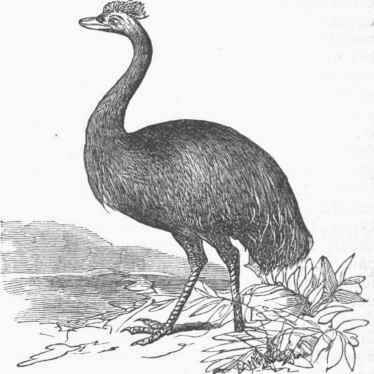
Emu (Dromaius Novae Hollandiae).
Continue to:


My Books

