


Encrinite
Description
This section is from "The American Cyclopaedia", by George Ripley And Charles A. Dana. Also available from Amazon: The New American Cyclopædia. 16 volumes complete..
Encrinite
Encrinite (Gr. a lily), a fossil genus of the order of crinoids, of the class echino-derms. It appeared among the earliest forms of animal life, its remains being preserved in the rocks of the Silurian period. In succeeding formations, nearly to the lias, they are often so abundant that calcareous strata extending over many miles are in great part made up of them. As described by Miller in his work on the crinoids, the animals of this family are furnished " with a round, oval, or angular column composed of numerous articulating joints, supporting at its summit a series of plates or joints, which form a cup-like body containing the viscera, from whose upper rim proceed five articulated arms, dividing into tentaculated fingers more or less numerous surrounding the aperture of the mouth." In the encrinite the stem is cylindrical; in the kindred genus pentacrinite it is five-sided. The cup-like body is the portion representing the flower of the lily, for which the creature is named. When the tentacula are spread out, the appearance is that of an opened flower; when closed, they represent the bud.
The stem served to attach the animal to any bodies in the water, and by the manner of articulation of the plates composing it, it admitted of much motion, swaying back and forth. By this means the head with its tentacula was brought within reach of its prey. The plates of the stem, separating into short cylinders, present the form in which the remains of this animal are most commonly seen. In the marble used for chimney pieces they are often very abundant, the polished surface presenting some of them of a different color from the ground in longitudinal section, some in oblique conical-formed cutting, and some in circular disks, being transverse sections. By the disintegration of the rock the little joints of the fossil stem frequently fall out, and may be gathered in great numbers. Each has a hole through its centre. Dr. Mantell says he has found them preserved in tumuli of the ancient Britons, having evidently been worn as ornaments. In the north of England they are called "wheel stones" and St. Cuthbert's beads," and were formerly used for rosaries.
The en-crinites are remarkable for the multiplicity of small calcareous pieces, which make up the various parts of the animal - the stem, the parts that may be called the ten arms, the hands and fingers, and the numerous tentacula which proceed from them all. These pieces, as enumerated by Parkinson in his "Organic Remains," amount to not less than 26,000, thus showing a complexity of structure equal to any that is met with in the nearest living analogues of these ancient animals. The structure of one of the fossil pentacrinites (a genus which began to abound as the encrinite disappeared, and has been represented in some of its species down to the present time from the lias, or indeed in a single species from epochs much more remote) has been cited by Dr. Buckland as " showing an equal degree of perfection, and a more elaborate combination of analogous organs than occurs in any other fossil species of more recent date, or in its living representative." The species thus cited is the Briarean pentacrinite of the lias.
The pentacrinus caput medusa is almost the only living analogue of the ancient crinoids. (See Ceinoidea.)
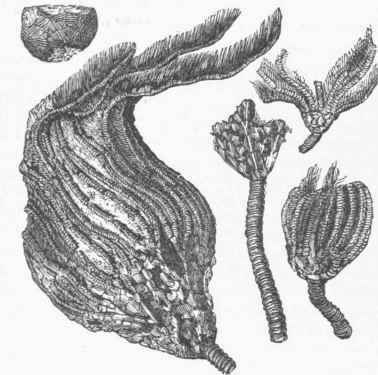
Enceinttes. - 1. Periechorinus (Actinocrinus). 2. Stem and Pelvis of ditto. 8. Pelvis of Crotalocrinus (Cyathocrinus). 4. Dimeracrinus Scosidactylus. 5. D. Decadactylus.
Continue to:


My Books

