


Gipsies, Or Gipseys Gypsies
Description
This section is from "The American Cyclopaedia", by George Ripley And Charles A. Dana. Also available from Amazon: The New American Cyclopædia. 16 volumes complete..
Gipsies, Or Gipseys Gypsies
Gipsies, Or Gipseys Gypsies , (a corruption of the word Egyptians), a vagabond people now found in most parts of the world. The names given to them by other nations are: Zingari in Italy, Gitanos in Spain, Zigeuner in Germany, Cziganyok in Hungary, Tzigani in Slavic countries, Tchinganeh in Turkey, Bohemiens in France (as they pretended to come from Bohemia), etc. They are also nicknamed Mattois, Gueux, Cagoux, and their language Blesquin in France; Zieh-Gauner (wandering rogues) in Germany, heathens in Holland, Tartars in Sweden, etc. They call themselves Kale or Mellele (the black), Mellelitchel (black people), Sinde or Sinte (probably from the Sanskrit Saindhavas, people of the Indies), but more commonly by some word signifying " people1' in the various gypsy dialects, as Manush, Rom, feminine Romni. As they are ignorant of their origin, and as history has failed to record their migrations, there are very many opinions on the subject. Hasse and Schirak attempted to connect them with the  of Herodotus, north of the lower Ister (Danube), reported to be of Median origin. Butt-ner, Rudiger, Baemeister, Pallas, and Grell-mann consider them to have come from India, whence they were driven by the ravages of Tamerlane (1398), and where they belonged to the Soodra caste, or to the Pariahs. Hiob Ludolf (Commentaries ad Historiam AEthi-opicam, 1691) gave a list of words supposed to be Egyptian, but which are rather Slavic. There are many roving tribes in India and Persia which resemble the gypsies. In northern Persia they are known as Karatchi, and in Kermanshah and Kurdistan as Kauli and Sus-mani. The Zingarro or Chungur of the Pun-jaub are also a wandering race. Vigne holds that modern gypsies are descendants of Cashmere Hindoos who fled from persecution toward the end of the 14th century. Arab Shah, who lived at Samarcand in 1422, says in his "Life of Timour" that the gypsies were probably descendants of Buddhists who emigrated about 300 B. C, when persecuted by Nara. In a paraphrase of the book of Genesis, written by an Austrian monk in 1122, similar vagrants were noticed as being Ishmaelites; but organized bands of gypsies first appeared in the Danubian provinces in 1417. They numbered about 14,000 in Italy as early as 1422. On Aug. 17, 1427, arrived at Paris a band of 120 strangers, claiming to be Christians of Lower Egypt who had been expelled by the Saracens. They said they had last come from Bohemia. They professed the gifts of fortune-telling and palmistry, and were great thieves.
They were expelled from Paris, but continued to wander in France, and other bands succeeded them. They appeared in Spain in 1447, in England about 1506, and in Sweden in 1514. Wherever they came they practised the arts of thieving and deception. Severe laws were passed against them, but these measures, not being simultaneous in the various states, failed of their effect. Spain exiled them in 1492, and about a century later renewed the decree of banishment. In England, Henry VIII. issued in 1530 a proclamation, subsequently renewed by Elizabeth, which made their stay in England for over a month a capital felony. The Scottish kings pursued a different policy, and seem to have given them a sort of protection. Italy, Denmark, Sweden, the Netherlands, and Germany took measures against them. In the first half of the 10th century they probably received an accession of numbers from Egypt, for in 1517 a revolt against the conquest of Sultan Selim took place under one Zinganeus, whose followers, being banished, took to wandering throughout the world in small companies. The sovereigns of Germany made efforts to reclaim and settle the gypsies.
Maria Theresa in 1768 ordered that the numerous bands throughout her dominions should be gathered in settled habitations, practise some trade, have their children educated, and be called Neubauern, new peasants. As they failed to obey, severer measures were enforced by Joseph II. in 1782, and at present the gypsies of Hungary, Transylvania, and Roumania, together about 250,-000, lead a more settled life than their brethren anywhere else. In Transylvania they are under the rule of a waywode of their own race, elected by themselves. They are likewise numerous in the southern provinces of Russia and in Turkey generally. Spain contains about 40,-000, some of whom follow a mixed occupation, as keepers of wine shops and horse dealers. A considerable number are in Norway; in France there are few or none; and in England their numbers have decreased to about 10,000. Estimates of the total number of gypsies in Europe are variously given from 500,000 to 700,-000. The laws against them have in most countries fallen into desuetude, they having to contend with a stronger force than legal prohibitions in the increase of intelligence among the rural population, who were formerly their patrons and victims.
In England the oppressive statutes against them were repealed in 1783, 1820, and 1856. - The gypsy physiognomy is Asiatic in type, with tawny complexion, quick black eyes, black hair, high cheek bones, slightly projecting lower jaw, narrow mouth with fine white teeth, which, with their lithe and agile figure, causes some of their young women to be considered beauties. Their habits are, however, so squalid and depraved as to cause them before they are past middle age to fall into decrepitude. The gypsies have few redeeming characteristics. They are treacherous, cowardly, revengeful, and cruel. They have little or no religious belief, and no words in their language to signify God, the soul, or immortality. Velasquez says, "The gypsies' church was built of lard, and the dogs ate it." Marriage is a temporary form with them, and the limits of consanguinity are not respected. They pretend that their skill in palmistry is the lore of the Egyptians. Their industry reaches no higher than the tinkering of hardware and turning small articles in wood, with occasionally some-assistance reluctantly given in farm labor. In Transylvania they do a little in washing gold. They frequently act as musicians, as they have a remarkable quickness in acquiring tunes by ear.
Some of them, as Keeskemeti, Kalozdy, and Bunko, have been celebrated violinists. The young persons of both sexes are fond of dancing, and exhibit their skill for money,, especially in Spain. The men wear no distinguishing dress from other similar vagabonds, but the women indulge their passion for gay colors and trinkets. In England the recognized gypsy woman's apparel is a red cloak with a hood, and a handkerchief tied over the head. Their huts are mere kennels of earth and boughs. It has been a question whether a band of genuine gypsies has ever been in America; but many English authorities maintain that the decrease of their number in the British isles is in a great measure due to their having emigrated to the United States. - The language of the gypsies, though everywhere preserving forms of an unmistakably Indian origin, differs greatly in the various countries in which it is spoken. The best known are the English, German, Hungarian, and Spanish gypsy dialects. We shall confine ourselves to the English dialect, and follow the statements made in regard to it by Bath C. Smart before the English philological society in London. The English gypsies generally use the English article, and but seldom their own forms, o for the masculine and y for the feminine.
Nouns generally terminate in a consonant, or else in o when masculine, and in i or y when feminine. The genitive is formed by adding esko or esto; the plural by you or or, and sometimes with an additional s, taken from English; as skam-min, a chair, skamminyors, chairs. Adjectives have invariably a final o or y, added even to English words. The comparative is formed by adding dair or dairo when there are no special forms, like coosko, good, fetterdairo, better. There seems to be no superlative termination. The pronouns are in many cases preserved in their original form, as you, he; lesty, his; yoi, she; latty, her. Instead of "I," they use "me," but for "of me" they return to their own mandy. The numerals are : yek, one; dooey, two; tring, three; stor, four; panch, five; shov, six; afta, seven; oitoo, eight; enneah, nine; and desh, ten. Afta, oitoo, and enneah are, however, of rare occurrence. Verbs are generally inflected as in English, but av is sometimes added as a sign of the first, and ella or I of the third person singular. Prepositions are: agal, before; ad-rey, within; aprey, upon; taley, down; paw-del, over.
The ease with which the gypsies introduce foreign words into their own speech will be seen from the following proverbs given by Charles G. Leland in his book "The English Gypsies and their Language " (London, 1873) :
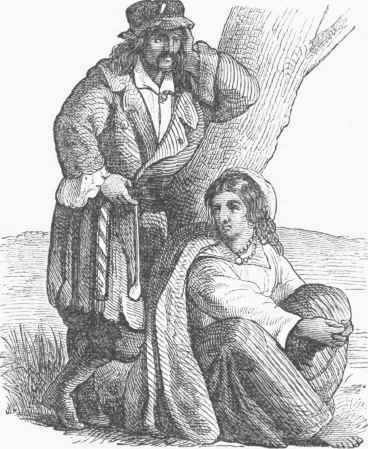
Bohemian Gypsies.
A cloudy Bala often purabens to a fino divvus. A cloudy morning often changes to a fine day.
It's sim io a choomer, kushti for kek till ifs It's like a kiss, good for nothing until it is pordered atween dui. divided between two.
- Works on the gypsies and their dialects are : Valentge's "Description of the East Indies " (Amsterdam, 1724-'6); Peyssonel, Sur les peu-ples barbares qui out habite sur les bords du Danube (1705); Pray, Annates Begum Hungarioe (5 vols, fol., Vienna, 1764-'70); Grell-mann, Historische Versuche uber die Zigeuner (Gottingen, 2d ed., 1787); Molnar, Specimen Linguoe Cingaricoe (Debreczin, 1798); Gardiner, " Essays, Literary, Political," etc. (Edinburgh, 1803); Hasse, Zigeuner im Herodot (Konigsberg, 1803); Bischoff, Deutsch-Zigeu-nerisches Worterbuch (Hmenau, 1827); John Staples Harriot, in the "Transactions of the Asiatic Society" for 1831; Cogalniceano, Es-quisse sur l'histoire, les moeurs et la langue des Cigains (Berlin, 1837); Predari, Origine e vi-cende dei Zingari (Milan, 1841); George Borrow, "The Zincali, or an Account of the Gypsies of Spain" (2 vols., London, 1841); Von Heister, Ethnographic und geschichtliche Noti-zen uber die Zigeuner (Konigsberg, 1842); Pott, Die Zigeuner in Europa und Asien (Halle, 1844-'5); Bataillard, De l'apparition et de la dispersion des Bohemiens en Europe (in the 5th vol. of the Bibliotheque de l'ecole de Chartres, 1844); Bohtlingk, Die Sprache der Zigeuner in Russland (St. Petersburg, 1852); Jimenez, Vocabulario del dialecto jitano (Madrid, 1854); Liebich, Die Zigeunef in ihrem Wesen und in ihrer Sprache (Leipsic, 1863); Ascoli, Zi-guenerisches (Halle, 18G5); Simson, "History of the Gypsies" (London, 1865); Kivasnikoff, "Collection of Songs of the Russian Gypsies," in Russian (Moscow, 18G9); Borrow, "Lavo-Lil: Word Book of the Romany or English Gypsy Language " (London, 1874); and numerous articles in the publications of philological societies.
Continue to:


My Books

