


Gotha
Description
This section is from "The American Cyclopaedia", by George Ripley And Charles A. Dana. Also available from Amazon: The New American Cyclopædia. 16 volumes complete..
Gotha
Gotha ,.I. Formerly an independent duchy (Saxe-Gotha), but now politically united with Coburg under the name of Saxe-Coburg-Gotha; pop. of Gotha in 1871, 122,030. (See Saxe-COBURG-GOTHA.) II. The capital, and alternately with Coburg the residence of the duke; pop. in 1871, 20,591. It is the principal station of the Thuringian railway, by which the distance to Halle is 83 m. and to Weimar 30 m. The palace of Friedenstein adjoins the town, and contains collections of tine arts and one of the richest collections of coins in Europe; also a library with upward of 200,000 volumes and more than 6,000 manuscripts, among which are 14 folio volumes of St. Bernard's correspondence and about 3,000 Arabic and Persian manuscripts. Gotha has a famous gymnasium, many excellent educational and charitable institutions, and an observatory established in 1859 by Hansen. It is one of the most prosperous trading and manufacturing places of Thuringia. It is the seat of a celebrated fire and life insurance company, and of the geographical establishment of Justus Perthes, the publisher of the Almanack de Gotha.
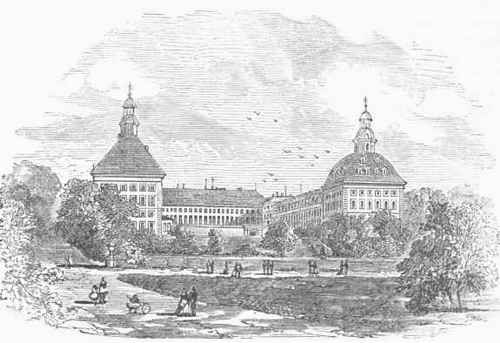
The Ducal Palace, Gotha.
Continue to:


My Books

