


Guava
Description
This section is from "The American Cyclopaedia", by George Ripley And Charles A. Dana. Also available from Amazon: The New American Cyclopædia. 16 volumes complete..
Guava
Guava , (Span, guayaba), a name for trees of the genus psidium, belonging to the myrtle family. There are about 100 species of the genus, which grow in tropical and sub-tropical America, though the number that bear edible fruit is small. The one best known as the guava is P. guaiava, of which there are several cultivated forms, differing in the size, shape, and quality of their fruit. It is a small tree, from 9 to 15 ft., seldom over 20 ft. high, with angular branches, and an abundance of elliptical pointed leaves, which are covered below with a velvety down. The flowers are solitary or three together in the axils of the upper leaves, about an inch in diameter, white, and with an agreeable odor; the fruit, usually about an inch in diameter, varies in size and shape; the principal cultivated varieties are called maliforme, apple-shaped, and pyriforme, pear-shaped, from the form of the fruit. Guavas are bright yellow, exceedingly fragrant, and filled with a yellowish or reddish seedy pulp, which has an acid-sweet flavor, but is rather disappointing to the taste after the sense of smell has been gratified by its odor.
The guava grows abundantly in the West Indies, has been acclimated in Algeria and other warm countries, and is cultivated under glass for its ornamental foliage and flowers as well as for its fruit. Catt-ley's or the purple guava, P. Catileyanum, though brought to Europe from China, is probably a native of South America; it is much more hardy than the common guava, and though its claret-colored fruits, with a pitted rind, are smaller and more acid, it produces them in greater abundance. The wood of the guavas is close-grained, but their principal value is in their fruit, which is consumed in the fresh state, and large quantities are made into jelly.
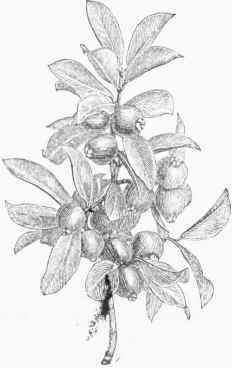
Guava (Psidium Catlleyanurn).
Continue to:


My Books

