


Gudgeon
Description
This section is from "The American Cyclopaedia", by George Ripley And Charles A. Dana. Also available from Amazon: The New American Cyclopædia. 16 volumes complete..
Gudgeon
Gudgeon , a cyprinoid fish of the genus gobio (Cuv.), found chiefly in the fresh-water streams and lakes of central and temperate Europe. It is characterized by a lengthened, rounded body, with short dorsal and anal fins without serrated rays; a labial barbel at each corner of the mouth; pharyngeal teeth, conical, slightly curved at the tip, and in two rows; and a wide, flattened head, with an obtuse snout, and the lower jaw the shorter; the swimming bladder is large and double. The common gudgeon (G.fluviatilis, Cuv.) is 7 or 8 in. long, greenish brown above and on the sides, white below, the pectorals, ventrals, and anal grayish white tinged with brown, and the dorsal and caudal pale brown, with darker spots. It occurs in shoals in the gravelly waters of Europe. The food consists of worms, aquatic insects and larvae, small mollusks, ova, and fry; the eggs are laid between April and August, and the young grow to a length of about 5 in. the first year. It is much esteemed for its delicate flavor, and affords good sport to the angler; it will bite at all times of day, but best in the morning and evening, and in cloudy weather; the line must be very fine, and the hook kept within an inch of the bottom; the best bait is the common red dunghill worm.
Five other species are described in Europe and Asia, and one from the Niagara river (G. cataractoe, Val.), about 5 in. long; the color of this above is gray, plumbeous on the sides, silvery white below, and the fins gray.
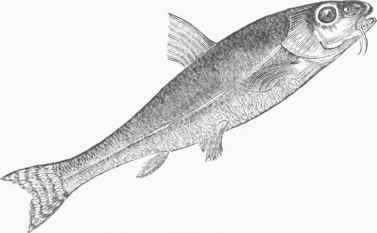
Gudgeon (Gobio fluviatilis).
Continue to:


My Books

