


Gull
Description
This section is from "The American Cyclopaedia", by George Ripley And Charles A. Dana. Also available from Amazon: The New American Cyclopædia. 16 volumes complete..
Gull
Gull , a web-footed bird, comprising several genera of the family laridoe, of which the typical genus larus (Linn.) is found over the marine portions of the entire world. The bill varies considerably in form and strength, though it is generally straight, with compressed sides, and curved at the end; nostrils lateral and oblong; wings long and pointed; tail usually even; tarsi robust; anterior toes united by a full web, and the hind toe short and elevated. The genus larus contains the largest and best known of the gulls, characterized by a strong hooked bill, nearly even tail, light-colored mantle, and white head. The largest of the gulls is the glaucous or burgomaster (L. glaucus, Brunnich), 30 in. long, with an alar extent of 5 ft.; the bill about 3 in., very stout, gamboge yellow, with a reddish orange patch near the end of the lower mandible; the general color is pure white, with a light grayish blue tinge on the back and wings. It is an inhabitant of the arctic seas, coming down in winter as far as New York. It is exceedingly shy, and notoriously voracious, eating fish, small birds, and carrion; it is less noisy than most other species. The eggs are pale purplish gray, with spots of brown and purple.
The young, as in gulls generally, are pale yellowish brown, with spots and bars of dusky. The black-backed gull (L. marinus, Linn.) is about the size of the last, from which it may be distinguished by the dark slate color of its back and wings, the black white-tipped primaries, and the yellow legs and feet. It is found from the entrance of Baffin bay to Maine, its favorite breeding places being on the coast of Labrador; in winter it goes as far south as Florida. It is a high, powerful, and majestic flier, resembling in this respect, as well as in its voracious habits, the vultures; it breasts the fiercest gales, skimming along the tops of the waves; it is a good walker, a light but slow swimmer, and no diver. It preys upon fish, young birds, eggs, and any floating carrion; in fact, upon everything except vegetable food; tyrannical and strong, it is also very cowardly, flying off when the bold little skuas or jagers (stercorarivs) attack or approach it. It is exceedingly shy, and very noisy in the breeding season; in captivity it is very long-lived. The breeding season is from the middle of May to the middle of June, and only one brood is raised in a year; the nest, composed of weeds and grasses, is placed upon rocky shelves, and the eggs, usually three, are about 3 by 2 in., of a pale greenish gray, with dark spots and blotches; both sexes take part in incubation, and the young are fed at first by regurgitation.
The eggs, like those of gulls generally, are good eating; great numbers of the young, when nearly able to fly, are killed and salted as food for the fishermen of Labrador and Newfoundland; the old birds are tough and unfit for food. The plumage is soft and thick, and is esteemed for pillows and similar articles. The herring or silvery gull (L. argentatus, Brunn.) is about 23 in. long, and 53 in alar extent; it resembles a small glaucous gull, except that the first six primaries are marked with black. This is a very shy species, with a powerful and graceful flight; it feeds principally on herring, and on the usual food of gulls. It is found from Newfoundland to Texas, and goes inland to the western rivers and northern lakes; it breeds from Labrador to Maine, nesting, when persecuted by man, on high trees; the eggs, about 3 by 2 in., are usually three, of a dull yellow color with spots and blotches of umber brown, and are excellent as food. - In the genus chroicocephalus (Eyton) the bill is moderate, slender, and much compressed; the size is small, and the head in the spring plumage has a dark hood, becoming white in winter; the contrast of black and white makes them very handsome birds.
The laughing gull (C. atricilla, Linn.), 17 in. long, has the mantle and wings bluish gray, the hood dark leaden gray, and white lines on the lids; found from Massachusetts to Texas. Bonaparte's gull (G. Bonapartei, Rich.), about 15 in. long, has a light mantle, grayish black hood, and a white band divided by a narrow black line around the posterior part of the eye; it is found from Nova Scotia to Texas, on the western rivers and lakes, the Pacific coast, and in the fur countries; in the neighborhood of Pu-get's sound it is eaten by some Indian tribes. - In the genus rissa (Leach), including the kittiwakes, the bill is long but strong, and the hind toe rudimentary or very small. The three-toed gull, or kittiwake (R. tridactylvs, Linn.), 17 in. long, has a pearl-gray mantle, the ends of the outer primaries black, and a general white plumage; it is found from Labrador and the fur countries to the southern coast in winter. There are three other species on the N. W. coast. - The ivory gull (pagophila burnea, Gmel.), about 19 in. long, has an entirely white plumage, with an ivory yellow bill, dusky at the base; all the species of the genus are found far at sea in high northern latitudes, where they feed principally on the flesh and fat of cetacean animals.
The larger and the arctic species, the former called goe-lands, are found also on the European continent. The common gull of Europe is the L. canus (Linn.). The larger terns, of similar appearance and habits but smaller size, are often called gulls.
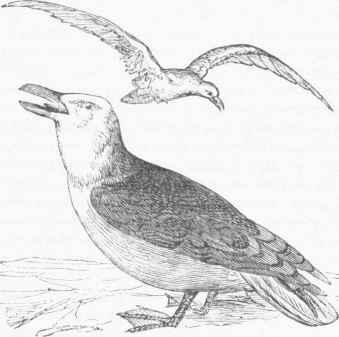
Black-backed Gull (Larus marinus).
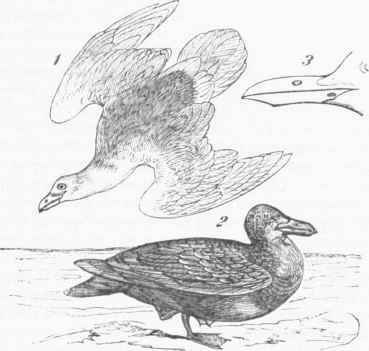
Silvery (lull (Larus argentatus). 1. Adult. 2. Young. 8. Bill.
Continue to:


My Books

