


Hamah, Or Hamath
Description
This section is from "The American Cyclopaedia", by George Ripley And Charles A. Dana. Also available from Amazon: The New American Cyclopædia. 16 volumes complete..
Hamah, Or Hamath
Hamah, Or Hamath (lleb., fortress or citadel), a city of northern Syria, situated on both sides of the Asi or Orontes, about 30 m. N. of Homs; pop. about 40,000, of whom about 10,000 are Greeks or fellahs belonging to the Greek church, about 800 Jacobites, and the remainder Moslems, the Jews having entirely disappeared. The Christian quarter in the S. \Y. part of the city is described by Burton as filthy and miserable. Four bridges span the river, and several huge wheels turned by the current raise the water to the level of the houses and fields. Each aqueduct and wheel is the property of a limited company. There are 24 minarets. An interesting part of modern Hamah is the castle mound, which, like that of Homs, was probably the site of an ancient temple. - It appears from Scripture that Hamath was the capital of a kingdom at the period of the exodus. Its king Toi yielded allegiance to David. Hamath was called great by Amos, and was ranked by the Assyrians among their most important conquests. According to Genesis, it was originally inhabited by the Canaanites, and it is frequently mentioned as the northern border of the promised land.
Under the name Epiphania it became famous in the days of the Seleucidae, and it is said that Seleucus Nicator kept there his stud of 500 elephants and 30,-000 brood mares. Under the Moslem rule it produced the celebrated scholar Abulfeda, prince of Hamah. The town has recently attracted considerable attention from the number of stones bearing inscriptions which have been found there. Burckhardt noticed these stones in 1812, but they remained in obscurity till 1870. when J. A. Johnson, consul general for the United States at Beyrout, and the Rev. S. Jessup of the Syrian mission, rediscovered them while looking through the bazaar of the old town. Copies and impressions of the inscriptions were carried to England by Burton and Tyrwhitt-Drake, and to the United States by Lieut. Steever and Prof. Paine. Copies of them have been published by the English exploration fund, by the anthropological society of Great Britain and Ireland, and by the Palestine exploration society of New York. Those issued by the last named in September, 1873, are absolute facsimiles prepared by W. II. Ward after the impressions of Steever and Paine. The inscriptions have been discussed by many eminent scholars, and notices of them have been published by Burton, Eisenlohr, Pe-termann, Hyde Clark, E. Thomas, Carter Blake, Staniland Wake, the Rev. Dunbar J. Heath, and others.
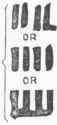
The stones are of black basalt, and the inscriptions are in relief. The writing is of an unknown character. Some of the signs resemble the Cypriote and others the Him-yaritic. Mr. E. Thomas has discovered that some small clay impressions of seals in the British museum are in the Hamath character; they had been attached to documents in the palace of Sennacherib at Nineveh, and date from about 700 B. C. In the Assyrian inscriptions appear a few notices of Hamath, which tend to show that the inhabitants were Semites, and that their neighbors to the north were a powerful tribe, called the Patina, who spoke a non-Semitic language. As the stones may have been removed from their original site to be used for building purposes in Hamath, it is possible that the inscriptions belong to the Patina. The various characters found in the Hamath inscriptions are shown in the preceding column.
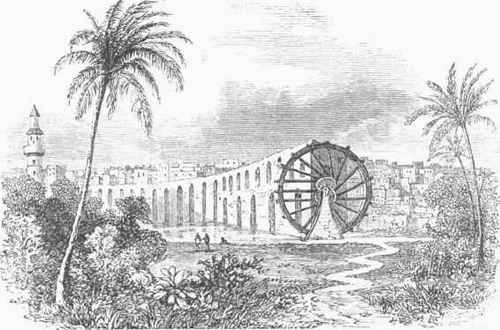
Hamah.
1
2

3

4

5

6

7

8

9

10

11

12

13

14

15

16

17

18

19

20

21

22

23

24

25

26

27

28

29

30

31

32

33

34

35

36

37

38

39

40

41

42

43 44

45

46

47
48

49

50

51

52

53

54


Characters of the Hamath Inscriptions.
Continue to:


My Books

