


Hornet
Description
This section is from "The American Cyclopaedia", by George Ripley And Charles A. Dana. Also available from Amazon: The New American Cyclopædia. 16 volumes complete..
Hornet
Hornet , a stinging hymenopterous insect, of the family diplopvera and tribe of vespiarioe or wasps, under which title their family and generic characters will be given. The European hornet (vespa crabro, Linn.) is about an inch long, larger than the common wasp; the thorax is black in the middle, and brown elsewhere; the abdomen is black with yellow borders, and below yellow with black spots; the upper lip yellow, and the eyes blackish; the body smooth; the wings are longitudinally folded, and the mandibles strong and dentated. The hornets, like the wasps, live in society, in nests containing males, females, and neuters, the last two of which do all the work and are armed with a venomous sting; their societies are republican, several females and their broods living and working harmoniously together. The nest is built on decayed trees, old posts, and in almost any sheltered place in barns and porticoes; it is of a rounded form, made of coarse materials, and of the color of faded leaves; the materials of which it is composed are prepared from particles of old wood or bark by their mandibles, reduced to a kind of papier mache or soft pasteboard; with this, after the inside of the nest has been thickly plastered, they make horizontal combs suspended from above by strong columns, the central being the largest; the cells are hexagonal, with the opening downward.
A few females, or perhaps a single one, having escaped the rigors of winter, begin to construct a few cells and lay their eggs in the spring, the first broods being neuters, which when perfect help their mothers in the domestic economy of the nest; the larva are footless, each enclosed in a separate cell, where it is fed on insects and honey stolen from bees; when the larvae have acquired their full growth, they line the cell with silk, covering the opening, and in this undergo their metamorphosis. The neuters aid in building the other nests, and infeeding the successive broods of larvae; as the family increases, new cells and additional platforms are constructed. The young females and young males come forth about the beginning of autumn, and all larvae which cannot become perfect before cold weather are destroyed by the neuters; the males perform no labor; both sexes meet on the trees in autumn, feeding on saccharine juices, and soon perish from the cold. There are about 150 individuals in a nest. Hornets prey upon other insects, especially flies, upon flesh, and ripe and sweet fruits; they also rob bees of their honey; a hornet's nest suspended in a place infested by flies will soon perceptibly diminish their numbers.
If their nest be disturbed, they fiercely attack and sting the in-trader, causing a painful and frequently dangerous wound. The wasp called hornet or "yellow jacket" in New England is the I'. maculata (Linn.); it is too common to need any description, and its habits are those of the family; it is often seen on trees infested with aphides or plant lice, for the sake of devouring and of carrying to its young the honey dew or sugary excretion of these insects. This species is very fierce if attacked. The nests of some of the South American species, cleared of the platforms of cells, are used as baskets, being light, strong, and very tight. Hornets, like the other wasps, make no honey. Many large wasps, varied with black and yellow, are called hornets in different parts of the country.
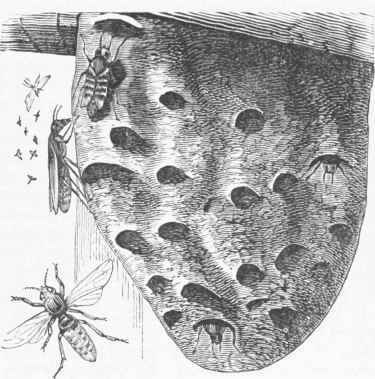
Hornet and Nest.
Continue to:


My Books

