


Ibis
Description
This section is from "The American Cyclopaedia", by George Ripley And Charles A. Dana. Also available from Amazon: The New American Cyclopædia. 16 volumes complete..
Ibis
Ibis, a wading bird of the family tantalidae, including the genera ibis (Moehr.) and geronti-cus (Wagl.); the genus tantalus (Linn.) will be noticed under Wood Ibis. The genus ibis is characterized by a lengthened, slender bill, curved for its whole length, with the sides compressed and tip obtuse; the nostrils are in a groove which extends to the tip of the upper mandible; forehead and base of bill, to behind the eyes and on the chin, in most species bare; wings long and pointed, the first and second quills equal and longest; tail rather short and nearly even; tibia bare for half its length, covered with hexagonal scales; tarsi slender, longer than the middle toe, with broad transverse scales in front; toes long and slender, the lateral ones united to the middle by a small web; hind toe long and slender, claws curved and rather weak. There are about half a dozen species, of which three are found in the United States. The red or scarlet ibis (I. rubra, Linn.) is about 28 in. long, the extent of wings a little over 3 ft., and the bill 6 1/2 in. The color is a uniform bright scarlet, with the tips of the outer primaries black; in the young the color is ashy, darkest above, with the under parts and rump white.
Its natural habitat is South America and the West Indies, but it has been seen in the southern states by Audubon; it is sometimes called, from the length and shape of the bill, the pink curlew. The white ibis, Spanish or white curlew (I. alba, Linn.), is 25 in. long, with an extent of wings of 40 in., and the bill 7 in. The. color of the plumage is pure white, with the tips of the outer five primaries shining greenish black; the bill is red, entirely so in the young birds, but with the terminal half black in the adult; the head in front of the eye is bare; the young birds are of a dull brown color, with the under parts and rump white. This species is very common in the southern Atlantic and gulf states, occasionally straggling as far north as New Jersey. They breed in large companies on the Florida keys on trees; the nest is about 15 in. in diameter, formed of twigs and roots, flat on the inside; the eggs are three, and are laid only once a year, 2 1/4 by 1 5/8 in., dull white, with pale yellow blotches and reddish brown spots; incubation generally takes place between the 10th of April and the 10th of May; the eggs afford excellent eating, though the yolk is of a reddish orange color when boiled, and the white a liver-colored jelly.
When breeding, they fly in flocks of several hundreds to the mud flats, sometimes to great distances, where they feed on crabs, crawfish, and other crustaceans, mollusks, and aquatic animals, until the tide begins to come in, whether by day or night. The flight is rapid and well sustained, effected by alternate flappings and sailings; they often rise very high, performing beautiful evolutions. They are fond of resorting to ponds or lakes in the woods, and often breed in such localities more than 300 m. from the sea; though not taking naturally to the water, they can swim tolerably well when forced to it; the walk is light and graceful. The flesh has a very fishy taste, and is rarely eaten except by the Indians. The glossy ibis (I. Ordi, Bonap.) is a smaller species, being about 21 in. long, with a bill of 4 1/3 in.; the general color is chestnut brown, with the back and top of head metallic green glossed with purple; the feathers continue almost to the bill, which is of a dusky black color. It exists in great numbers in Mexico, and it has been procured as far north as Massachusetts. The green ibis (I. falcinellus, Linn.) is a native of southern Europe and northern Africa; it much resembles the glossy ibis, being purplish brown, with a deep green mantle; in the young birds the head and neck are pointed with whitish.
These ibises all live in warm climates, performing their annual migrations, and are generally seen on lands recently inundated, and on river banks, seeking for worms, snails, crustaceans, insects, and the roots of bulbous plants, or on the sea coast as above mentioned. - The genus geronticus has a stronger bill, a longer and broader tail (the third and fourth quills the longest), the tarsi and toes stouter, and the head and neck more denuded of feathers than in the preceding genus; in some of the species the scapulars are long, and consist of decomposed plumes. There are about 20 species, found in the warmer parts of Africa, Asia, and South America, of which only one will be mentioned here, the sacred ibis of the ancient Egyptians (G. AEthiopicus, Lath.). It is about as large as a domestic fowl; the plumage is white, with the ends of the quills, the elongated barbs of some of the wing coverts extending over the wings and tail, bill, feet, and naked part of the head and neck, black; it is found throughout northern Africa. This bird was reared in the temples of ancient Egypt with the greatest care, and was embalmed; it was forbidden to kill one on pain of death.
This superstitious people reverenced the ibis, not because they supposed that it destroyed noxious reptiles, or that there was any relation between the changes of its plumage and the phases of the moon, but because they associated its annual appearance with the period of the inundation of the Nile, the source of the fertility and healthfulness of the land; the crafty priests led the people to believe that the increase of the river, which brought the birds there in search of food, was the consequence instead of the cause of their visit; the educated class regarded the ibis as the harbinger of the fruitful epoch of their year, as we look upon the coming of the bluebird and the swallow as the signs of spring. A black ibis was also honored and embalmed. The flight of these birds is powerful and high, with the neck and feet extended horizontally, and accompanied by occasional harsh cries. They probe the mud with their bills in search of insects, worms, mollusks, etc, advancing by slow steps; they arrive in Egypt when the Nile begins to increase, and migrate about the end of June, not nesting in that country; they are caught in great numbers by the modern Egyptians in nets, and their bodies are frequently exposed for sale in the markets. Both species usually go in small flocks.
All the species have the same habits, frequenting both overflowed lands and dry open plains; they sometimes devour frogs and small aquatic lizards, but do not destroy serpents as Herodotus and many writers since have maintained; when satiated with food they perch on high trees, and are very watchful; the nest is either on a decayed tree or on the ground, and the eggs are two or three in number. For full details on the sacred ibis, see Savigny's Histoire natu-relle de l'ibis (8vo, Paris, 1805).
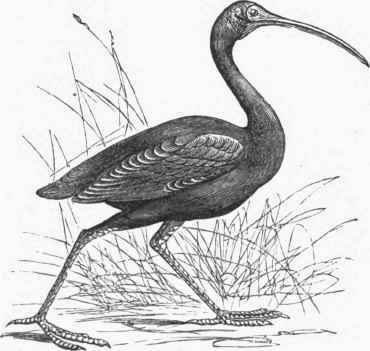
Scarlet Ibis (Ibis rubra).
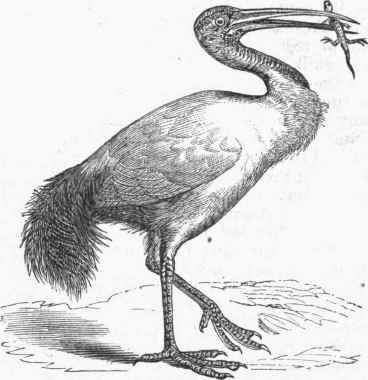
Sacred Ibis (Geronticus AEthiopicus).
Continue to:


My Books

