


Oporto, Or Porto
Description
This section is from "The American Cyclopaedia", by George Ripley And Charles A. Dana. Also available from Amazon: The New American Cyclopædia. 16 volumes complete..
Oporto, Or Porto
Oporto, Or Porto (Port. 0 Porto, the port), a city of Portugal, in the province of Minho, on the right bank of the Douro, about 3 m. from the sea, and 173 m. N. by E. of Lisbon; lat. 41° 8' N., lon. 8° 37' W.; pop. (including the six suburbs) in 1864, 89,194. It is the most important emporium of Portugal, and is officially styled the "loyal and uncon-quered city of Porto." It is built partly on level ground along the river, and partly on the sides and summits of two hills, and presents a fine appearance from the sea. On the land side it is protected by a small fort and an old wall flanked with towers; and the entrance to the port is commanded by the fort of Sao Joao da Foz. Along the river for about two miles extends a quay. A broad, well paved street extends to two other good streets, which join it obliquely and lead to the upper parts of the town. The other streets on the declivities are crooked and narrow, and a portion of the E. part is accessible only by steps cut into the rock. Among the finest squares is that of Sao Ovidio. The houses are generally well built, and are whitewashed.
There are more than 90 churches and chapels, the most prominent of which are the cathedral and the churches of Sao Francisco dos Congregados, Sao Ildefonso, and Dos Clerigos, the last famous for its tower, 210 ft. high. Other notable edifices are the bishop's palace, 15 convents, now used for secular purposes, the town hall, royal hospital, foundling hospital, exchange, and opera house. Among the principal public institutions are a library of 80,000 volumes, a mint, a museum, a medical college, an academy of navigation and commerce, a seminary, and many schools. The English factory house is a handsome building, with a library and public rooms. The city is lighted with gas, and has many gardens and fountains. A suspension bridge connects it with Villa Nova, on the opposite bank of the Douro, where, along the river, are extensive wine vaults. The summer resort of Sao Joao da Foz adjoins the city, and near it is the bar of the Douro, which prevents the ingress of vessels of more than 500 tons burden, and is noted for maritime disasters. Measures for improving its navigation are in progress. The climate of Oporto is cold and damp in winter, but in summer it is exceedingly warm.
The manufactures, which are of little importance, consist chiefly of iron ware, hats, silks, linens, pottery, casks, and filigree work. Local industry is encouraged, and the consumption of foreign goods is limited by a high protective tariff. The total imports do not exceed $800,-000 annually. The exports consist principally of port wine; this trade is almost exclusively in English hands, and would be more considerable if it were not for the British duty of £14 a pipe of 115 gallons; the exports in 1871 included 31,956 pipes, or nearly 3,700,000 gallons. The total value of the exports, comprising cattle (chiefly oxen), fruit, sumach, and lesser articles, such as oil, lemons, oranges, salt, leather, and cork, amounts annually to $9,000,-000. Nearly 700 vessels enter the port annually, upward of 100 of which are steamers. The city is connected with Lisbon and other places by railway. - The site of Oporto was anciently called Cale, afterward Portus Cale, whence the name of the country, Portugal. It was held alternately by the Moors and Christians from the 8th to the 11th century, and in 1092 the latter subdued it and remained in undisputed possession.
John II. conferred many privileges upon it, but they were withdrawn in 1757 in consequence of the resistance of the inhabitants to a wine monopoly. The French captured it in 1808, but retired in the following year when Wellington crossed the Douro. Oporto was conspicuous during the revolutionary period of 1820. It suffered terribly in 1828-'33, when it was alternately the principal seat of Dom Miguel and Dom Pedro, and again during the revolution of 1847. (See Portugal).
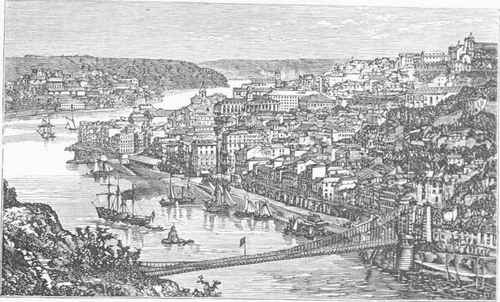
Oporto.
Continue to:


My Books

