


Peat
Description
This section is from "The American Cyclopaedia", by George Ripley And Charles A. Dana. Also available from Amazon: The New American Cyclopædia. 16 volumes complete..
Peat
Peat, the partially decomposed remains of vegetation that accumulate in localities which are at all times wet or damp. The mass consists of matted roots, leaves, and stems of plants, the forms of which are sometimes distinctly preserved, and at others are lost in the mucky substance produced by their decomposition. It forms layers several feet thick, and in some places repetitions of these are found alternating with others of sand. (See Bog.) There are immense bodies of peat in Ireland, and it also abounds in Scotland and on the continent along the coasts of the North sea. Tracts of peat land occur on the N. E. coast of North America in Labrador, Newfoundland, and An-ticosti, where the summers are not excessively warm, and where frequent fogs give the peat mosses the amount of moisture they require. On the S. coast of Anticosti a plain covered with peat extends more than 80 m., with an average breadth of 2 m. and a thickness of from 3 to 10 ft. In the United States peat is little known south of the state of New York; but it is met with in bogs of considerable extent in the N. part of that state, in New Eng-gland, and west and north to Iowa, Minnesota, and Canada. Its range is chiefly limited to the temperate zones, and to localities where the climate is moist and the subsoil is impervious to water.
Darwin says that in the southern hemisphere 45° marks its nearest approach to the equator. Very great differences are observable in peat beds. Some peats are gray, and others red or black; the majority when dry are dark brown-red or snuff color. They also vary remarkably in weight and consistence. Some are compact, destitute of fibres or other traces of vegetation, and on drying shrink greatly and yield tough dense masses, which burn readily and make an excellent fuel; others are light and porous, and remain so on drying, containing much vegetable matter which is but little advanced in the peaty decomposition. Some peats are almost entirely free from mineral matter, and leave when burned but a small percentage of ash; others contain considerable lime or iron in chemical combination, or sand or clay in mechanical admixture. The nature of the vegetation from which peat has been formed has much effect upon its character. Peats chiefly derived from mosses which have grown in the full sunlight have a yellowish red color in their upper layers, which usually becomes darker as we go down, running through brown, until at a considerable depth it is black.
Those produced principally from grasses are grayish at the surface, being full of silvery fibres, the skeletons of the grasses and sedges, while below they are commonly black. Moss peat is oftenest fibrous, and when dried forms elastic masses. Grass peat when taken a little below the surface is commonly destitute of fibres, is earthy in appearance when wet, and dries to dense, hard lumps. In Germany the "ripest," most perfectly formed peat is called pitch peat or fat peat; it is dark brown or black, and comparatively heavy and dense. When moist, it is firm, sticky, and coherent, resembling clay, and may be cut and moulded to any shape. On drying it becomes hard, and a burnished surface takes a lustre like wax or pitch. In Holland, Friesland, Holstein, and Denmark, a so-called mud peat is " fished up " from the bottoms of ponds, as a black mud or paste, which on drying becomes hard and dense like the pitchy peat. - The process of burning demonstrates that peat consists of two kinds of substances: one, the larger portion, is combustible, and is organic or vegetable matter; the other, remaining indestructible by fire, is mineral matter or ash. The combustible part of peat varies considerably in its proximate composition.
It is an indefinite mixture of perhaps many compound bodies, the precise nature of which is unknown. They have received the collective names of humus and geine, consisting of resinous and bituminous matters, crenic, apocrenic, ulmic, hu-mic, and geic acids, in combination with lime, magnesia, iron, and manganese, and forming ulmates, humates, etc, of these bases. While there is little doubt that other compounds exist in peat, it appears to be certain that these are the chief constituents, to which it owes its peculiar properties. Below are tabulated analyses of some of these substances:
CONSTITUENTS. | |||
Ulmic acid, artificial from sugar. | 67.10 | 4.20 | 28.70 |
Humic acid, from Frisian peat.. | 61.10 | 4.30 | 34.60 |
Crenic acid... | 56.47 | 274 | 40.78 |
Apocrenic acid.......... | 45.70 | 4.80 | 49.50 |
In general we may say that the ripest and heaviest peat contains 10 or 12 per cent more carbon and 10 or 12 per cent, less oxygen than the vegetable matter from which it is produced; while between the unaltered vegetation and the last stages of humification, the peat runs through an indefinite number of stages. The mineral part of peat, which remains as ashes, is variable in quantity and composition. Usually a portion of sand, which is sometimes the larger portion, is found in it. Some peats leave when burned much carbonate of lime; others chiefly sulphate of lime; others principally oxide of iron; silicic and phosphoric acids, magnesia, potash, soda, alumina, and chlorine also occur in small quanti-, ties in the ash of all peats. With the exception of alumina, all these bodies are important ingredients of agricultural plants. Those bases (lime, oxide of iron, etc.) which are found as carbonates or oxides in the ashes, exist in the peat itself in combination with the humic and other organic acids. When these compounds are destroyed by burning, the bases remain as carbonate. - Peat is valuable as a fertilizer and as fuel.
Considered as an amendment to the soil, the value of peat (usually called muck by farmers) depends upon its remarkable power of absorbing and retaining water, both as a liquid and as a vapor; its power of absorbing ammonia; its effect in promoting the disintegration and solution of the mineral ingredients of the soil; and its influence on the temperature of the soil. As a direct fertilizer its value depends upon the organic matters, the inorganic or mineral ingredients, and the peculiarities attending its decay. Peat is directly applied to soils, is placed in stables as an absorbent, or is composted with manures. For either of these purposes it is essential that it be exposed to the weather for six months or a . year previous to being used. This " weathering," as it is called, by alternate freezing and thawing completely disintegrates the mass of the peat, and at the same time facilitates certain chemical changes due to the action of the atmosphere, which remove the excess of organic acids and otherwise render it better fitted for incorporation into the soil, and as food for plants. - In Ireland and north European countries peat has long been extensively used as fuel.
It is only within a comparatively few years that the increased cost of wood and coal in the older of the United States has directed attention to this abundant source of combustible material. The best peat for fuel is that which is most free from undecomposed vegetable matters, which has therefore a homogeneous brown or black aspect, and is likewise free from admixture of earthy substances. Such peat is usually found at a considerable depth, is unctuous when moist, shrinks greatly in drying, and forms hard and heavy masses when dry. These are the oldest and ripest peats, contain most carbon, and are the most compact. The difference in weight between fresh and dry peat of any quality is very great. Fibrous peat fresh from the bog may contain 90 per cent, of water, of which 70 per cent, must evaporate before it can be called dry. The proportion of water in earthy or pitchy peat is less, but it is always large, so that from 500 to 900 lbs. of fresh peat must be lifted in order to make 100 lbs. of dry fuel. The quantity of water retained by air-dried peat and wood is about the same, 20 per cent., but in thoroughly seasoned wood or peat it may be only 15 per cent. When hot-dried the proportion may be 10 per cent, or less.
While peat is still moist it gathers moisture from the air, and in this condition it has been known to burst the sheds in which it was stored, or even to set them on fire; but after becoming dry to the eye and touch, it is no more affected by dampness than seasoned wood. - Peat is prepared for use by hand and by machinery, and is also burned into charcoal and distilled for illuminating gas. It is prepared by hand as follows: The surface material, which from the action of the elements has been pulverized to muck and is full of roots and undecomposed matter, must be removed usually to the depth of a foot or more; a deep ditch is then run from an outlet a short distance into the peat bed, and the working goes on from its banks. It is important that system be followed in raising the peat, or there will be great waste of fuel and of labor. A "field" is next laid off about 20 ft. square, by making vertical thrusts with a sharp spade in parallel lines, as far apart as the breadth' of the sods, 4 or 5 in. It is then cut at right angles the length of the sods, 18 or 20 in. The sods are lifted by horizontal thrusts of the spade at a depth of 3 in., and are placed on a light barrow or board and carried off to the drying ground, where they are laid flatwise to drain and dry.
In Ireland it is the custom, after the peats have lain thus for a fortnight, to place them on end close together, and after further drying the sods are built up into stacks about 12 or 15 ft. long, and 4 ft. wide at the bottom, narrowing at the top, with a height of 4 to 5 ft. The outer turfs are inclined so as to shed the rain. In these " clamps " on the bog the peat often remains until wanted for use. In Germany it is common to excavate by vertical thrusts of the tool represented in fig. 1. The three sides of this cut as many sides of the block, the bottom being torn out, or a second workman in the ditch cuts out the blocks of a proper thickness by horizontal thrusts of a sharp spade. In Ireland the "slane" is employed, a common form of which is seen in fig. 2, it being a long narrow spade, 20 x 6 in., with a wing at right angles to the blade. In north Prussia the peat-cutting machine of Brosowsky is extensively employed. It consists of a cutter like the four sides of a box, with oblique edges, which by a crank and rack work is forced down into the peat perhaps 20 ft. It can cut only upon the edge of an excavation, and when it has penetrated sufficiently a blade is driven by levers under the cutter. A mass is thus loosened of 24 x 28 in. and perhaps 10 ft. in length.
This is lifted by reversing the crank, and the mass cut with the spade into blocks. With this machine four hands will cut and lay out 3,000 cubic feet of peat daily. When peat exists as a paste or mud, saturated with water, it is dredged from the bottom of the bog by means of an iron scoop, like a pail with sharp upper edges, to which is fastened a long handle. The bottom is made of coarse sacking, so that the water may escape. The fine peat is emptied upon the ground, where more water is absorbed or evaporated, so that the mass is left somewhat plastic. It is then placed upon a drying bed enclosed by boards 14 in. wide set on edges. As the peat cracks on the surface by further drying, it is compressed with a mallet or flail or by being trodden by men who have flat boards attached to their feet. The mass is thus reduced to a continuous sheet of half its former thickness, and becomes too firm to receive the impression of a man's foot. After it is cut into blocks, every alternate block is placed crosswise upon the other, air is admitted to the whole, and the blocks are rapidly dried.
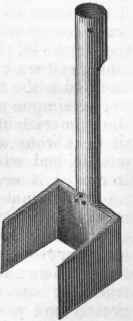
Fig. 1. German Peat Knife.
Peat that cannot be cut, and yet is not so saturated with water as to make mud, is often worked into a paste and moulded into blocks, which when dried become very firm. This is called hand peat or moulded peat. - The mechanical preparation of peat may be effected by pressure, by drying, and by the two combined. Fresh peat has been pressed by direct pressure and between rollers. The latter method is the more effective; but while simple pressure will bring the material into smaller bulk, if it be fibrous and light it is also elastic, and when the pressure is removed it acquires again much of its original volume. At Neustadt, in Hanover, a fibrous peat has been prepared for metallurgical purposes by passing it through iron rollers; it was reduced two thirds in bulk, burned more regularly, gave a coherent coal, and withstood carriage better. On the whole, methods which rely upon pressure alone have not been successful. Other methods reduce the peat to a pulp by grinding it in a sort of pug mill, and then moulding and drying the purified pulp either in sheds, in the open air, or by artificial means.
The inventor of the original process was Weber of Staltach in Bavaria. His machine and process have undergone many modifications both in Europe and America. In this country, Mr. T. H. Leavitt of Boston has patented machinery which operates essentially after the plan of Weber, the hot drying omitted. The apparatus consists principally of a strong box 3 ft. square and 6 ft. high, supported upon a stout framework about 4 ft. above the floor of a suitable building, which should be near the bog, and is best constructed on a side hill, so that easy access can be had to the lower story on one side from the foot of the hill, and to the second story on the other side. The top of the tank should be open, and even with the floor of the second story, so that the raw peat can be dumped directly into it, as represented in tig. 3. Within the tank, and firmly fixed to its sides, are numerous projections of a variety of forms, adapted to the treatment of the material in its several stages as it passes through the mill, which is divided into three apartments; through the centre of the tank revolves an upright, to which are affixed knives and arms varying in form and structure to correspond to the stationary projections in each apartment; below the tank is a receiver or hopper; and under this is a moulding or forming machine, 2 ft. wide and 12 ft. long, of simple construction, which receives the condensed material from the hopper and delivers it in blocks of anv desired form and size.
The whole is adapted to be driven by a small steam engine, and requires about six and ten horse power respectively for the two sizes of machines constructed, of the capacity of 50 and 100 tons each of crude peat per day of ten hours. Mr. James Hodges of Montreal conceived the idea of a manufactory complete, which might be made to float about in the bog, excavating, pulping, manufacturing, and spreading out the pulped peat to dry. There are also the Elsberg, the Ashcroft and Betteley, Aubin's, and Haight's processes, and many others, all of which by different mechanical appliances accomplish the same result, the grinding and moulding of the peat, with subsequent drying, either in the open air or by artificial heat. Among the latest machines devised for this purpose is that of Thomas George Walker, which both grinds and artificially dries the material. The wet peat, after being puddled in a pug-mill vat and heated by waste steam, is forced through the bottom into a box, whence it is blown by a steam jet through 400 ft. of 6-inch cast-iron pipe, coiled up in the furnace under the boiler, by which means it is thoroughly dried. It then passes through a larger pipe into a receiver, at the bottom of which it falls into a mould, where it is pressed into form by a plunger.
The residual steam and gases pass from the top of this receiver into a tank through another pipe, whose end is under water, in which any dust carried off by the steam is deposited; and the waste steam and gases thus purified pass thence back to the pug-mill jacket, where they are used to heat the new material. A second tank, under the pug mill, receives the water from the waste steam condensed in the jacket, and all combustible gases rising to the top are conveyed through a pipe to the furnace and utilized as fuel. The successive heating of the peat in the pug-mill vat, and in the long passage through the 6-inch pipe, so prepares it that it is easily moulded into a compact form as it leaves the receiver. A simple and effectual process for condensing peat has been invented by Mr. Franklin Dodge of Oswego, N. Y., which employs a cylindrical mill with perforated disk triturators, placed in a scow and working in the bed. The peat is ground to a pulp, spread on a platform, and exposed to the air for a few days, when it is cut into blocks, turned, and afterward dried in cribs, which completes the process. - Charcoal made from uncompressed peat excels in antiseptic and deodorizing properties.
In Oarinthia and Hanover the fresh peat is dried in kilns which are heated with the waste heat from certain metallurgical operations. In many European countries peat is also charred in furnaces or kilns, and yields an exceedingly valuable coal, superior to wood charcoal. In S. E. Germany and Austria peat, both air- and kiln-dried, and peat charcoal are extensively used in metallurgical operations, particularly in smelting iron. Peat has also been used to a limited extent in this country for the same purpose. The raw peat can only be used mixed with charcoal, on account of the water it contains.

Fig. 2. Irish Slane.
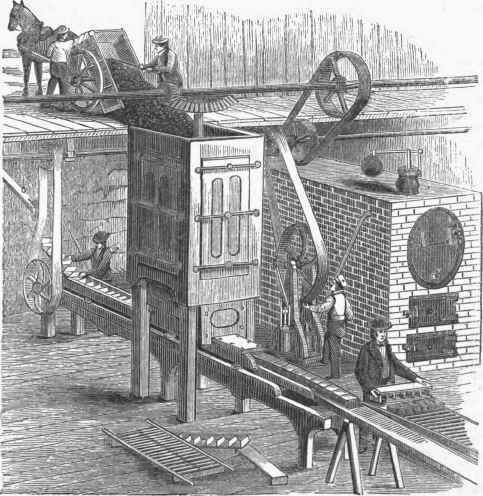
Fig. 3. - Leavittfs Peat Machine.
Distilled in an iron retort, and the volatile products passed through a red-hot iron tube in order to convert the paraffine and ingredients of the tar into gaseous hydrocarbons, 100 parts of peat have yielded, of porous charcoal or peat coke, 36 parts; ammoniacal liquor, 18-88; thick tar containing paraffine, 5.14; and illuminating gas, 40. The illuminating power of the gas was equal only to that of seven candles, but the quantity obtained was at the rate of about 14,000 ft. per ton, which is as much as is afforded by the best boghead cannel coal. When purified by passing through an alkaline mixture, it was found free from sulphur, and in this respect preferable to coal gas. The qualities of the coke are highly extolled; and one of these being its freedom from sulphur, it is well adapted for the reduction of ores, in the treatment of which the presence of this element is highly objectionable. By destructive distillation peat affords a variety of useful products, as pyroligneous acid or crude acetic acid, ammonia, volatile and heavy oils from which paraffine may be obtained, wood naphtha, inflammable gases, charcoal, tar, etc.
Extensive works for this purpose were established about 1850 in Ireland. - The chief value of peat in the United States is likely to be for domestic purposes, although it has been used in some localities on locomotives and under steam boilers. It can be burned in open grates, close stoves, furnaces, ranges, and all the ordinary variety of heating apparatus in use in dwelling houses. Fibrous and easily crumbling, peat is usually burned upon a hearth, without a grate either in stoves or open fireplaces. Dense peat burns best upon a grate; the bars should be thin and near together, so that the air may reach every part of the fuel. (See Coal).
Continue to:


My Books

