


Abyssinian Church
Description
This section is from "The American Cyclopaedia", by George Ripley And Charles A. Dana. Also available from Amazon: The New American Cyclopædia. 16 volumes complete..
Abyssinian Church
According to the Chronicles of Axum, a work probably written by a Christian Abyssinian in the 4th century, the first apostle of Christianity in Abyssinia was the chamberlain of the Queen Candace of Ethiopia whose baptism is recorded in Acts vii. 27. But the actual origin of the Abyssinian church dates from about 316, when there landed on the coast of Abyssinia an exploring expedition sent out by Meropius of Tyre. Its members were all murdered except the two nephews of Meropius, Frumentius and Aedesius, who were presented to the king as slaves. After the death of the king, Frumentius became the instructor of the hereditary prince and actually regent of the country. When the prince became of age, Aedesius returned to Tyre; but Frumentius, who had previously organized the Roman and Greek merchants residing in Abyssinia into a Christian church, went to Alexandria and was consecrated by Athanasius bishop of Abyssinia. As the king himself with a large portion of the people was baptized, Axum soon became the see of a metropolitan (abuna), with seven suffragans.
The emperor Constantine vainly endeavored to prevail upon Frumentius and the Abyssinian prince to adopt Arianism. When in the 5th and 6th centuries the Monophysites obtained control of the patriarchal see of Alexandria, the whole Abyssinian church joined this sect. In the 6th century the Mono-physite priest Julianus spread Christianity in Nubia, which for several centuries was a wholly Christian country, until in the 16th century Mohammedanism became predominant. Others of the sect gradually Christianized large tracts of the country. When the Portuguese in the 16th century opened a passage into the country, an attempt was made to bring about a union of the Abyssinian church with Rome. A Roman Catholic patriarch of Ethiopia was appointed, but his efforts were unsuccessful. The Jesuit missionaries, who first established themselves in the country in 1555, succeeded in 1624 in inducing the heads of the church to submit to the pope; but the union lasted only a few years, and the subsequent labors of the Jesuits and the propaganda in this direction were equally fruitless.
Since 1841 Roman Catholic missionaries of the order of Lazarists have renewed the effort to establish a union between the Abyssinian and the Roman churches, and in 1859 King Uby6 of Tigre sent an embassy to make his submission to the pope; but the hopes raised by this event were disappointed, though several villages have been gained for the Catholic church, and placed under a vicar apostolic. In 1830 the first Protestant missionaries, Gobat (subsequently Anglican bishop of Jerusalem) and Kugler, arrived in Abyssinia; they were soon followed by others, among whom Isenberg and Krapf have become best known. They obtained political influence, and in 1841 a pupil of the English Protestant mission school in Cairo, Andraos, was consecrated, under the name of Abba Salama, abuna of Abyssinia by the Coptic patriarch of Alexandria. Through him they hoped to gain the Abyssinian church for an evangelical reformation, and the hope was strengthened when a prince apparently devoted to them became, under the name of Theodore, ruler over all Abyssinia. But Theodore, when his power was fully established, banished or imprisoned the missionaries; and the abuna, who remained friendly to the Protestants, though he did not like to hear of conversions, died a prisoner in 1867. - Having always been Monophysitic, disputes about the nature of Christ have not torn the Abyssinian church into factions; but it is agitated by discussions on what are termed the several nativities of Christ, of which the leading party at present reckons three.
Recently controversies have arisen as to whether Christ possessed consciousness and a knowledge of good and evil while yet in the womb of the Virgin, and whether Christ is now equal or inferior to the Father in authority and power. But the most virulent dispute is whether the Virgin Mary is the mother of God, or only the mother of Jesus, and therefore whether she is entitled to equal honors with her Son. Circumcision is used in the Abyssinian church for both sexes, and precedes baptism. The Jewish sabbath is still observed as well as the Christian Sunday, and dancing still forms part of the ritual, as it did in the Jewish temple. Children are baptized by immersion and adults by copious affusion. The Nicene creed is used, the Apostles' being unknown. Communion is administered daily to the laity in both kinds. Confession is rigidly practised. Candidates for the priesthood must be able to read, to sing, and grow a beard, and they pay two pieces of rock salt as the price of being breathed upon by the abuna, and having the ! sign of the cross made over them. The orders in church government are abuna, bishops (ko-mur), alaka, who has charge of the revenues, and priests and deacons, who prepare the communion bread.
The bishops now have only the duty of keeping the churches and church utensils sacred; the seven dioceses into which the church was formerly divided have become extinct. Priests and monks are very abundant. It requires 20 priests and deacons to do the full duties of one church. The numerous monks are all placed under the jurisdiction of the etshege, the superior of the convent Debra Libanos in Shoa. He ranks next to the abuna, and his authority is greatly respected in all matters of faith. He governs not only the numerous convents of his own order, but also those of the second order of the country, that of St. Eustathius. The most celebrated convents are Debra Libanos in Shoa, St. Stephen on Lake Haik in the Yesbu country, Debra Damo and Axuin Thion in Tigre, and Lalibela in Lasta. The secular priests are, as in the other oriental churches, allowed to be once married, but the monks, take the vow of celibacy. The churches are small, and their walls are covered with hideous pictures of the Virgin Mary, the saints, the angels, and the devil.
Each church has a tabot or ark of the covenant, on which its sanctity wholly depends; it contains a parchment bearing the name of the patron saint, and stands behind a curtain in the holy of holies, which only the alaka and the priest who consecrates the elements are allowed to enter. If a man has had four wives and outlives them all, he must go into a monastery or be excommunicated. The husband can break the marriage tie at any time by becoming a monk, and leave his wife to take care of the children. The priests have the power of granting divorces. - There is a version of the Bible in the ancient language of the empire of Axum, usually called the Ethiopian, but by the natives the Geez language. It was probably made from the Greek in the 4th or 5th century, and is still the only one used in the church services, though the ancient Ethiopian language is no longer spoken. The Ethiopian Bible contains all the books of the Roman Catholic canon, with several others, the best known of which is the book of Enoch. The total number of books is 81. A translation of the Old and New Testaments in the living Amharic language was made by Meeka, an Abyssinian, the companion of Bruce. - See Gobat, " Three Years' Residence in Abyssinia "; Isenberg's and Krapf's missionary journals in Abyssinia; Volz, Die Christ-liche Kirche Aethiopiens (in Studien und Kritiken, 1809, giving a review of all the information to be obtained from the recent literature on Abyssinia); Stanley, "The Eastern Church," pp. 96-99.
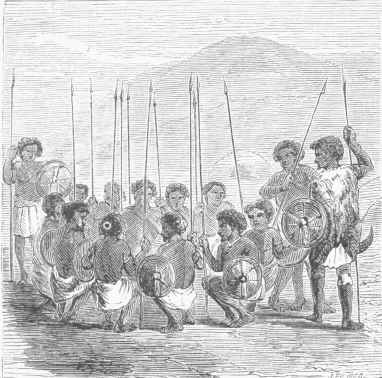
Abyssinian Warriors.
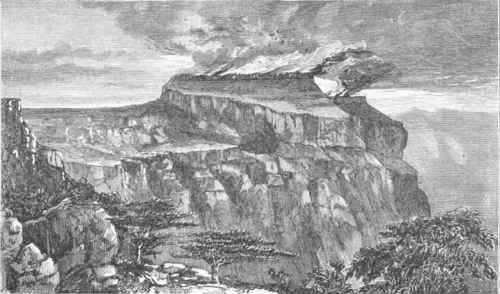
The Burning of Magdala during the Attack by the British.
Continue to:


My Books

