


Actinism
Description
This section is from "The American Cyclopaedia", by George Ripley And Charles A. Dana. Also available from Amazon: The New American Cyclopædia. 16 volumes complete..
Actinism
Actinism (Gr. a ray of light), the peculiar property or force of that portion of the sun's rays which produces the chemical effects shown in photography. That the actinic rays are different from those which produce heat and light was shown as far back as 1842 by Prof. J. W. Draper of New York, who recognized in them a new principle or force, for which he proposed the name of tithonicity, and for the rays that of tithonic. The name now adopted was given by Mr. R. Hunt of England. It is found that actinism does not exist in the most luminous rays of light, and that these rays ac-tually tend to prevent the peculiar effects of this force upon inorganic matter. The quantity of actinism in the sun's rays varies with the time of day and with the seasons. It is intercepted by red, orange, and yellow glass; hence photographers now use glass of these colors to admit light to their so-called dark rooms. Such glass transmits the solar heat, while blue and violet glass, which transmit little or nothing of this heat, transmit the actinic rays.
The reason of this has been explained by experiments in taking photographs of the solar spectrum; they proved that no actinism exists in the red, orange, and yellow rays, that it commences feebly in the green, becomes stronger in the blue, and is strongest in the violet; but what is remarkable, it is also found to extend far beyond the latter color, in the dark space entirely outside the visible spectrum. In photographing the spectroscopic lines, it is found that this dark space contains scores of them as well as the visible part of the spectrum, and it appears that the only reason that we do not see these ultra-actinic rays is that the liquids in our eyes cannot transmit waves of such great velocity; when this velocity is decreased by throwing the spectrum on some fluorescent substance, as paper, painted with a solution of quinine, or on uranium glass, the lines may be rendered visible. The so-called fluorescent substances reduce the velocity of the luminous waves falling on them; in fact, they emit luminous waves of a less velocity than those by which they arc illuminated. Mr. Rutherfurd of New York has made the most elaborate photographs of all the lines in the actinic portion of the solar spectrum, the invisible as well as the visible, to the number of several thousand.
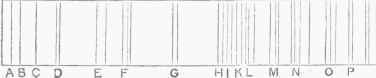
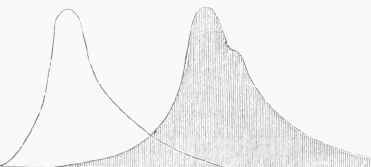
A few of these lines are represented in the spectrum given here, of which only the portion from A to II is visible, while that from II to P is invisible, but may be photographed, even to a further extent than is here represented. The height of the unshaded curve below represents the intensity of the light in the corresponding portion above, while the height of the shaded curve represents the intensity of the actinic action. It is seen that while the strongest light is in the yellow between the lines I) and E, there is a total absence of actinism here; the strongest actinism is foun near the lines II, where there is scarcely any light left, so that the spectrum dwindles down in darkness at that spot, while this actinism extends about twice the length of the visible spectrum. - In regard to the asserted action of the actinic rays on germination and the growth of plants, the most conscientious experiments have proved that only darkness promotes germination, and that plants want for their growth not that light alone from which the heated rays have been eliminated by passing it through blue or violet glass.
Such glass cannot increase the actinic power, but only decrease the light and heat, and experience has shown that most plants suffer decidedly by such treatment; that the green coloring matter of the leaves, of which the chlorophyline is the most important, needs the red rays for its promotion; and that all plants must, in order to prosper, have the benefit of the full unadulterated solar light.
Action.
Visible Lines.
Invtsiblelimes
BED.
GREEN.
VIOLET.
DARK SPACE.
Prismatic Spectrum of Solar Light
Luminous Rays Actinic Rays.
Curves representing the comparative intensity of the luminous and actinic rays in different parts of the solar spectrum.
Continue to:


My Books

